

Publications
Here you will find research papers from our customers and our R&D team that use Fluxim’s R&D tools.
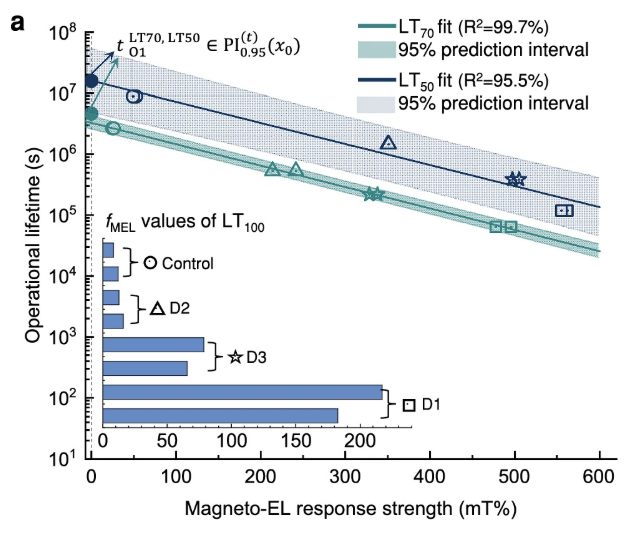
Research Paper — Predicting Blue OLED Lifetime with Magneto-Electroluminescence
Ji, J., Jung, Y. H., Jang, E.-J., Song, B., Oh, J., Lee, J.-H., Kwon, J. H., & Yoo, S. (2026). Magnetic electroluminescent response as a predictive indicator of operational lifetime in phosphorescent blue OLEDs. Nature Communications, 17, Article 10650.

Review Paper — Multiscale Modeling of Colloidal Quantum Dot Optoelectronics
Uyen, P. P., & Kim, B. (2026). From materials to devices: Multiscale modeling of colloidal quantum dot optoelectronics. Nanomaterials, 16, 1338.

Research Paper — Elongated Grain Morphology Enables Efficient NIR-II Sn Perovskite LED
Guan, X., Li, Y., Su, Y., Meng, Y., Tong, H., Luo, Y., Lin, K., Liu, H., Wang, Y., Li, Y., Zhang, Y., Zhang, Q., Hao, S., Chen, X., Zhang, S., Lu, J., Xie, F., & Wei, Z. (2026). Elongated grain morphology for efficient and radiant NIR-II Sn-based perovskite light-emitting diodes. Nature Communications

Research Paper — Host anisotropy controls emitter orientation in OLEDs
Nguyễn, B.-M., Kröber, J., Schütz, P., Ruhland, K., May, F., & Brütting, W. (2026). Effect of host anisotropy on phosphorescent emitter orientation and light outcoupling in OLEDs. Advanced Optical Materials, 14, e00002.

Research paper:Enhancing π-Delocalization and Suppressing Traps via Doping in Electron Transport Materials for Efficient Semitransparent Organic Photovoltaics
Mo, Y., Wang, J., Chen, H. et al. Enhancing π-Delocalization and Suppressing Traps via Doping in Electron Transport Materials for Efficient Semitransparent Organic Photovoltaics. Nano-Micro Lett. 18, 247 (2026).

Research Paper — Amorphous multilayers improve reverse-bias stability in perovskite solar cells
Huang, X., et al. (2026). Amorphous self-assembled multilayers for perovskite solar cells with improved reverse bias stability. Nature Energy.

Research Paper — Machine learning unlocks impedance analysis for perovskite solar cells
Nabil, M., Grau, I., Grau-Crespo, R., Hamad, S., & Anta, J. A. (2026). Inversion of the impedance response towards physical parameter extraction using interpretable machine learning. Advanced Energy Materials.

Research Paper — Fullerene derivatives reduce recombination losses in ternary organic solar cells
Panagiotopoulos, A., et al. (2026). Fullerene derivative integration controls morphological behaviour and recombination losses in non-fullerene acceptor-based organic solar cells. Materials Horizons.

Research Paper — Impact of Luminescent Coupling on Perovskite–Silicon Tandem EQE
Zeder S. J., Krucker T., Moia D., Jenatsch S., Artuk K., Wolff C., Ballif C., Ruhstaller B., Aeberhard U.
Solar RRL (2025).

Research Paper: Tilted-Oriented 2D Perovskites for High-Performance Solar Cells
Kim, C., Lee, D. G., Kim, Y., Park, J., Kim, K., Kim, J., Lee, J., Lee, H., Seo, J., Jeon, N., Jeong, H., Kang, S., Lee, B., & Min, J.* (2025). Tilted-Oriented 2D Perovskites for High-Performance Solar Cells. Advanced Energy Materials.

Research paper: Stabilizing Perovskite Solar Cells at 85 °C via Additive Engineering and MXene Interlayers
Baumann, F., Padilla-Pantoja, J., Caicedo-Roque, J. M., Karimipour, M., Vahedigharehchopogh, N., Santiso, J., Ballesteros, B., Miranda Gamboa, R. A., Tian, Z., Raga, S. R., & Lira-Cantú, M. (2025). Stabilizing perovskite solar cells at 85 °C via additive engineering and MXene interlayers. EES Solar. Royal Society of Chemistry.

Research Paper: Self-assembled hole-selective contact for efficient Sn-Pb perovskite solar cells and all-perovskite tandems
Jingwei Zhu, Xiaozhen Huang, Yi Luo, Wenbo Jiao, Yuliang Xu, Juncheng Wang, Zhiyu Gao, Kun Wei, Tianshu Ma, Jiayu You, Jialun Jin, Shenghan Wu, Zhihao Zhang, Wenqing Liang, Yang Wang, Shengqiang Ren, Changlei Wang, Cong Chen, Jinbao Zhang and Dewei Zhao (2024), Self-assembled hole-selective contact for efficient Sn-Pb perovskite solar cells and all-perovskite tandems. Nature Communications.

Research Paper: Dual Interface Modification for Reduced Nonradiative Recombination in n–i–p Methylammonium-Free Perovskite Solar Cells
Rodriguez-Perez, J.J., Esparza, D., Ans, M., Contreras-Solorio, D.A., Diaz Perez, T., Rodriguez-Pereira, J., Barea, E.M., Zarazua, I., Prochowicz, D., Akin, S., Martinez-Pastor, J.P., Pascual, J., Mora-Seró, I. and Turren-Cruz, S.-H. (2025), Dual Interface Modification for Reduced Nonradiative Recombination in n−i−p Methylammonium-Free Perovskite Solar Cells. ACS Appl. Mater. Interfaces, 17, 8610−8618.

Research Paper: Equivalent-circuit modeling of electron-hole recombination in semiconductors and mixed ionic-electronic conductors
Moia, D. (2025), Equivalent-circuit modeling of electron-hole recombination in semiconductors and mixed ionic-electronic conductors. Physical Review Applied, 23: 014055.

Research Paper: Analytical model for interface recombination limited ideality factors in p-i-n perovskite solar cells
Sandberg, O.J., Kumar, M., Stolterfoht, M., Neher, D. and Armin, A. (2025), Analytical model for interface recombination limited ideality factors in p-i-n perovskite solar cells. APL Energy, 3: 036107.

Research Paper: Drift-diffusion modeling of perovskite solar cells: past and future possibilities
Singh, A. and Gagliardi, A. (2025), Drift-diffusion modeling of perovskite solar cells: past and future possibilities. EES Solar. DOI:

Research Paper: Enlarging moment and regulating orientation of buried interfacial dipole for efficient inverted perovskite solar cells
Peng, Y., Chen, Y., Zhou, J., Luo, C., Tang, W., Duan, Y., Wu, Y. and Peng, Q. (2025), Enlarging moment and regulating orientation of buried interfacial dipole for efficient inverted perovskite solar cells. Nature Communications.

Research Paper: Small Molecular Organic Hole Transport Layer for Efficient Inverted Perovskite Solar Cells
Ahmmed, S., Karim, M. A., He, Y., Cao, S., Kayesh, M. E., Matsuishi, K., & Islam, A. (2025). Small Molecular Organic Hole Transport Layer for Efficient Inverted Perovskite Solar Cells. Solar RRL, 7, e202500017.

Research paper: Bulk Passivation of Lead Halide Perovskites: The Key to High-Performance Indoor Photovoltaics at Very Low-Light Intensities
Karpiola, E., Grandhi, G.K., Doyranli, C., Han, Y., Alexander, A., Jagadamma, L.K., Tewari, A., Manna, D. and Vivo, P. (2025), Bulk Passivation of Lead Halide Perovskites: The Key to High‐Performance Indoor Photovoltaics at Very Low‐Light Intensities. Solar RRL, 11

Research Paper: Dopant-free hydrophobic fluorene-based HTMs with methoxy-triphenylamine and carbazole groups for improved perovskite solar cell performance
Bhat, V.G., Keremane, K.S., Subramanya, K.S., Archana, S., Hegde, A., Asuo, I.M., Poudel, B. and Dalimba, U.K. (2025), Dopant-free hydrophobic fluorene-based hole transport materials: impact of methoxy-substituted triphenylamine and carbazole peripheral groups on the performance of perovskite solar cells. Sustainable Energy Fuels, 9: 2769.