

Litos Lite References

Litos Lite in published research
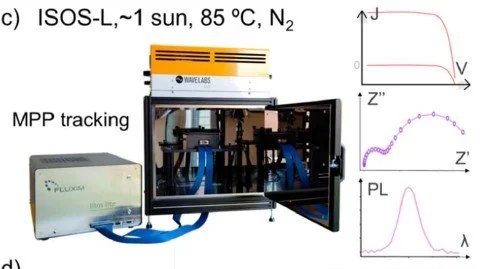
Litos Lite is Fluxim’s ISOS-compliant stability tester with parallel J–V and maximum-power-point tracking for organic, perovskite and perovskite/silicon tandem solar cells and minimodules. Researchers use it to follow how efficiency changes under continuous illumination and to compare the stability of materials, interfaces and processing routes.
Google Scholar lists about 90 documents that mention Litos Lite together with Fluxim (articles, theses and conference papers, excluding patents; search run 15 November 2026). Below we summarise 18 papers across 2 application areas, published between 2022 and 2026, with a link to each original paper.
Last updated 15 November 2026. Summaries are written by Fluxim from the published papers; each links to the original.
Litos Lite research by application
Perovskite Solar Cells 14 papers
Operational stability of perovskite solar cells: maximum-power-point tracking under continuous illumination, J–V scans over time and ISOS-style protocols to compare additives, interface layers and ion migration.
Common topics: , , ,
- Litos Lite and Vitios Support Flexible Perovskite Tandem Modules (2026)
- Stabilizing Perovskite Solar Cells at 85 °C via Additive Engineering and MXene Interlayers (2025)
Organic & Thin-Film PV 4 papers
Organic solar cells: photostability and J–V performance over time, used to compare donor and acceptor materials, processing solvents and interlayers.
Common topics:
- Phenanthrenequinone, a Nonvolatile, Nonhalogenated Solid Additive for Enhancing Thermal Stability in Organic Solar Cells (2025)
- Switching From Acceptor to FRET Donor: How the Organic Solar Cell Architecture Can Change the Role of a Chromophore (2025)
Questions about Litos Lite research
What is Litos Lite used for in research?
Litos Lite is Fluxim’s ISOS-compliant stability tester for solar cells and minimodules. It runs parallel J–V scans and maximum-power-point tracking under illumination, so researchers can follow efficiency over time and compare the stability of different materials, interfaces and processing routes.
How many publications have used Litos Lite?
Google Scholar lists about 90 documents that mention Litos Lite together with Fluxim (articles, theses and conference papers, excluding patents; search run 15 November 2026). This page summarises 18 papers, published between 2022 and 2026. Each summary links to the original paper.
Which solar cells are tested with Litos Lite?
Among the papers on this page: Perovskite Solar Cells (14), Organic & Thin-Film PV (4). 3 of the perovskite papers deal with mobile ions.
What is the difference between Litos Lite and Litos?
Litos Lite is a compact stability tester with parallel J–V and maximum-power-point tracking for solar cells and minimodules. Litos has 16 or 32 channels in four chambers with individual temperature and illumination control, for both OLEDs and solar cells.
How do I get Litos Lite?
You can request a quote or a demo from Fluxim’s Litos Lite demo page.
Litos Lite paper library
Litos Lite and Vitios Support Flexible Perovskite Tandem Modules
Luo, J., Austin, J. S., Romio, A., Cabas Vidani, A., Lai, H., Bühler, C., Saroglia, S., Quintana Ceres, P. O., Dimitrievska, M., Glatzel, T., Shih, C.-J., & Fu, F. (2026). Scalable coating of spatially uniform WBG perovskites via inhibiting SAM aggregation for flexible all-perovskite tandem modules. Small Science, 6, e70379.
This Small Science paper demonstrates scalable doctor-blade coating of spatially uniform wide-bandgap perovskites for flexible all-perovskite tandem modules.
How Litos Lite was used: Used for operational stability testing under MPP tracking at 65 °C, following the ISOS-L-2 protocol.
Original paper: Litos Lite and Vitios Support Flexible Perovskite Tandem Modules (DOI)
Phenanthrenequinone, a Nonvolatile, Nonhalogenated Solid Additive for Enhancing Thermal Stability in Organic Solar Cells
Kim, S. Y.; N’goran, P. E.; Jin, A. L.; Asuo, I. M.; Doumon, N. Y. Phenanthrenequinone, a Nonvolatile, Nonhalogenated Solid Additive, for Enhancing Thermal Stability in Organic Solar Cells. ACS Materials Au 2025, DOI: 10.1021/acsmaterialsau.5c00144.
Organic solar cells (OSCs) often rely on halogenated solvent additives that boost initial power conversion efficiency but undermine long‑term stability.
How Litos Lite was used: Litos‑Lite was used for current–voltage measurements and stability testing under ISOS protocols.
Stabilizing Perovskite Solar Cells at 85 °C via Additive Engineering and MXene Interlayers
Baumann, F., Padilla-Pantoja, J., Caicedo-Roque, J. M., Karimipour, M., Vahedigharehchopogh, N., Santiso, J., Ballesteros, B., Miranda Gamboa, R. A., Tian, Z., Raga, S. R., & Lira-Cantú, M. (2025). Stabilizing perovskite solar cells at 85 °C via additive engineering and MXene interlayers. EES Solar. Royal Society of Chemistry.
This research focuses on stabilizing Perovskite Solar Cells (PSCs) at 85\text{ °C} using additive engineering and 2D Ti3C2 MXene interlayers.
How Litos Lite was used: Litos Lite was the commercial setup employed for MPPT operational stability analysis (ISOS-L2 protocol) of PSCs at 85 °C and ∼100 mW cm−2 illumination over periods exceeding 20 h.
Switching From Acceptor to FRET Donor: How the Organic Solar Cell Architecture Can Change the Role of a Chromophore
Jin, H., Mallo, N., Zhang, G., Lindsay, O., Chu, R., Gao, M., McAnally, S., Etchells, I.M., Burn, P.L., Gentle, I.R. and Shaw, P.E. (2025), Switching From Acceptor to FRET Donor: How the Organic Solar Cell Architecture Can Change the Role of a Chromophore. Adv. Funct. Mater.,
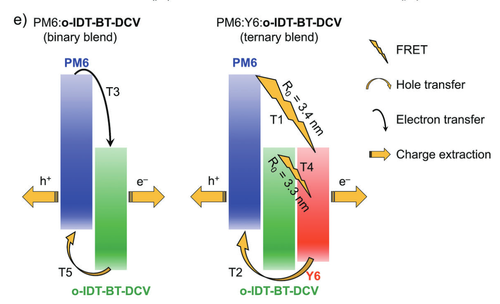
This study investigates the non-fullerene acceptor (NFA) o-IDT-BT-DCV in binary and ternary organic solar cells (OSCs) with a PM6:Y6 host blend. The core goal was to understand its role in enhancing performance and stability.
How Litos Lite was used: Fluxim’s Litos Lite setup was explicitly used for photostability measurements.
Chemical structure and processing solvent of cathode interlayer materials affect organic solar cells performance
Kim, S. Y., Sawangwong, P., Atkinson, C., Welch, G. C., & Doumon, N. Y. (2025). Chemical structure and processing solvent of cathode interlayer materials affect organic solar cells performance. Journal of Materials Chemistry C, 13, 13131–13143
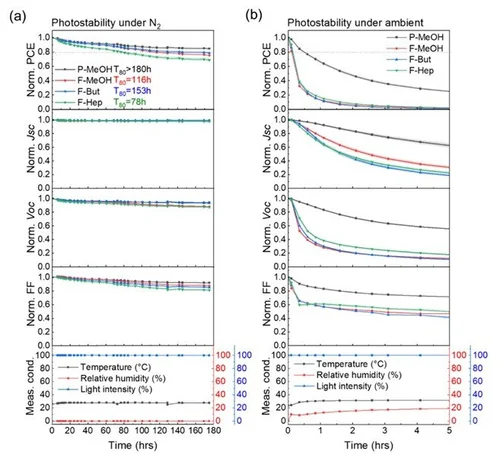
Photostability of PM6:Y6 OSCs with PDINO (MeOH) and F-PDIN-EH (MeOH, 1-butanol, heptane) under N₂ and ambient: PDINO/MeOH shows the longest lifetime; F-PDIN-EH/heptane degrades fastest.
How Litos Lite was used: Dark J–V of electron-only devices; stability and light-intensity Jsc/Voc per ISOS D-1/L-1/T-1 with an AM 1.5 simulator.
The Roles of Ion Migration on Perovskite Solar Cell Operational Stability at Various Illumination Intensities
Tanko, K.T., Raga, S.R., Vahedigharehchopogh, N., Baumann, F., Karimipour, M., Miranda-Gamboa, R.A. and Lira-Cantú, M. (2025), The Roles of Ion Migration on Perovskite Solar Cell Operational Stability at Various Illumination Intensities. Sol. RRL, 9: 2500162.
This academic paper explores the operational stability of perovskite solar cells (PSCs), focusing on how ion migration impacts their degradation.
How Litos Lite was used: The LITOS Lite setup from FLUXiM AG was used for Maximum Power Point (MPP) tracking stability measurements of perovskite solar cells (PSCs).
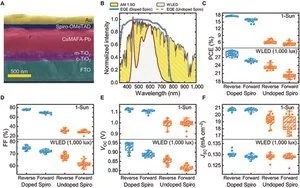
Is Doping of Spiro-OMeTAD a Requirement for Efficient and Stable Perovskite Indoor Photovoltaics?
Morteza Najarian, A., Vafaie, M., Chen, B. et al.Nat Rev Phys6, 219–230 (2024).
The study investigates the necessity of doping Spiro-OMeTAD in lead halide perovskite (LHP) indoor photovoltaics (IPVs).
How Litos Lite was used: Litos Lite was utilized to perform J–V reverse and forward sweeps (scan rate 50 mV s−1), maximum power point (MPP) tracking, and stable power output (SPO) measurements on the prepared photovoltaic cells.
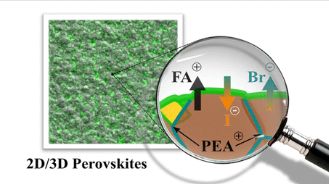
Anion and Cation Migration at 2D/3D Halide Perovskite Interfaces
Raphael F. Moral, Carlo A. R. Perini*, Tim Kodalle, Ahyoung Kim, Finn Babbe, Nao Harada, Javid Hajhemati, Philip Schulz, Naomi S. Ginsberg, Shaul Aloni, Craig P. Schwartz, Juan-Pablo Correa-Baena*, and Carolin M. Sutter-Fella*ACS Energy Lett. 2024, 9, 6, 2703–2716Publication Date: May 14, 2024
This study investigates ionic dynamics at 2D/3D halide perovskite interfaces in solar cells, revealing that light and heat induce ion migration.
How Litos Lite was used: The photovoltaic performance assessment was conducted utilizing a Fluxim Litos Lite arrangement, which featured a Wavelabs Sinus-70 AAA solar simulator that produced an AM1.5 spectrum for excitation purposes.
Original paper: Anion and Cation Migration at 2D/3D Halide Perovskite Interfaces (DOI)
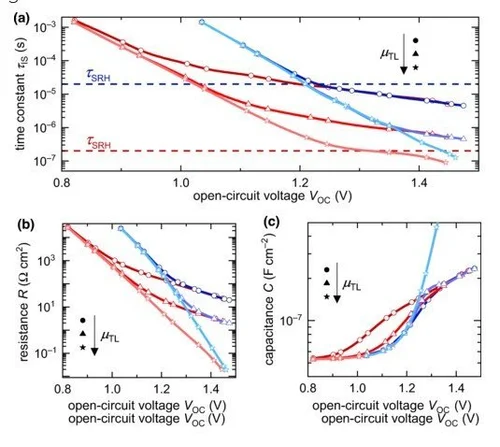
How Charge Carrier Exchange between Absorber and Contact Influences Time Constants in the Frequency Domain Response of Perovskite Solar Cells
Sandheep Ravishankar, Zhifa Liu, Yueming Wang, Thomas Kirchartz, and Uwe RauPRX Energy 2, 033006 – Published 2 August 2023
Researchers present a model for the frequency and time domain optoelectronic response of perovskite solar cells (PSCs). The model emphasizes the role of charge carrier exchange between the perovskite and the transport layer.
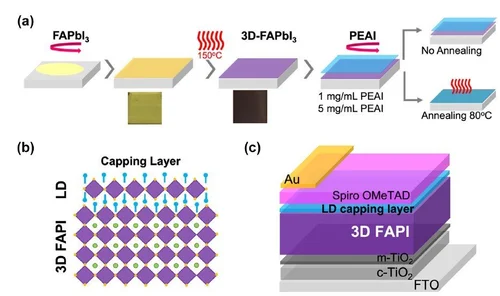
Bulky cation hinders undesired secondary phases in FAPbI3 perovskite solar cells
Juanita Hidalgo, Lahoucine Atourki, Ruipeng Li, Andrés-Felipe Castro-Méndez, Sanggyun Kim, Emmet A. Sherman, Alexander S. Bieber, Meng-ju Sher, Lea Nienhaus, Carlo A.R. Perini, Juan-Pablo Correa-Baena,Materials Today, Volume 68, 2023, Pages 13-21, ISSN 1369-7021
Interfacial treatments using bulky cations on 3D lead halide perovskites (LHPs) have led to over 25% power conversion efficiencies, but the reasons for this boost remain unclear.
How Litos Lite was used: Solar cell performance was evaluated under a solar simulator Litos Lite from Fluxim, with AM1.5 spectrum, same light intensity for the maximum power point tracking for 180 s.
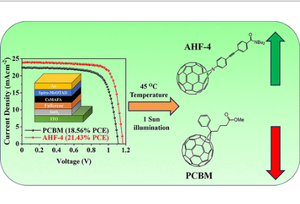
Molecular Engineering of Azahomofullerene-based Electron Transporting Materials for Efficient and Stable Perovskite Solar Cells
Rohit D. Chavan, Bartłomiej Bończak, Joanna Kruszyńska, Apurba Mahapatra, Muhammad Ans, Jan Nawrocki, Kostiantyn Nikiforow, Pankaj Yadav, Jan Paczesny, Faranak Sadegh, Muhittin Unal, Seckin Akin, and Daniel ProchowiczChemistry of Materials 2023 35 (19), 8309-8320
This study introduces a novel azahomofullerene (AHF-4) as an interlayer in perovskite solar cells (PSCs), enhancing charge transfer and film quality while reducing recombination.
How Litos Lite was used: The photovoltaic performance was evaluated using a Fluxim Litos Lite setup, equipped with a Wavelabs Sinus LS2 solar simulator with AM 1.5 spectrum for excitation.
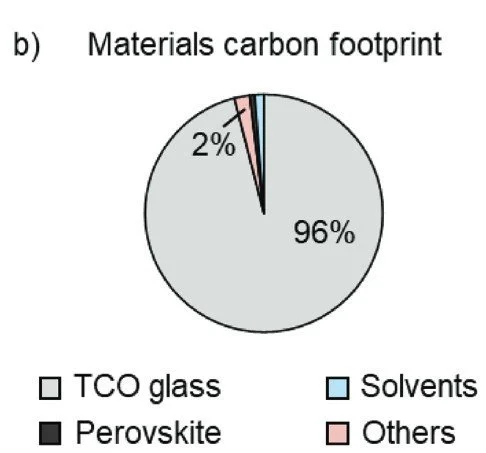
Sustainable and Circular Management of Perovskite SolarCells via Green Recycling of Electron Transport Layer-CoatedTransparent Conductive Oxide
Larini, V., Ding, C., Faini, F., Pica, G., Bruni, G., Pancini, L., Cavalli, S., Manzi, M., Degani, M., Pallotta, R., De Bastiani, M., Ma, C.-Q., Grancini, GAdv. Funct. Mater. 2023, 2306040.
Transparent conductive oxide (TCO)-coated glasses are a costly and environmentally impactful part of perovskite solar cells (PSCs), accounting for 56% of their total cost and 96% of their carbon footprint.
How Litos Lite was used: Stability measurements were conducted by coupling a WavelabsSINUS-70 solar simulator with a Fluxim Litos Lite module and perform-ing maximum power point tracking for 1000 h under an N2atmosphere at1 sun illumination, employing a shadow mask of 1.25 mm2active area.
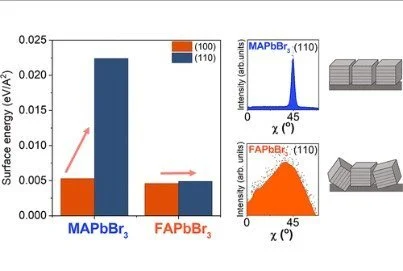
Solvent and A‑Site Cation Control Preferred Crystallographic Orientation in Bromine-Based Perovskite Thin Films
Juanita Hidalgo, Yu An, Dariia Yehorova, Ruipeng Li, Joachim Breternitz, Carlo A.R. Perini, Armin Hoell, Pablo P. Boix, Susan Schorr, Joshua S. Kretchmer, and Juan-Pablo Correa-BaenaChemistry of Materials 2023 35 (11), 4181-4191
This scientific article investigates the factors that determine crystallographic orientation in lead bromide perovskites.
How Litos Lite was used: Litos Lite was used to measure the current density-voltage (J-V) characteristics of the solar cells.
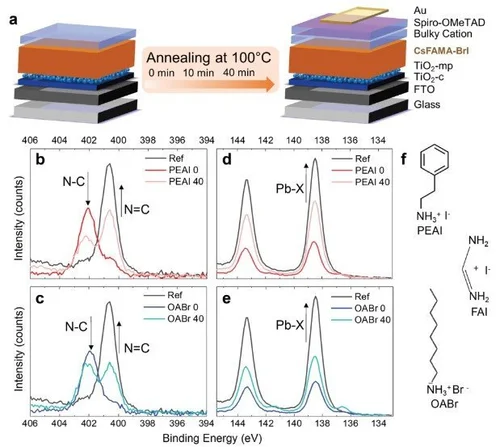
Interface Reconstruction from Ruddlesden–Popper Structures Impacts Stability in Lead Halide Perovskite Solar Cells
Carlo Andrea Riccardo Perini, Esteban Rojas-Gatjens, Magdalena Ravello, Andrés-Felipe Castro-Mendez, Juanita Hidalgo, Yu An, Sanggyun Kim, Barry Lai, Ruipeng Li, Carlos Silva-Acuña, and Juan-Pablo Correa-BaenaAdv. Mater. 2022, 34, 2204726
This study investigates the impact of bulky-cation-modified interfaces on the stability of halide perovskite solar cells, which has not been extensively explored.
How Litos Lite was used: Device Characterization: The photovoltaic performance was evaluated using a Fluxim Litos Lite setup, equipped with a Wavelabs Sinus-70 AAA solar simulator with AM1.5 spectrum for excitation.
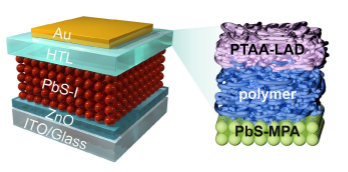
Double-side Interfacial Engineering of Hole Transport Layer Enables Efficient and Operationally Stable Colloidal Quantum Dot Solar Cells
Researchers achieved a record 14.28% efficiency and 520-hour operational stability in PbS CQD solar cells using Fluxim’s Litos Lite. A double-side engineered HTL dramatically improved performance and lifetime in air.
This study presents a breakthrough in improving both the efficiency and operational stability of PbS colloidal quantum dot (CQD) solar cells using organic hole transport layers (HTLs).
How Litos Lite was used: Stability measurements were conducted using Litos Lite, Fluxim’s high-throughput light soaking system.
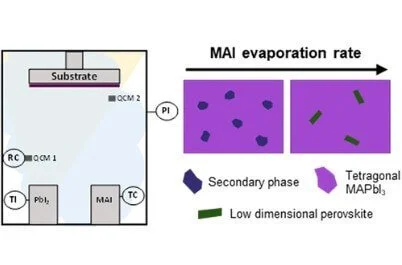
Formation of a Secondary Phase in Thermally Evaporated MAPbI3 and Its Effects on Solar Cell Performance
Andrés-Felipe Castro-Méndez, Carlo A. R. Perini, Juanita Hidalgo, Daniel Ranke, Jacob N. Vagott, Yu An, Barry Lai, Yanqi Luo, Ruipeng Li, and Juan-Pablo Correa-BaenaACS Applied Materials & Interfaces Article ASAP
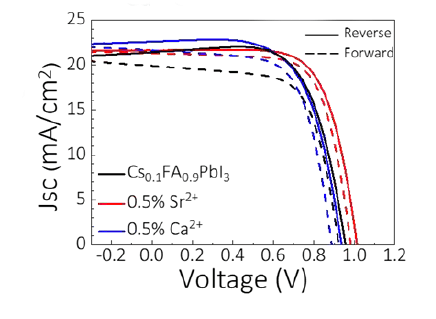
In this paper the researchers investigate the role of Sr and Ca additives to CsFA-PbI solar cells on performance.
How Litos Lite was used: Litos Lite was used to perform JV scan under 1 sun illumination.
Effects of Alkaline Earth Metal Additives on Methylammonium-free Lead Halide Perovskites Thin Films and Solar Cells
Hurriyet Yuce, Diana LaFollette, Mustafa M. Demir, Carlo A.R. Perini, Juan-Pablo Correa- BaenaSol. RRL 2100999.
In the article the researchers investigate the crystal formation of co-evaporated MAI -PbI2 films at different temperature on the Perovskite Solar Cell (PSC) performance and correlate it to the occurrence of different phases.
How Litos Lite was used: The J-V curves of the devices were measured in a forward and reverse bias under the solar simulator (Fluxim, Litos Lite) with AM1.5 spectrum at a scan rate of 15 mV/s.
Bulky cation diffusion in lead halide perovskite solar cells
Perini, Carlo and Rojas-Gatjens, Esteban and Ravello, Magdalena and Castro Mendez, Andres Felipe and Hidalgo, Juanita and An, Yu and Li, Ruipeng and Silva-Acuña, Carlos and Correa-Baena, Juan-Pablo
The impact on device stability of the bulky cation-modified interfaces in halide perovskite solar cells is not well-understood.
How Litos Lite was used: The photovoltaic performance was evaluated using a Fluxim Litos Lite setup, equipped with a Wavelabs Sinus-70 AAA solar simulator with AM1.5 spectrum for excitation.
Original paper: Bulky cation diffusion in lead halide perovskite solar cells (DOI)

No papers match these filters. Try removing one.
Papers using all Fluxim tools: Publications · Product page: Litos Lite · Litos references
What researchers say about Litos Lite
-

Dr. Justin Chen, Reinhold Dauskardt Group, Stanford University
“Recently, we received a Litos Lite with 56 channels. I am so glad that the instrument integrates an LED-based sun simulator. This is far more convenient than replacing Xenon bulbs all the time. The custom-made sample holders work for our 3 different sample layouts, and with the parallel JV characterization and MPPT, we are saving a lot of time. I also appreciate the good support received by the Fluxim team.”
-

Prof. Juan-Pablo Correa-Baena, Leader of the Energy Materials Lab, Materials Science and Engineering at Georgia Tech, USA
“LITOS LITE is highly recommended! We have one in our labs and we are saving hours of work by measuring many samples at one time. No time to build our setup up so this was a great purchase!"
-

Prof. Giulia Grancini Director of ERC HYNANO project and pvsquared2 team and University of Pavia, Italy
“5 star recommendation for LITOS LITE and FLUXIM support. A great choice for my lab, for setting up a nicely working system for monitoring stability under different conditions of our perovskite solar cells! Great communication with FLUXIM for installation, training and support! Highly recommended! “
-

Dr. Sonia R. Raga Senior Researcher CSIC Científico Titular Nanostructured Materials for Photovoltaic Energy
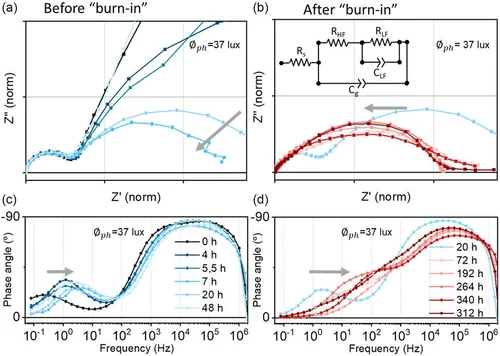
"We have been using Litos lite for several years now, almost continuously, with reliable results. Any issue found has been immediately addressed by the awesome technical support from Fluxim. Recently, we have taken Litos Lite capabilities to new boundaries by combining the MPP tracking with impedance spectroscopy measurements in PAIOS. This involved the manipulation of the stage during MPP experiment. The results were exceptional, it is possible to track not only the device output power but also many other physical properties extracted from EIS along the degradation curve, expanding the understanding on cell stability"
-

Professor Paola Vivo, Material Chemistry, Tampere University, Finland
Litos Lite has been highly valuable for systematic stability testing and parallel JV/MPP tracking under controlled conditions. Its compatibility with standardized ISOS protocols allows for meaningful lifetime analysis across multiple devices, which is critical in our studies on device degradation and operational stability.