Paios Modules
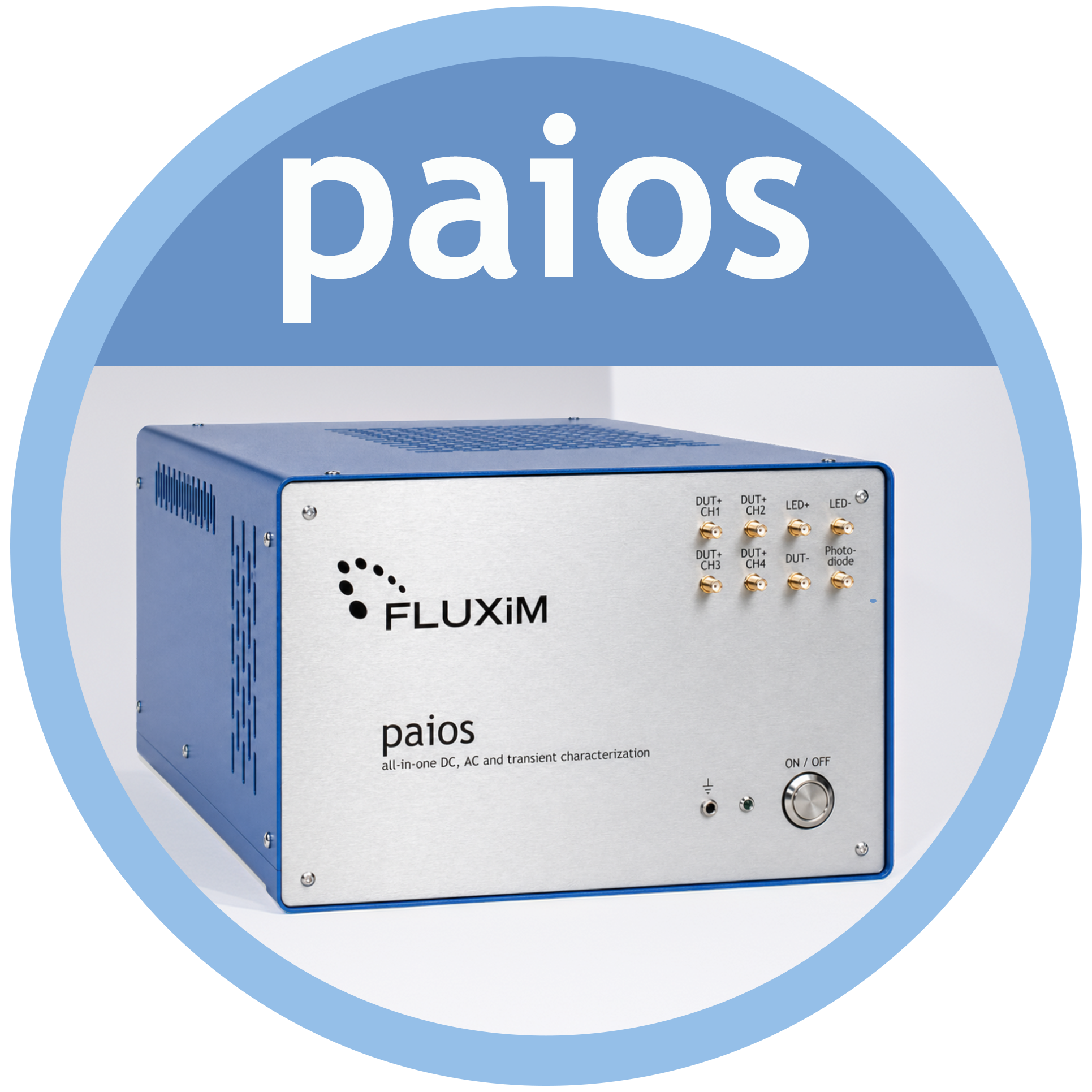
Flexible Probe Station - Basic Measurement Table
Paios is delivered with a probe station to provide a fully calibrated system down to the contacting probes. Our probes are designed to obtain a reproducible contact with low parasitic resistance to your device. The magnetic feet allow flexible positioning and contacting of different sample sizes and layouts. All module functionalities below are operated through the Fluxim Characterization Suite (CS) software—integrating hardware control, data acquisition, and analysis for Paios systems.
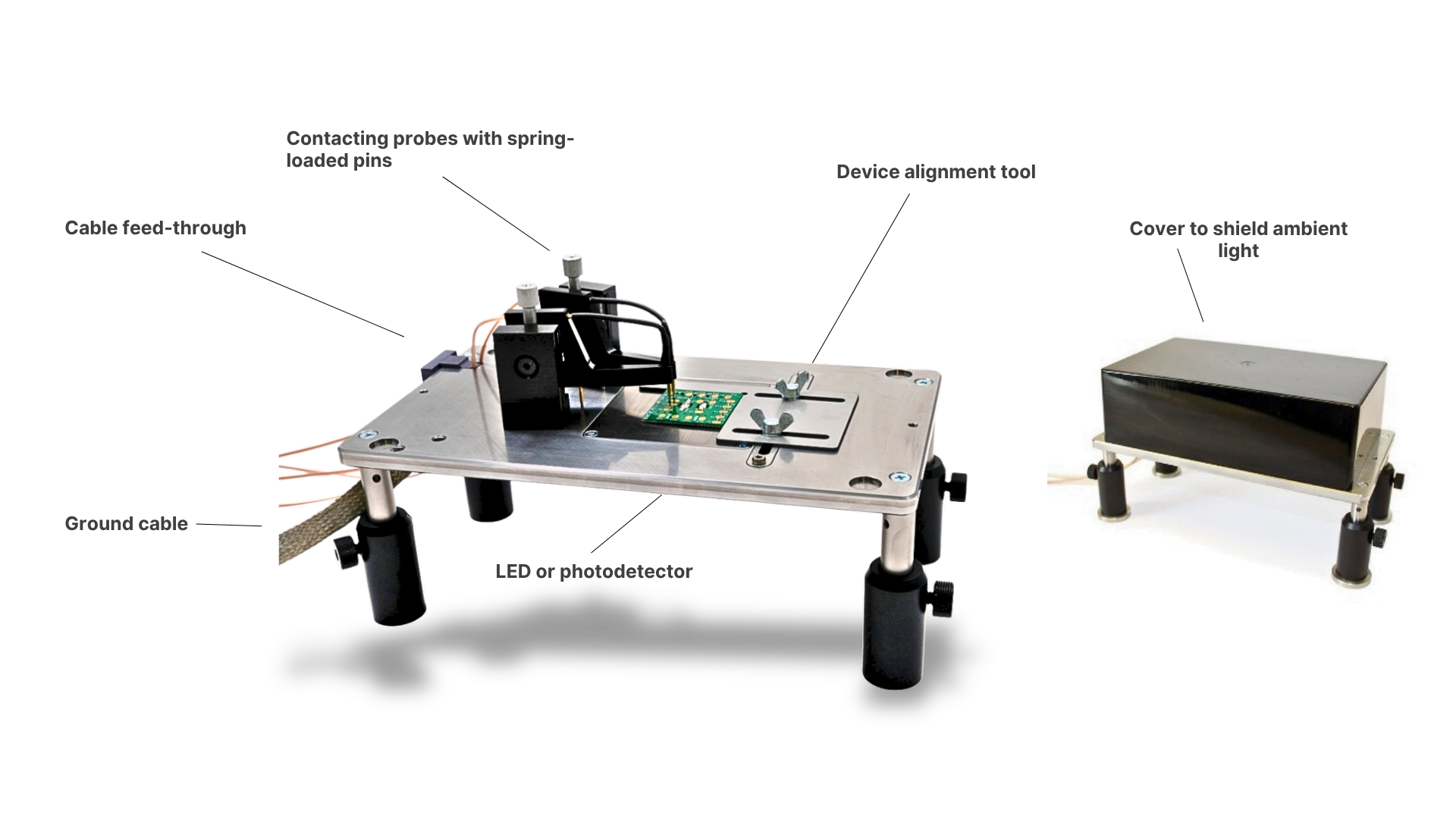
The sample can be easily aligned using our alignment tool.
The measurement table comes with a black lid to ensure the reproducibility of dark measurements.
We also deliver customized sample holders upon request.
Spectrometer
Measure the emission spectrum of your LED or solar cells with a calibrated fiber-coupled spectrometer.
Wavelength range: 360 - 1100 nm.
Integration time: 9 us to 20 s (1 ms to 10 min for older versions).
Automatic dark-spectrum correction.
Measure luminance, radiance, EQE, lm/W, CRI, CIE coordinates.
Liquid Nitrogen Cryostat
Perform all Paios experiments at low and high temperatures with this liquid nitrogen cooling and heating system.
Automatic temperature control and data acquisition.
Temperature range: -120°C to +150°C.
Maximum temperature ramp: 50 K/min.
Samples are stored under an inert atmosphere.
Compatible with basic and automated meaurement table.
Peltier Cryostat
Perform all Paios experiments at low and high temperatures with this Peltier based cryostat.
Automatic temperature control and data acquisition.
Peltier cooling and heating system.
Temperature range: -50°C or -20°C to +80°C.
Customized sample holder included in the standard product.
Multiplexing: Measuring 4 solar cells or LEDs in sequence automatically.
The chamber can be evacuated or flushed with inert gas.
LED, photodiode, or spectrometer, or the automated measurement stage can be mounted.
Automated Measurement Table
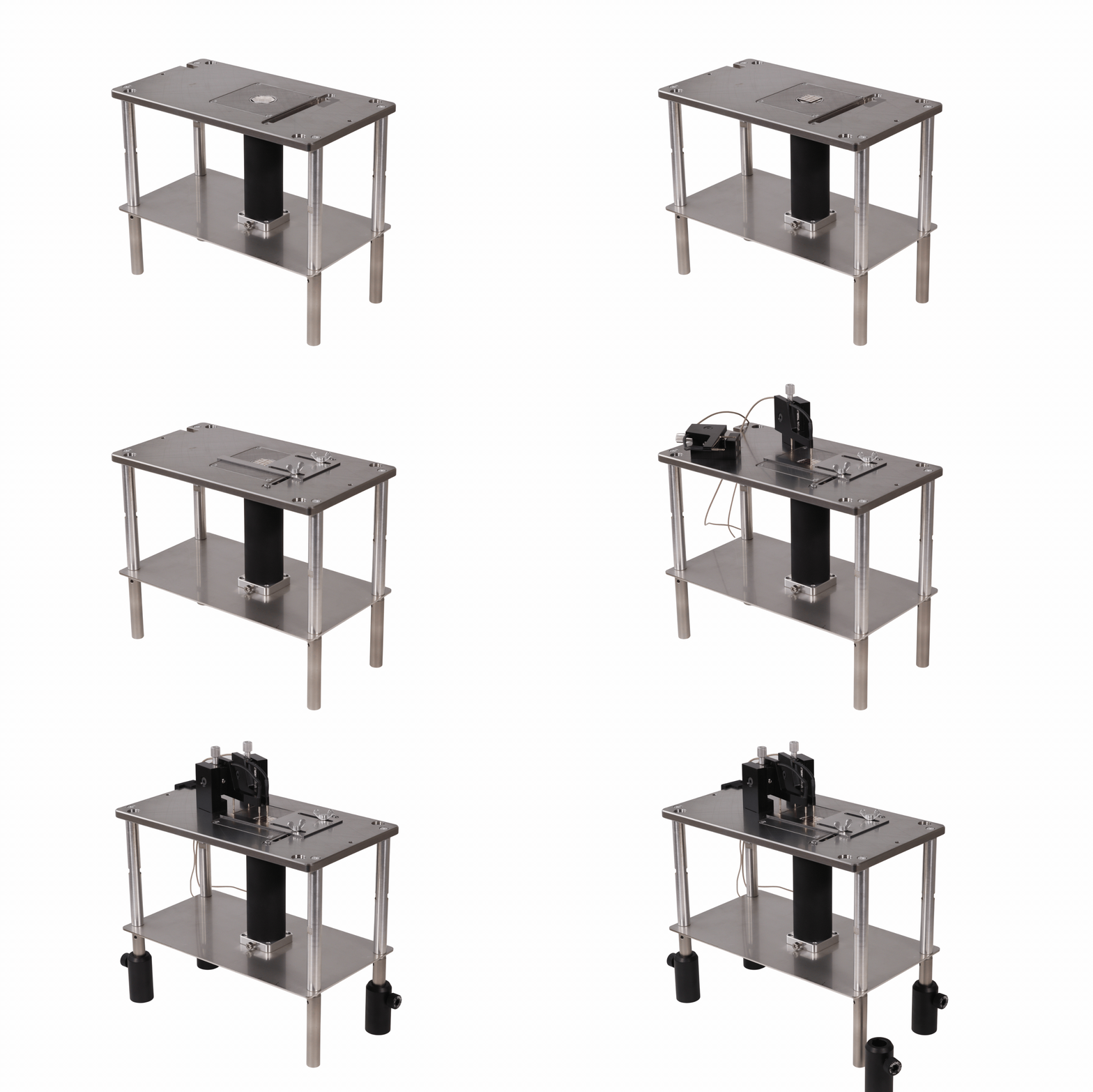
The automated measurement table switches between measurement instruments or light sources, automatically. It can be equipped with:
Photodetector
Spectrometer
White LED
Multi-LED module (additional 15 monochromatic LEDs)
Nanosecond Pulser module
Empty space for existing sun simulator
For Solar Cell Research
The white or monochromatic LED(s) can be used for illuminating solar cells in steady-state IV-curves as well as fast light pulses and light-modulated experiments. By switching to the photodetector or spectrometer you can furthermore analyze the electroluminescence properties of efficient solar cells.
For LED Research
Measure the OLED/PLED spectrum, efficiency roll-off, and transient electroluminescence without moving the sample. By using a blue or UV LED, Paios can also measure the OLED/PeLED photo-response.
Multi-LED Extension Module
15 monochromatic LEDs in the range 350-1100 nm.
Controlled and integrated with the Automated Measurement Table.
Perform all experiments with different LEDs.
Linearity and absolute spectral calibration.
Measure “mini-EQE” of solar cells.
Custom-Made Sample Holders and Multiplexing
Quantitative conclusions from experiments usually require statistics from characterizations on multiple devices. This can be tedious and time-consuming.
With the Paios multiplex module, up to 4 devices can be connected simultaneously. Paios measures the devices automatically after each other. This saves a lot of time for the operator.
Combination with Customized Sample Holder
We also offer customized sample holders. The sample holder is compatible with the basic or automated measurement table. Sample holders are available for substrate sizes up to 2-inch:
top-contact, bottom-emission/bottom-illumination devices
top-contact, top-emission devices
tandem solar cells with 1 top and 1 bottom contact
Glovebox Feedthrough
Paios can also be used in combination with a glovebox. Hereby, Paios is placed outside the glovebox and the measurement table (or the sample holder) can be used inside. We provide customized cable feedthroughs for your glovebox.
Source Measure Unit (SMU)
The standard Paios has a measurement range of +-12 Volt. With the SMU module, the voltage range is extended to +-60 Volt. High voltage also allows the measuring of tandem OLEDs with high turn-on voltages.
Min. measurable current: 1 pA.
You can also perform AC measurements in the frequency range 10 mHz to 10 kHz at bias voltages up to 60 Volt.
Measure transient experiments with sampling frequency 100 kSa/s.
Measure current pulses by employing the current-source mode of the SMU.
Light Mixing Rod (LMR)
The Light Mixing Rod (LMR) is an add-on for Paios LED illumination to increases the illumination uniformity and make the optical coupling more consistent. In our internal measurements, using the LMR increased the measured short-circuit current (Isc) by about 70% compared with direct LED illumination.
The LMR is available as an upgrade for both the Basic and the Automated Measurement Table.
We offer different apertures to reach an optimal intensity and unformity for a given solar cell area.
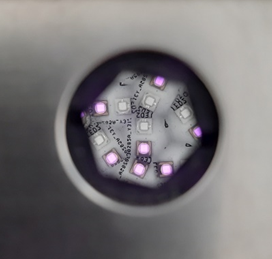
Top view of the Paios 2-LED array as seen through the light mixing rod aperture, showing the typical kaleidoscope effect.

An illuminated sample using the LMR add-on.

The LMR add-on is available in several lengths proportionate to the aperture size to ensure homogeneous light.
LMR impact on average Jsc and nonuniformity
| Pixel size | 2x2 mm | 4x4 mm | 7x7 mm | 10x10 mm |
|---|---|---|---|---|
| Average Jsc (uA) | ||||
| Standard 16 mm aperture, no LMR | 280 | 211 | 160 | 130 |
| LMR 8 mm diameter | 409 | 408 | - | - |
| LMR 10 mm diameter | 310 | 309 | 299 | - |
| LMR 20 mm diameter | 99 | 99 | 99 | 98 |
| Nonuniformity (%) | ||||
| Standard 16 mm aperture, no LMR | 21 | 33 | 54 | 73 |
| LMR 8 mm diameter | 0.8 | 5.1 | - | - |
| LMR 10 mm diameter | 1.5 | 2.0 | 28 | - |
| LMR 20 mm diameter | 0.8 | 1.7 | 2.5 | 3.1 |
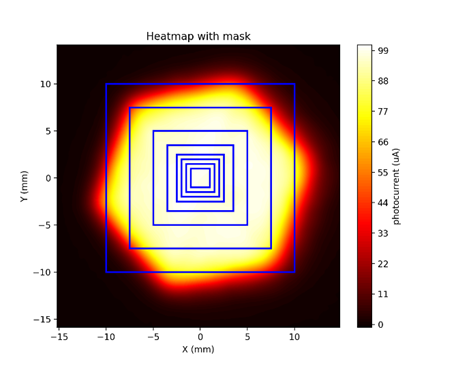
Heatmap of photocurrent distribution measured with Paios using a light mixing rod. Blue square masks indicate different active areas (2x2 mm to 10x10 mm) used to evaluate illumination uniformity across the device surface.

Paios Videos
More About Paios