

Litos References

Litos in published research
Litos is Fluxim’s stress-test platform for degradation analysis of OLEDs and solar cells. It runs 16 or 32 devices in parallel in four chambers, each with its own temperature and illumination, and records their performance over time. Researchers use it to age perovskite solar cells under light and heat, track their maximum power point, and follow OLED lifetime.
Google Scholar lists about 180 documents that mention Litos together with Fluxim (this includes Litos Lite) (articles, theses and conference papers, excluding patents; search run 15 November 2026). Below we summarise 8 papers across 2 application areas, published between 2022 and 2025, with a link to each original paper.
Last updated 15 November 2026. Summaries are written by Fluxim from the published papers; each links to the original.
Litos research by application
Perovskite Solar Cells 5 papers
Operational and thermal stability of perovskite solar cells: aging under 1-sun illumination at controlled temperature, maximum-power-point tracking and repeated J–V scans to compare interface layers, additives and encapsulation.
Common topics:
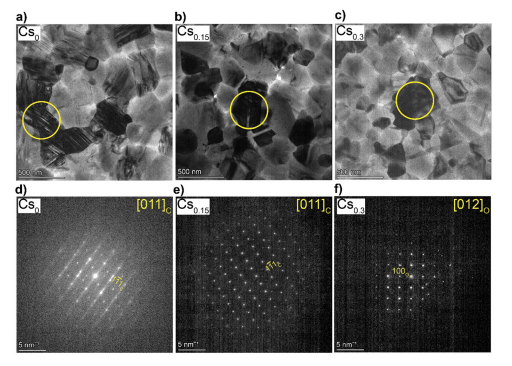
- Alleviating nanostructural phase impurities enhances the optoelectronic properties, device performance and stability of cesium-formamidinium metal–halide perovskites (2024)
- Vapor Phase Infiltration Improves Thermal Stability of Organic Layers in Perovskite Solar Cells (2023)
OLEDs 3 papers
OLED lifetime and degradation: stressing devices in Litos and characterising them between stress periods, for example with Paios, to find where degradation happens.
Common topics:
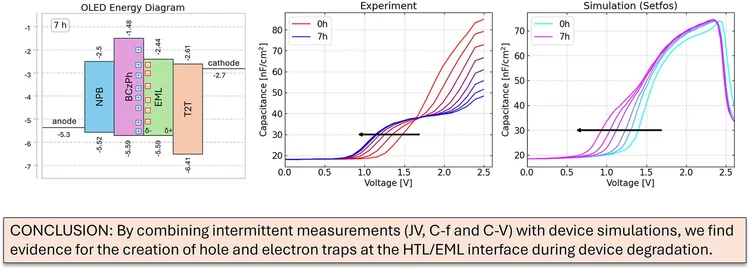
- Evidence for localized trap formation during TADF OLED degradation (2025)
- Ultrapure green organic light-emitting diodes based on highly distorted fused π-conjugated molecular design (2023)
Questions about Litos research
What is Litos used for in research?
Litos is Fluxim’s stress-test platform for OLEDs and solar cells. It ages 16 or 32 devices in parallel under controlled temperature and illumination and records their performance over time, so researchers can compare the stability of different materials, interfaces and encapsulation.
How many publications have used Litos?
Google Scholar lists about 180 documents that mention Litos together with Fluxim (this includes Litos Lite) (articles, theses and conference papers, excluding patents; search run 15 November 2026). This page summarises 8 papers, published between 2022 and 2025. Each summary links to the original paper.
What is the difference between Litos and Litos Lite?
Litos has 16 or 32 channels in four chambers with individual temperature and illumination control, for both OLEDs and solar cells. Litos Lite is a compact ISOS-compliant stability tester with parallel J–V and maximum-power-point tracking for solar cells and minimodules. Some papers on this page used both.
How do I get Litos?
You can request a quote or ask questions about Litos through Fluxim’s contact page.
Litos paper library
Evidence for localized trap formation during TADF OLED degradation
Edoardo Stanzani, Stefano Sem, Simon Züfle, Beat Ruhstaller, Sandra Jenatsch,Organic Electronics, Volume 139, 2025, 107204, ISSN 1566-1199
This research lead by joint first authors Edoardo Stanzani and Dr.
How Litos was used: In summary, Litos stressed the devices, Paios characterized them intermittently, and Setfos simulated the device behavior to help understand the degradation mechanisms.
Original paper: Evidence for localized trap formation during TADF OLED degradation (DOI)
Alleviating nanostructural phase impurities enhances the optoelectronic properties, device performance and stability of cesium-formamidinium metal–halide perovskites
Othman, M., Jeangros, Q., Jacobs, D. A., Futscher, M. H., Zeiske, S., Armin, A., Jaffrès, A., Kuba, A. G., Chernyshov, D., Jenatsch, S., Züfle, S., Ruhstaller, B., Tabean, S., Wirtz, T., Eswara, S., Zhao, J., Savenije, T. J., Ballif, C., Wolff, C. M., & Hessler-Wyser, A. (2024). Energy & Environmental Science. The Royal Society of Chemistry.
This study investigates the effects of cationic alloying in cesium-formamidinium perovskite films on optoelectronic properties and solar cell performance.
How Litos was used: In the study, Fluxim's Paios system was used for conductivity measurements, and Litos for accelerated aging tests under thermal and photonic stress, evaluating the stability of perovskite solar cells.
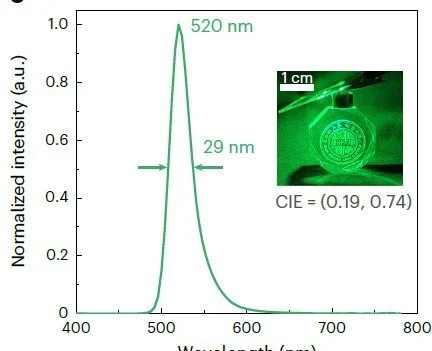
Ultrapure green organic light-emitting diodes based on highly distorted fused π-conjugated molecular design
Fan, XC., Wang, K., Shi, YZ. et al.Nat. Photon. (2023).
Researchers developed a new ultrapure green emitter called DBTN-2 for use in organic light-emitting diode (OLED) displays, which has a highly efficient operation due to the introduction of multiple carbazole moieties resulting in a high density of triplet states and a fast…
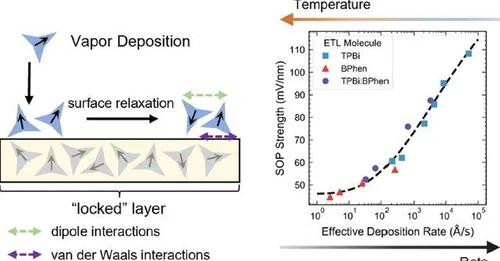
Process Engineered Spontaneous Orientation Polarization in Organic Light-Emitting Devices
Siliang He, Evgeny Pakhomenko, Russell J. HolmesCS Appl. Mater. Interfaces 2023, 15, 1, 1652–1660
This work quantitatively examines SOP formation in the ETL, considering the impact of film processing conditions and treating the vapor-deposited film as a supercooled glass.
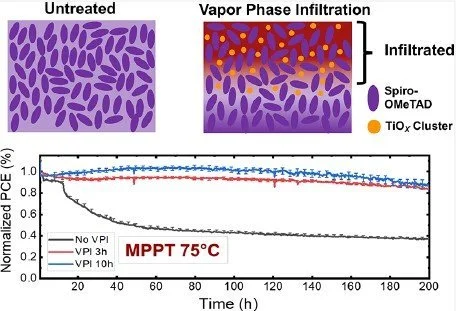
Vapor Phase Infiltration Improves Thermal Stability of Organic Layers in Perovskite Solar Cells
Andrés-Felipe Castro-Méndez, Jamie P. Wooding, Selma Fairach, Carlo A. R. Perini, Emily K. McGuinness, Jacob N. Vagott, Ruipeng Li, Sanggyun Kim, Vivek Brahmatewari, Nicholas Dentice, Mark D. Losego, and Juan-Pablo Correa-BaenaACS Energy Lett. 2023, 8, 1, 844–852Publication Date: January 3, 2023
This study investigates the use of vapor phase infiltration (VPI) to improve the stability of organic charge transport layers, such as hole-selective spiro-OMeTAD in perovskite solar cells (PSCs) and other organic electronic devices.
How Litos was used: Device stability measurements were carried out by tracking the maximum power point (MPP) of the devices while keeping constant the temperature of the films (by Peltier pads) at 75 °C using the stability measurement platform Litos from Fluxim.
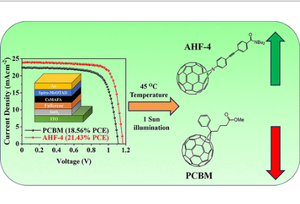
Molecular Engineering of Azahomofullerene-based Electron Transporting Materials for Efficient and Stable Perovskite Solar Cells
Rohit D. Chavan, Bartłomiej Bończak, Joanna Kruszyńska, Apurba Mahapatra, Muhammad Ans, Jan Nawrocki, Kostiantyn Nikiforow, Pankaj Yadav, Jan Paczesny, Faranak Sadegh, Muhittin Unal, Seckin Akin, and Daniel ProchowiczChemistry of Materials 2023 35 (19), 8309-8320
This study introduces a novel azahomofullerene (AHF-4) as an interlayer in perovskite solar cells (PSCs), enhancing charge transfer and film quality while reducing recombination.
How Litos was used: Aging tests were also performed using a Fluxim Litos setup, and 1 Sun equivalent illumination with no UV component, holding the substrates at 45 ± 5 °C in a N2 atmosphere and using an MPP tracking algorithm.
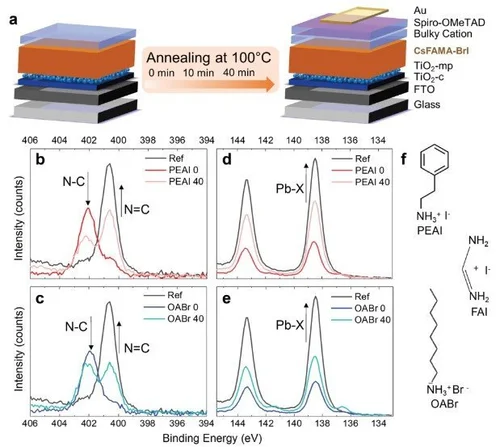
Interface Reconstruction from Ruddlesden–Popper Structures Impacts Stability in Lead Halide Perovskite Solar Cells
Carlo Andrea Riccardo Perini, Esteban Rojas-Gatjens, Magdalena Ravello, Andrés-Felipe Castro-Mendez, Juanita Hidalgo, Yu An, Sanggyun Kim, Barry Lai, Ruipeng Li, Carlos Silva-Acuña, and Juan-Pablo Correa-BaenaAdv. Mater. 2022, 34, 2204726
This study investigates the impact of bulky-cation-modified interfaces on the stability of halide perovskite solar cells, which has not been extensively explored.
How Litos was used: Aging tests were performed using a Fluxim Litos setup, using 1 Sun equivalent illumination with no UV-component, holding the substrates at 55 °C in a N2 atmosphere and using an MPP tracking algorithm.
Bulky cation diffusion in lead halide perovskite solar cells
Perini, Carlo and Rojas-Gatjens, Esteban and Ravello, Magdalena and Castro Mendez, Andres Felipe and Hidalgo, Juanita and An, Yu and Li, Ruipeng and Silva-Acuña, Carlos and Correa-Baena, Juan-Pablo
The impact on device stability of the bulky cation-modified interfaces in halide perovskite solar cells is not well-understood.
How Litos was used: Aging tests were performed using a Fluxim Litos setup, using 1 Sun equivalent illumination with no UV-component, holding the substrates at 55 °C in a N2 atmosphere and using a maximum power point tracking algorithm.
Original paper: Bulky cation diffusion in lead halide perovskite solar cells (DOI)

No papers match these filters. Try removing one.
Papers using all Fluxim tools: Publications · Product page: Litos · Litos Lite references
Learn More

