
Research Paper:Phenanthrenequinone, a Nonvolatile, Nonhalogenated Solid Additive for Enhancing Thermal Stability in Organic Solar Cells
Scientific summary
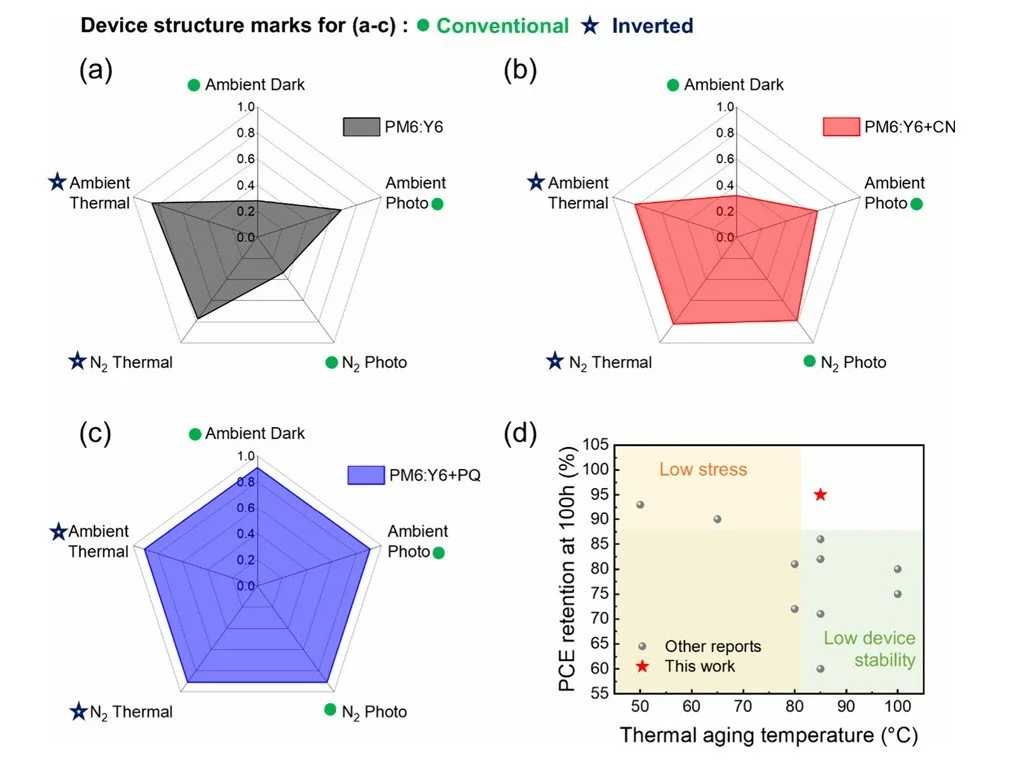
Organic solar cells (OSCs) often rely on halogenated solvent additives that boost initial power conversion efficiency but undermine long‑term stability. This study introduces 9,10‑phenanthrenequinone (PQ), a commercially available, nonvolatile, nonhalogenated solid additive that improves both efficiency and stability when blended with PM6:Y6 active layers. Compared with the commonly used chloronaphthalene additive, PQ raises the glass‑transition temperature of the bulk heterojunction, reduces energy disorder and phase segregation, and suppresses burn‑in degradation. PQ‑based, unencapsulated devices retained over 93 % of their initial power conversion efficiency after 100 h of thermal aging at 85 °C, while also increasing the efficiency from 14.3 % to 15.2 % in conventional device structures.
Publication details
Authors: Souk Y. Kim, Pascale E. N’goran, Arthur L. Jin, Ivy M. Asuo, Nutifafa Y. Doumon
Journal: ACS Materials Au
Year: 2025
DOI: 10.1021/acsmaterialsau.5c00144
PDF: Phenanthrenequinone‐a‐nonvolatile‐nonhalogenated solid additive for enhancing thermal stability in organic solar cells
Fluxim tools used
Litos Lite: Litos‑Lite was used for current–voltage measurements and stability testing under ISOS protocols.
Paios: Paios system equipped with a white‑LED light source provided transient photocurrent (TPC) and transient photovoltage (TPV) measurements to analyse charge‑carrier dynamics.
Why this research matters
Nonvolatile, nonhalogenated PQ offers a safer and more sustainable additive that enhances both efficiency and thermal stability compared with traditional solvent additives.
PQ increases the glass‑transition temperature and suppresses phase segregation, leading to negligible burn‑in degradation and high PCE retention.
The comprehensive stability study across multiple stress conditions provides guidance for the commercialization of durable organic solar cells.
Frequently asked questions
Why choose phenanthrenequinone as an additive? PQ is commercially available, low‑cost, nonvolatile and nonhalogenated, and its rigid conjugated structure with two carbonyl groups promotes π–π stacking. These features help suppress phase segregation and reduce energy disorder in the PM6:Y6 bulk heterojunction.
How does PQ improve device stability compared to chloronaphthalene? Devices with PQ exhibit a higher glass‑transition temperature and reduced phase segregation, leading to negligible burn‑in degradation. Unencapsulated PQ‑based devices retain over 93 % of their initial efficiency after 100 h at 85 °C, whereas conventional additives can accelerate degradation.
Which Fluxim instruments were used? The authors used the Litos‑Lite platform for J‑V measurements and ISOS‑protocol stability testing, while the Paios system enabled transient photocurrent and photovoltage studies to analyse charge‑carrier dynamics.