
Research Paper — Fullerene derivatives reduce recombination losses in ternary organic solar cells
Scientific summary
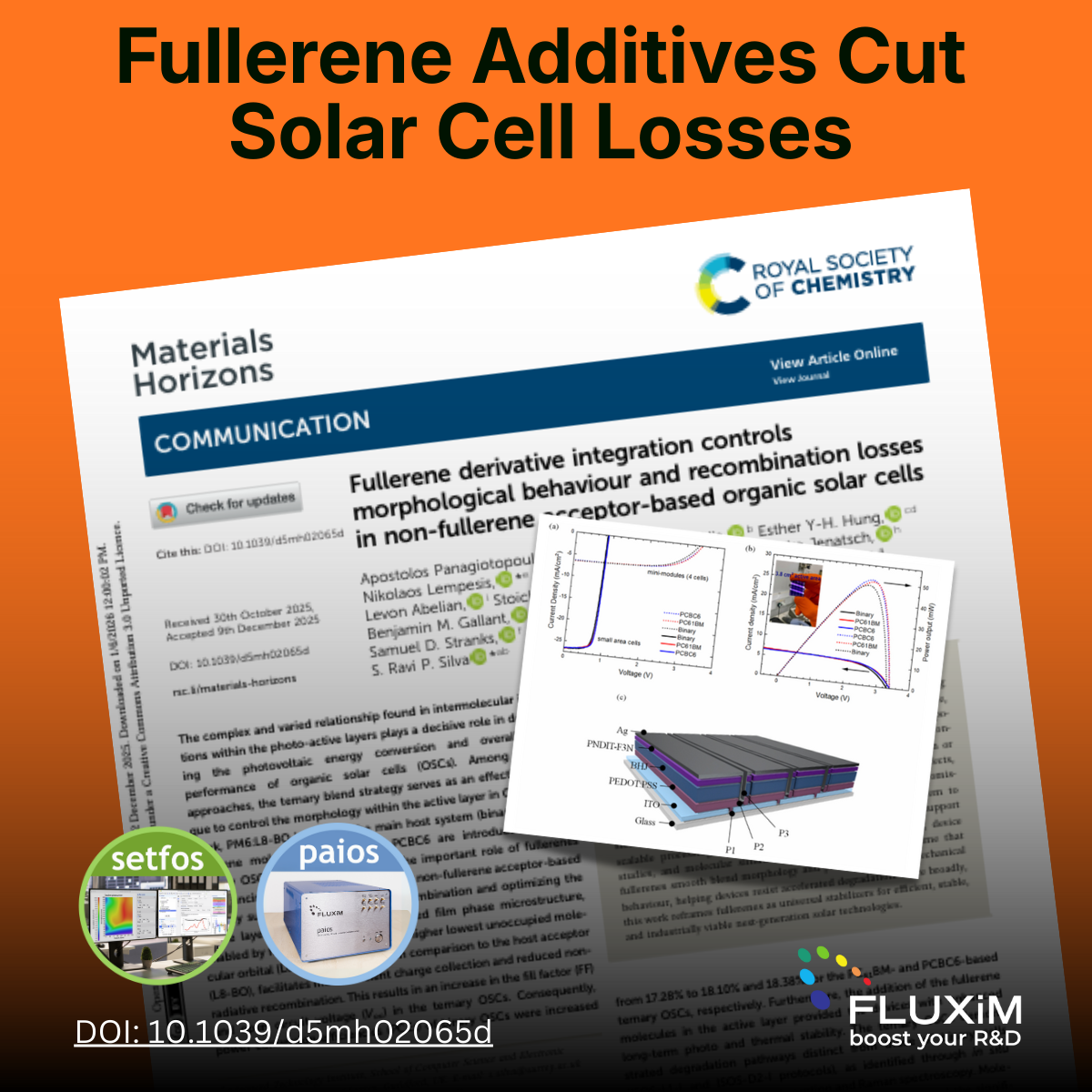
Ternary organic solar cells have demonstrated power conversion efficiencies beyond 20%, but morphology control and its impact on recombination in multi-component systems remain challenging. In this work, fullerene derivatives were added at low concentration to a PM6:L8-BO non-fullerene acceptor system. The addition reduced trap-assisted recombination and increased the power conversion efficiency to 18.38%, with similar improvements observed in mini-modules.
Panagiotopoulos, A., et al. (2026). Fullerene derivative integration controls morphological behaviour and recombination losses in non-fullerene acceptor-based organic solar cells. Materials Horizons. https://doi.org/10.1039/D5MH02065D
Fluxim-specific summary
Photo-CELIV measurements were performed using Paios, revealing differences in charge transport and recombination behaviour between binary and ternary devices. Optoelectronic device simulations carried out with Setfos showed that the experimental JV characteristics and transient responses can only be explained consistently by a reduction in Shockley-Read-Hall recombination when a fullerene derivative is added.
Why it matters
Clarifies the role of fullerene derivatives as ternary additives in non-fullerene OSCs
Links transient electrical measurements with device-level recombination modelling
Demonstrates that efficiency gains persist in mini-module devices
FAQs
What role do the fullerene derivatives play in this study?
They are used as low-concentration additives in a non-fullerene acceptor system.
What experimental method was used to study recombination?
Photo-CELIV measurements.
How was the recombination mechanism identified?
By comparing experimental results with optoelectronic device simulations.