
Scientific summary
Ultra-thin PEDOT:PSS films used in narrow-bandgap perovskite solar cells are shown to form a vertically segregated structure consisting of a PSS-rich surface layer and a PEDOT-rich bulk. This vertical phase segregation induces interfacial electric dipoles that hinder hole extraction and contribute to reduced performance and poor reproducibility. By incorporating the non-ionic surfactant Triton X-100, surface PSS accumulation is reduced, leading to improved interfacial charge extraction and enabling flexible all-perovskite tandem solar cells with efficiencies up to 25.4%, as well as flexible tandem mini-modules reaching 19.7%.
Lai, H., Zhu, J., Kuo, RT. et al. Tailored PEDOT:PSS phase segregation for high-efficiency flexible all-perovskite tandem solar cells and mini-modules. Nat Commun (2025). https://doi.org/10.1038/s41467-025-66479-0
Fluxim-specific summary
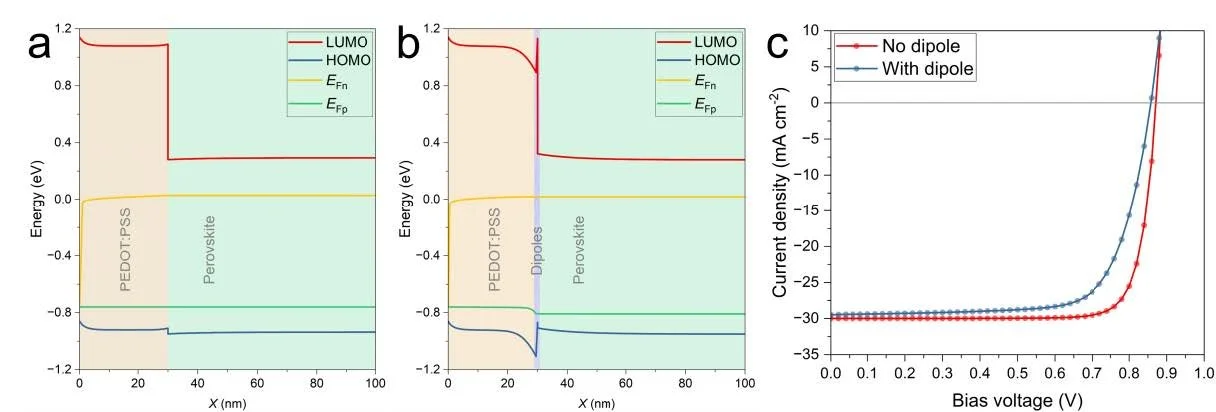
Drift–diffusion simulations performed with Setfos were used to model dipole-induced energy-level shifts at the PEDOT:PSS/perovskite interface and their impact on short-circuit current density and fill factor. Laoss simulations were applied to analyze loss mechanisms in flexible tandem mini-modules, including shunting and dead-area losses, and to project achievable efficiencies for larger-area flexible tandem modules based on optimized laser scribing and layout design
Why it matters
Identifies interfacial dipoles in PEDOT:PSS as a hidden loss mechanism in perovskite tandems
Demonstrates how interface engineering directly improves flexibility, efficiency, and reproducibility
Shows how simulation accelerates module-scale optimization and scaling strategies
FAQs
What problem does PEDOT:PSS cause in perovskite solar cells?
Ultra-thin PEDOT:PSS films form a vertically segregated structure with a PSS-rich surface layer. This structure creates interfacial electric dipoles that hinder hole extraction at the PEDOT:PSS/perovskite interface, reducing current density, fill factor, and device reproducibility.
How does Triton X-100 improve device performance?
Triton X-100 reduces surface accumulation of insulating PSS in PEDOT:PSS films. This weakens dipole formation at the buried interface, improves interfacial charge extraction, and leads to higher efficiency and improved uniformity in narrow-bandgap and tandem perovskite solar cells.
What role do simulations play in this study?
Drift–diffusion simulations using Setfos model the impact of interfacial dipoles on energy-level alignment, current density, and fill factor. Laoss simulations analyze loss mechanisms in flexible tandem mini-modules and project achievable efficiencies for larger-area modules with optimized laser scribing and layout design.
Are the reported efficiencies measured or simulated?
The 25.4% efficiency for flexible tandem solar cells and the 19.7% efficiency for flexible mini-modules are experimentally measured. Module efficiencies exceeding 24% are projected based on optoelectronic simulations for optimized 10 × 10 cm² flexible modules.
Is this approach compatible with scalable manufacturing?
Yes. The study demonstrates simulation-guided laser scribing and layout optimization for flexible tandem mini-modules, indicating that the interface engineering strategy is compatible with scalable module fabrication, provided uniform film deposition and optimized interconnection processes are achieved.