
Research Paper — Effect of microlens arrays on light extraction efficiency in red and green quantum-dot light-emitting diodes
Scientific summary
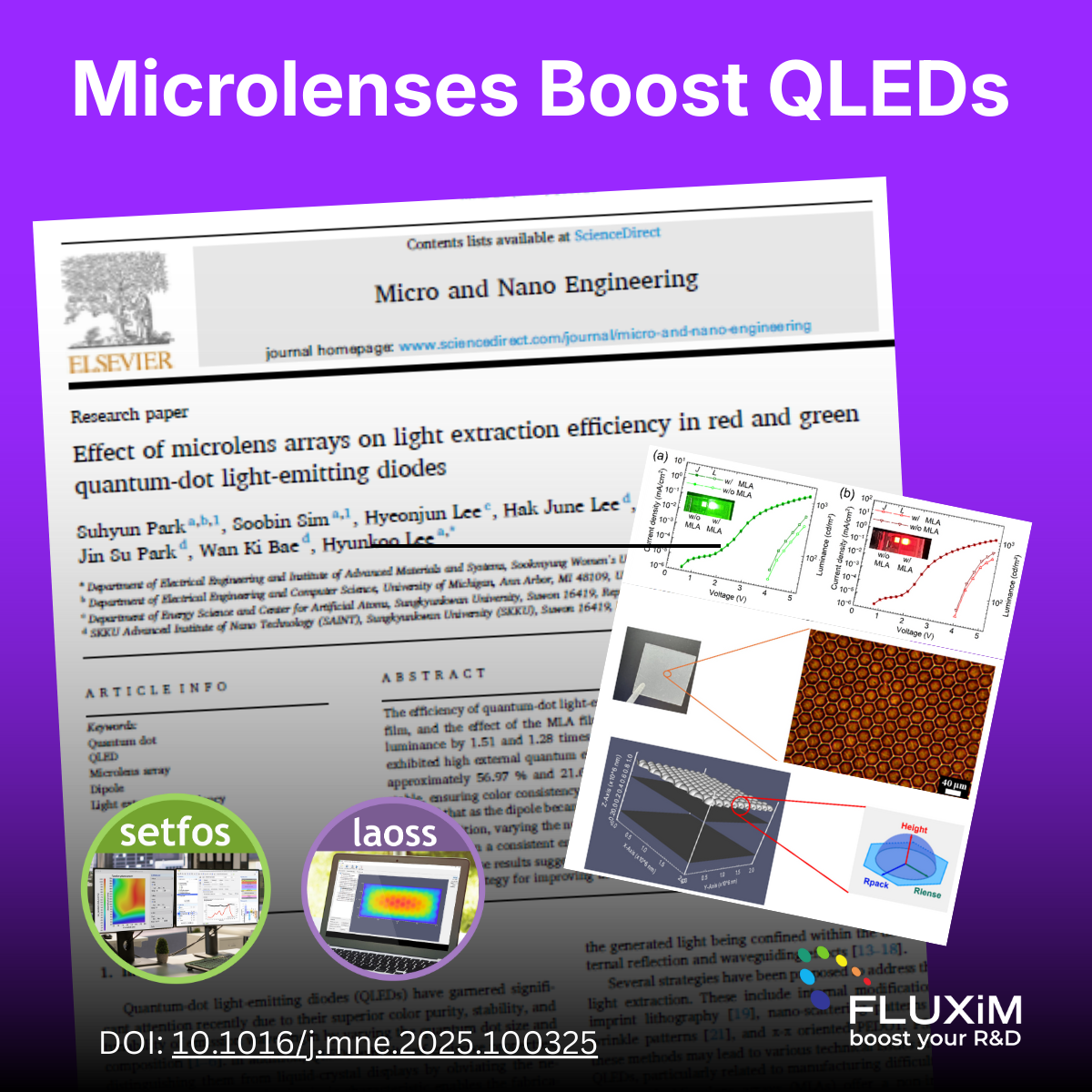
Improving QLED efficiency is not only about better materials or new architectures - a large fraction of emitted light is trapped by internal reflections. This study shows that microlens array (MLA) films attached to the substrate side increase brightness and EQE for green and red QLEDs while keeping spectra stable with viewing angle. Using Setfos and Laoss, the authors reproduce the extraction gains and show that more vertical dipole orientation and higher microlens density can further amplify outcoupling.
Publication details
Authors: Suhyun Park; Soobin Sim; Hyeonjun Lee; Hak June Lee; Jeong Woo Park; Jin Su Park; Wan Ki Bae; Hyunkoo Lee
Journal: Micro and Nano Engineering
Year: 2025
DOI: 10.1016/j.mne.2025.100325
PDF: Open access via the journal page (CC BY-NC-ND).
Fluxim tools used
Used for thin-film optics of the planar QLED stack.
The authors fed in measured n and k (ellipsometry, 380–780 nm) for each layer and had Setfos calculate the spectrally and angularly resolved optical response of the multilayer stack - specifically angular reflectance, angular transmittance, and spectral radiance / emission distribution for the emitter in the stack.
Used for 3D ray tracing including the microlens array (MLA) geometry and the full stack.
Laoss took the Setfos-derived optical quantities for the underlying stack and then traced rays through the MLA + PET film + glass substrate + device stack to compute light extraction efficiency (extracted light / total emitted light) and EL intensity, and to run parameter sweeps (dipole orientation, microlens radius/height, packing radius/density).
Why this research matters
External MLA films boost QLED outcoupling without changing the electrical stack design
Maintains angular color stability while increasing forward emission and EQE
Simulation pinpoints practical levers (dipole orientation, MLA density) for further gains
Frequently asked questions
Q: Does the Microlens array (MLA) change the emission colour or spectra?
A: No - the EL spectra remain essentially unchanged with viewing angle, supporting colour stability.
Q: Why is the Microlens array (MLA) benefit larger for green than red devices?
A: The relative enhancement depends on wavelength-dependent optics and emitter dipole orientation, which affect how effectively the MLA redirects trapped modes.
Q: Which Microlens array (MLA) parameter is most important to optimize?
A: Increasing microlens density (coverage) has a strong impact, while changing microlens size shows a more modest effect