
Research Paper — Litos Lite and Vitios Support Flexible Perovskite Tandem Modules
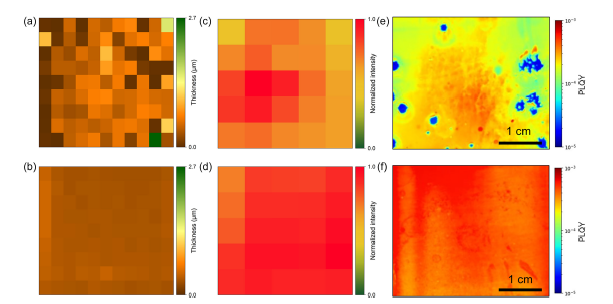
This Small Science paper demonstrates scalable doctor-blade coating of spatially uniform wide-bandgap perovskites for flexible all-perovskite tandem modules. By inserting a NiOx interlayer, the authors suppress Me-4PACz SAM aggregation, improve perovskite ink wettability, and enable uniform WBG perovskite films on 5 × 5 cm² flexible substrates. Vitios was used for PLQY imaging to evaluate spatial optoelectronic uniformity, while Litos Lite was used for ISOS-L-2 MPP stability testing at 65 °C.
Publication details
Authors: Jincheng Luo, Jonathan S. Austin, Alessia Romio, Antonio Cabas Vidani, Huagui Lai, Cédric Bühler, Stefano Saroglia, Pedro Octavio Quintana Ceres, Mirjana Dimitrievska, Thilo Glatzel, Chih-Jen Shih, Fan Fu
Journal: Small Science
Year: 2026
DOI: 10.1002/smsc.70379
PDF link if allowed: https://doi.org/10.1002/smsc.70379
Fluxim tools used
Litos Lite — used for operational stability testing under MPP tracking at 65 °C, following the ISOS-L-2 protocol.
Vitios — used for PLQY imaging of flexible WBG perovskite films to assess spatial optoelectronic uniformity.
Why it matters
Enables scalable coating of uniform WBG perovskites on flexible 5 × 5 cm² substrates.
Shows how SAM aggregation control improves wettability, film coverage, and module reproducibility.
Demonstrates >20% flexible all-perovskite tandem mini-modules over 10.8 cm² aperture area.
FAQs
Q: Which Fluxim tools were used in this paper?
A: Litos Lite was used for operational stability testing, and Vitios was used for PLQY imaging.
Q: What did Vitios help show?
A: Vitios helped visualize spatial PLQY uniformity across flexible WBG perovskite films, supporting the claim that the NiOx/Me-4PACz interface improves optoelectronic homogeneity.
Q: Why is Litos Lite relevant here?
A: Litos Lite was used for MPP tracking at 65 °C under ISOS-L-2 conditions, helping evaluate operational stability of flexible perovskite devices.