
Research Paper — Setfos Guides BT.2020 Red OLED Cavity Design
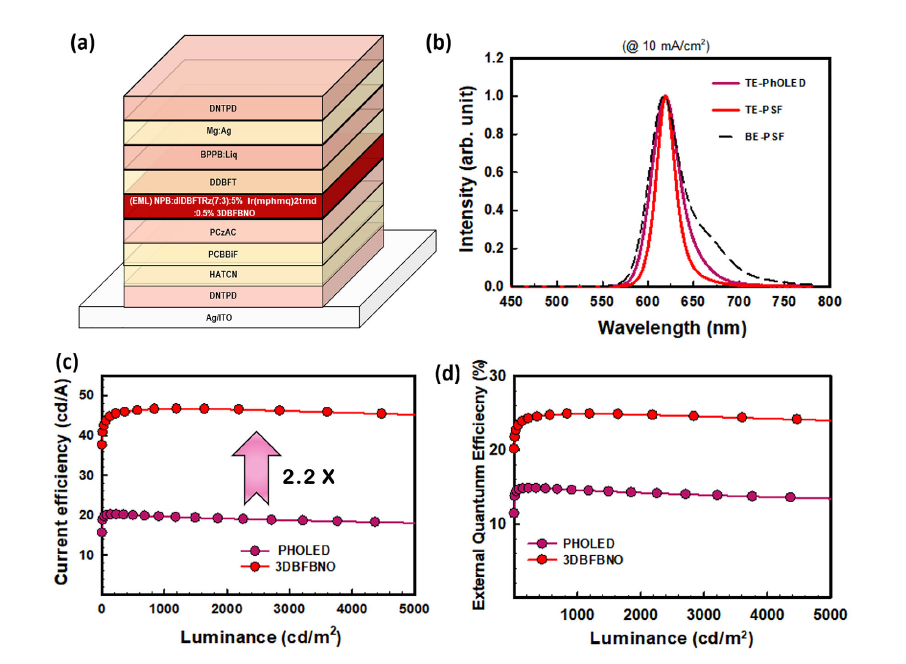
This Small paper presents dibenzofuran-modulated red MR-TADF emitters for efficient, stable OLEDs approaching BT.2020 color requirements. The optimized 3DBFBNO device achieved 31.63% EQE, <1% roll-off at 5000 cd m⁻², and LT90 of 571 h using an exciplex-assisted PSF architecture. Setfos was used to optimize the top-emission OLED microcavity, enabling 619 nm emission with an ultranarrow 23 nm FWHM and CIE coordinates of (0.68, 0.32).
Publication details
Authors: Meghana Tirupati, Nisha Vergineya S, Odugu Pavan Kumar, Aradhya Rajput, Hae Ung Kim, Jun Yun Kim, Subramanian Muruganantham, Jang Hyuk Kwon
Journal: Small
Year: 2026
DOI: 10.1002/smll.74546
PDF link if allowed: https://doi.org/10.1002/smll.74546
Fluxim tools used
Setfos — used for optical microcavity simulation of the top-emission OLED.
Why it matters
Supports OLED design for BT.2020 red color purity.
Combines molecular emitter design, exciplex-assisted PSF architecture, and top-emission cavity engineering.
Shows how Setfos helps optimize OLED cavity design for spectral narrowing and color coordinates.
FAQs
Q: Which Fluxim tool was used in this paper?
A: Setfos was used for optical microcavity simulations of the top-emission OLED.
Q: What did Setfos help optimize?
A: Setfos helped optimize cavity length, electrode reflectivity, and emission-zone position to narrow the OLED emission spectrum.
Q: Why is this important for OLED displays?
A: BT.2020 displays require highly saturated red emission. This work shows how emitter design and cavity engineering can move red OLEDs closer to that target.