
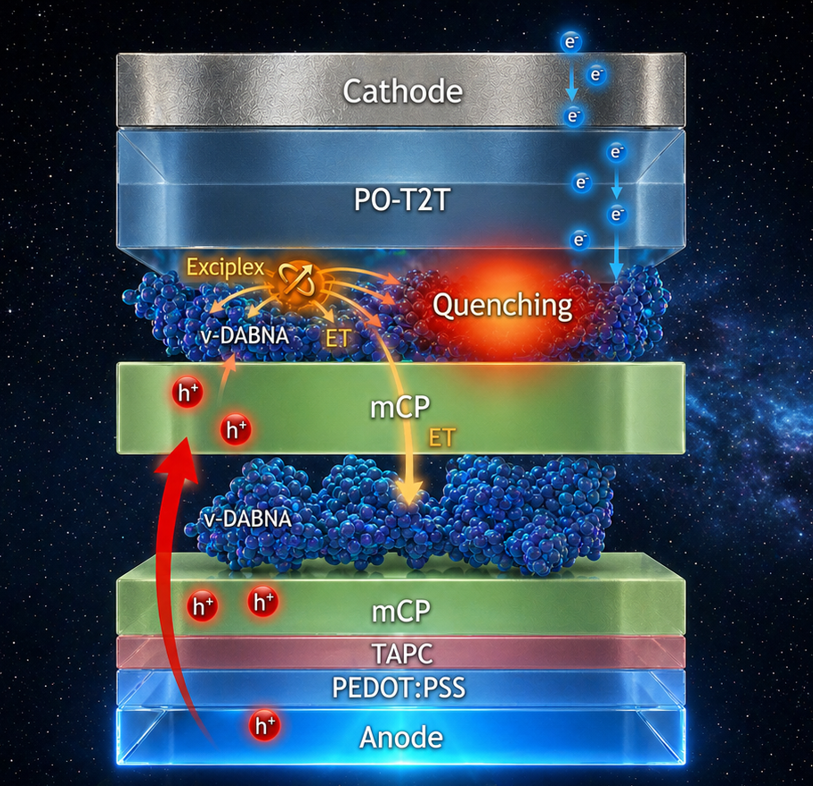
This ACS Applied Electronic Materials paper presents a ν-DABNA double-emitter ultrathin-EML OLED that increases peak EQE from 9.6% to 14.2%. By placing a second ultrathin emitter away from the primary mCP/PO-T2T recombination interface, the device improves exciton harvesting and reduces non-radiative losses. Setfos was used for optical mode analysis and electro-optical OLED simulations, showing that the efficiency gain is mainly driven by FRET-mediated exciton redistribution rather than optical-cavity effects.
Publication details
Authors: Edoardo Stanzani, Michele Forzatti, Sergio M. Saiz, Daniel Tordera, Henk J. Bolink, Simon Zeder, Vasileios Georgakopoulos Paltidis, Balthasar Blülle, Beat Ruhstaller, Sandra Jenatsch
Journal: ACS Applied Electronic Materials
Year: 2026
DOI: 10.1021/acsaelm.6c00271
Fluxim tools used
Setfos — used for Optical Mode Analysis, 1D drift-diffusion, and 3D Master Equation OLED simulations.
Why it matters
Shows how emitter placement can improve EQE in simplified, nondoped OLED stacks.
Demonstrates how Setfos separates optical outcoupling from electronic and excitonic loss mechanisms.
Provides a simulation-supported route for OLED researchers working on exciton management and efficiency roll-off.
FAQs
Q: Which Fluxim tool was used in this paper?
A: Setfos was used for optical and electro-optical OLED simulations.
Q: What did Setfos help show?
A: Setfos helped show that the EQE improvement is not mainly caused by optical-cavity effects, but by exciton redistribution and FRET-mediated harvesting.
Q: Why is this relevant for OLED R&D?
A: It shows how simulation can guide emitter placement, exciton management, and simplified OLED stack design.