
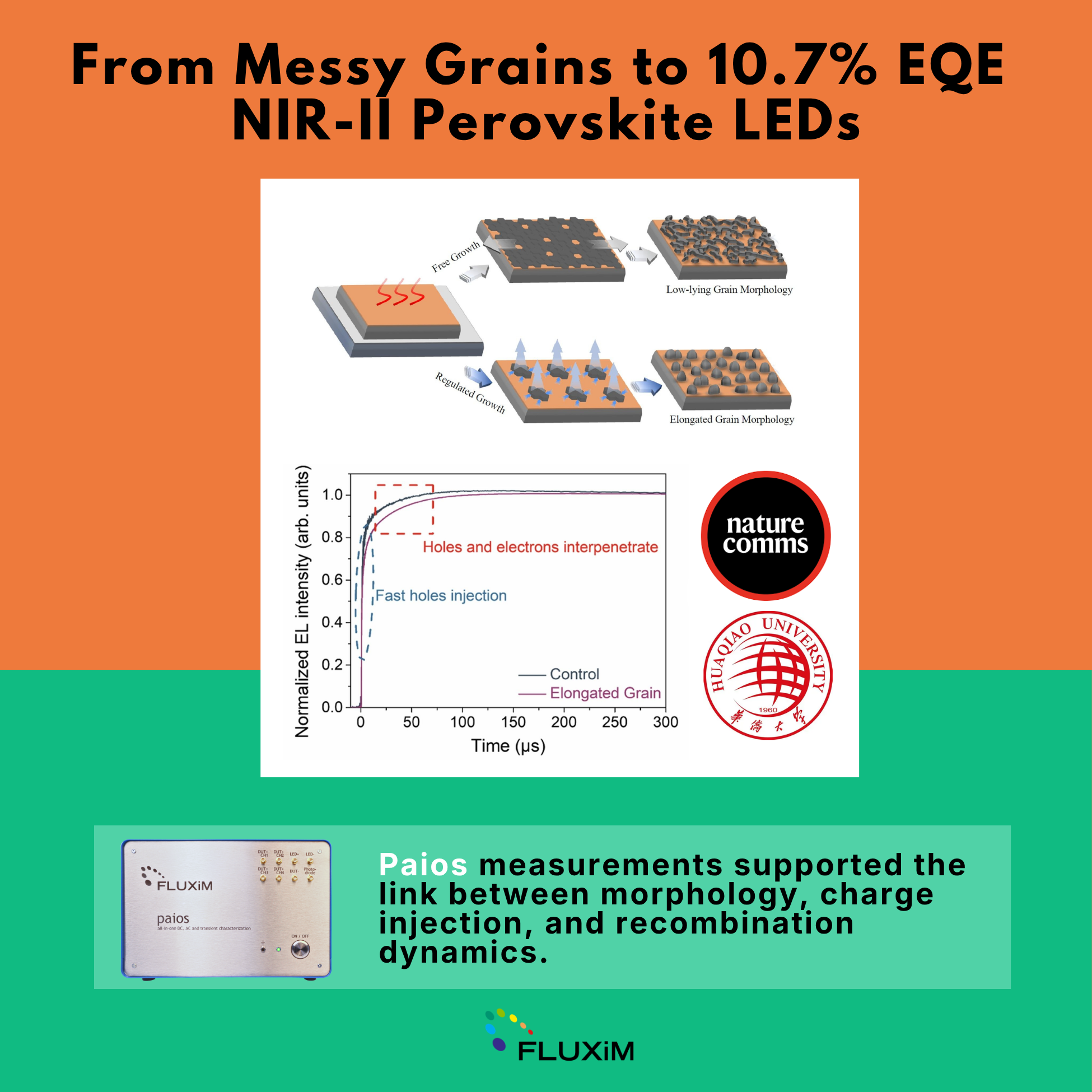
Sn-based NIR-II perovskite LEDs are attractive for lead-reduced infrared emission, but excessive hole injection and recombination losses limit high-radiance efficiency. Guan et al. use 18-crown-6 to regulate CsSnI3 crystallization, forming elongated island-like grains that reduce hole over-injection and confine recombination deeper in the perovskite bulk. The optimized LEDs reach 10.7% EQE, 173 W sr^-1 m^-2 radiance, and low efficiency roll-off. Paios measurements provided transient EL, C-V, and impedance evidence linking morphology to charge injection and recombination dynamics.
Publication details
Authors: Xiang Guan, Yuqing Li, Yu Su, Yuanyuan Meng, Han Tong, Yujie Luo, Kebin Lin, Hong Liu, Yuanzhi Wang, Yaqing Li, Yan Zhang, Qin Zhang, Siwei Hao, Xi Chen, Shaopeng Zhang, Jianxun Lu, Fengxian Xie, and Zhanhua Wei
Journal: Nature Communications
Year: 2026
DOI: 10.1038/s41467-026-72625-z
PDF link:https://www.nature.com/articles/s41467-026-72625-z. The article is open access under CC BY-NC-ND 4.0, which restricts commercial reuse and derivative adaptations.
Fluxim tools used
Paios — used for transient electroluminescence, capacitance-voltage, and impedance spectroscopy.
Why it matters
Shows how grain morphology can control charge balance in Sn-based NIR-II perovskite LEDs.
Connects morphology changes to injection, accumulation, recombination-zone position, and efficiency roll-off.
Demonstrates how Paios helps validate device-physics mechanisms beyond standard EQE and radiance curves.
FAQs
Which Fluxim tool was used in this paper?
Paios was used for transient EL, capacitance-voltage, and impedance spectroscopy measurements.
What was the main device improvement?
The optimized Sn-based perovskite LEDs achieved 10.7% EQE and 173 W sr^-1 m^-2 radiance at 963 nm.
Why are elongated grains important?
They reduce excessive hole injection and help keep the recombination zone deeper inside the perovskite emissive layer.