
Research Paper — Setfos Simulations Link Halide Segregation to Ionic Losses in Wide-Bandgap Perovskites
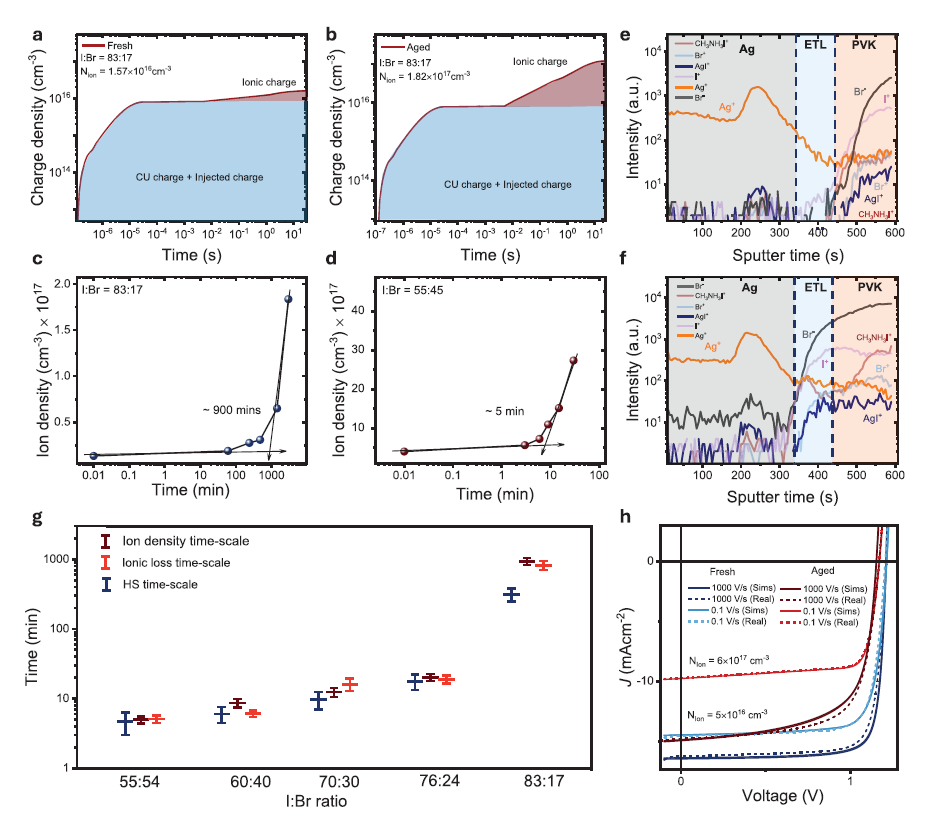
This Advanced Energy Materials paper shows that halide segregation, ion density evolution, and ionic performance losses occur on closely related timescales in wide-bandgap mixed-halide perovskite solar cells. The results suggest that poor stability in segregation-prone devices is mainly driven by enhanced ionic losses and field-screening effects, rather than only charge-carrier funneling. Setfos was used for drift-diffusion simulations, helping connect measured mobile ion densities with the observed JV losses.
Publication details
Authors: Nikhil Kalasariya, Paria Forozi Sowmeeh, Francisco Pena-Camargo, Francesco Vanin, Tino Lukas, Yuxin Dong, Qifan Feng, Ziwei Liu, Waqar Ali Memon, Danpeng Gao, Jianqiu Gong, Xin Wu, Andres Felipe Castro Mendez, Jan Hagenberg, Zahra Abadi, Thomas Hultzsch, Xinyi Zhao, Sahil Shah, Hui Yu, Varun Srivastava, Jianbin Xu, Ni Zhao, Felix Lang, Zonglong Zhu, and Martin Stolterfoht
Journal: Advanced Energy Materials, 16(15), Article e03866
Year: 2026
DOI: 10.1002/aenm.202503866
Fluxim tools used
Setfos — drift-diffusion simulations using SETFOS for 55:45 wide-bandgap perovskite cells. Mobile ion concentrations derived from BACE measurements on fresh and aged devices were incorporated into the Setfos simulations and compared with experimental JV curves at fast scan and steady-state conditions, showing that increased mobile ion density can explain the observed degradation losses.
Why it matters
Connects halide segregation directly to increased ion density and ionic performance loss.
Shows that Setfos simulations can validate whether measured mobile ion densities explain JV degradation.
Supports better stability analysis for wide-bandgap perovskites used in tandem solar cells.
FAQs
Q: What is the main finding of the paper?
A: Halide segregation, ion density increase, and ionic performance losses evolve and partially recover on similar timescales.
Q: Which Fluxim tool was used?
A: Setfos was used for drift-diffusion simulations of JV behavior in fresh and aged perovskite solar cells.
Q: Why is this important for tandem solar cells?
A: Wide-bandgap perovskites are key top-cell materials for tandems, but their stability is limited by halide segregation and ion-induced losses.