
Research Paper — Microscale Optoelectronic Synapses with Switchable Photocurrent from Halide Perovskite
Summary
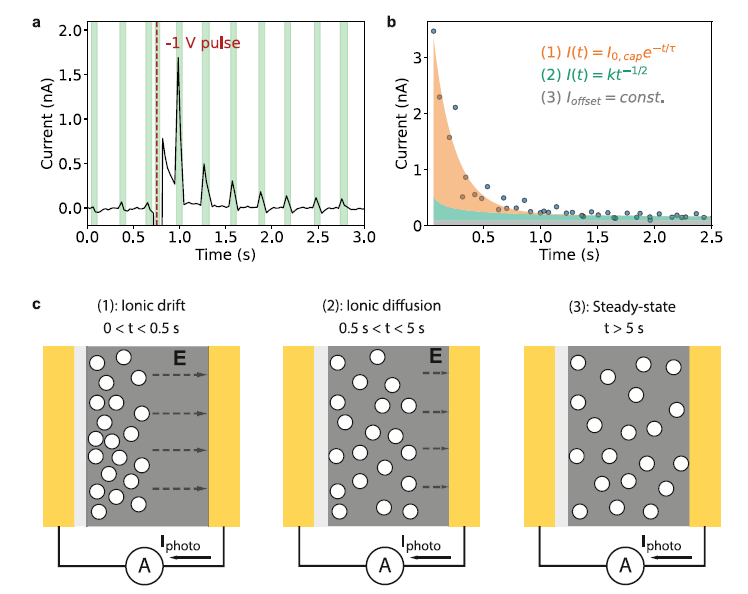
Researchers at AMOLF developed microscale halide perovskite optoelectronic synapses that use ion migration to control photocurrent after a voltage pulse. The volatile response decays over seconds, can be tuned by voltage and illumination, and can switch polarity for excitatory or inhibitory synaptic behavior. Setfos by Fluxim was used for drift-diffusion simulations to support the proposed ion-migration mechanism behind the transient photocurrent response.
Authors: Jeroen J. de Boer, Agustin O. Alvarez, Moritz C. Schmidt, Dimitris Sitaridis, Bruno Ehrler
Journal: ACS Applied Electronic Materials
Year: 2026
DOI: 10.1021/acsaelm.5c02469
Why it matters
Shows how halide perovskites can combine light sensing and neuromorphic signal processing in microscale devices.
Demonstrates volatile photocurrent control through ion migration, relevant for short-term memory and visual attention mechanisms.
Uses Setfos simulations to support the physical interpretation of transient ion-driven electric fields.
FAQs
Which Fluxim tool was used in this paper?
Setfos was used for drift-diffusion simulations of potential and mobile ion density relaxation.
What is the main mechanism behind the photocurrent change?
A voltage pulse redistributes mobile ions in the perovskite, producing a transient electric field that changes photocurrent under illumination.
Why is photocurrent polarity switching important?
It allows the same synaptic device to represent excitatory or inhibitory behavior, which is useful for neuromorphic network architectures.