
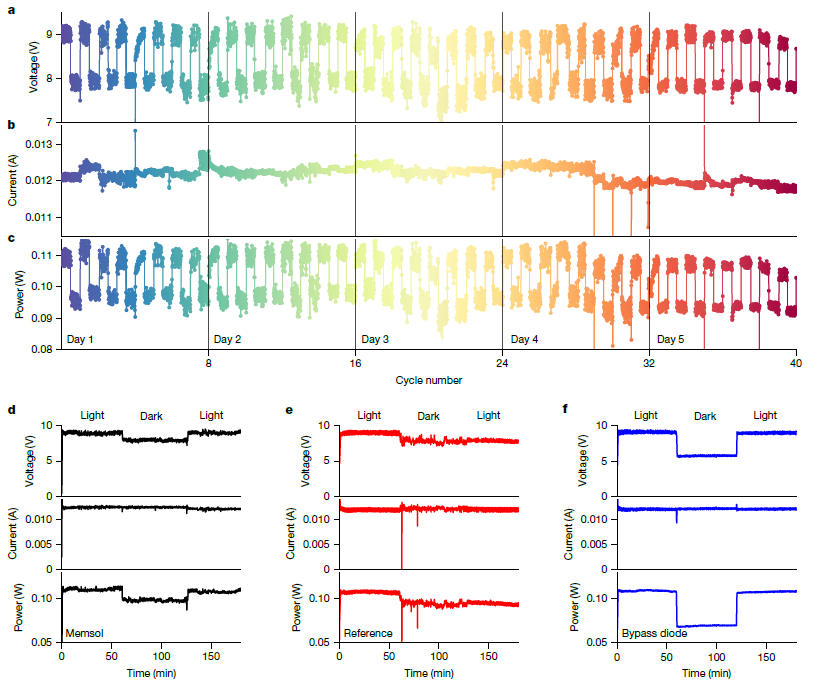
This Nature paper introduces Memsol, a perovskite solar cell with an integrated memristor that acts as an internal bypass element during shading-induced reverse bias. Under reverse bias, the memristor switches into a low-resistance state to protect the solar cell; under illumination, it returns to a high-resistance state so the cell resumes normal photovoltaic operation. A prototype version of Vitios was used for lock-in thermography, helping visualize localized reverse-bias heating in the Memsol device and compare it with reference-cell breakdown behavior
Publication details
Authors: Mahdi Mohammadi, Fuxiang Ji, Tristan Sachsenweger, Kazem Meraji, Sharun Parayil Shaji, Wolfgang Tress
Journal: Nature
Year: 2026
DOI: 10.1038/s41586-026-10275-3
PDF link if allowed: https://doi.org/10.1038/s41586-026-10275-3
Fluxim tools used
The paper used a prototype version of Vitios. In the published methods, the system is described as a custom lock-in thermography setup using an Optris PI640i thermal camera, voltage pulses from a National Instruments source-measure unit, and a custom demodulation algorithm to generate temperature-amplitude images. This setup was used to localize reverse-bias heating in the Memsol device and compare it with the reference perovskite solar cell. The work demonstrates a key Vitios application: visualizing localized hotspots and reliability risks in photovoltaic devices under electrical stress.
Why it matters
Shows a new integrated bypass concept for protecting perovskite solar cells under partial shading.
Uses thermal imaging to reveal where reverse-bias heating occurs in Memsol versus reference devices.
Demonstrates how Vitios-type imaging can help study reliability, hotspots, and reverse-bias failure mechanisms in perovskite photovoltaics.
FAQs
Q: Which Fluxim tool was used in this paper?
A: A prototype version of Vitios was used for lock-in thermography / thermal imaging. The published paper describes the imaging setup and algorithm but does not explicitly name Vitios.
Q: What did the Vitios prototype help show?
A: It helped localize Joule heating under reverse bias, showing confined heating at the integrated memristor in Memsol and different heating behavior in reference devices.
Q: Why is this relevant for perovskite reliability?
A: Reverse-bias stress and partial shading can create hotspots and irreversible degradation. Thermal imaging helps visualize these failure pathways and assess protection strategies.