
Research Paper — Quantum-dot interlayers reduce plasmon losses in phosphorescent OLEDs
Summary
Researchers from Kyung Hee University, the University of Cologne and the University of St Andrews developed an inverted phosphorescent OLED in which an InP-based quantum-dot interlayer redirects energy that would otherwise be lost through surface plasmon polariton modes. The optimized QD device reached 20.95% EQE, compared with 15.67% for the reference OLED, while also showing substantially improved operational stability.
Setfos was used to analyse the OLED optical modes, power dissipation, outcoupling and layer-thickness dependence. These simulations helped establish the optical-loss distribution of the reference device and showed that the efficiency increase could not simply be attributed to the refractive index of the added QD layer. Explicit QD near-field behaviour was investigated separately using 3D FDTD simulations.
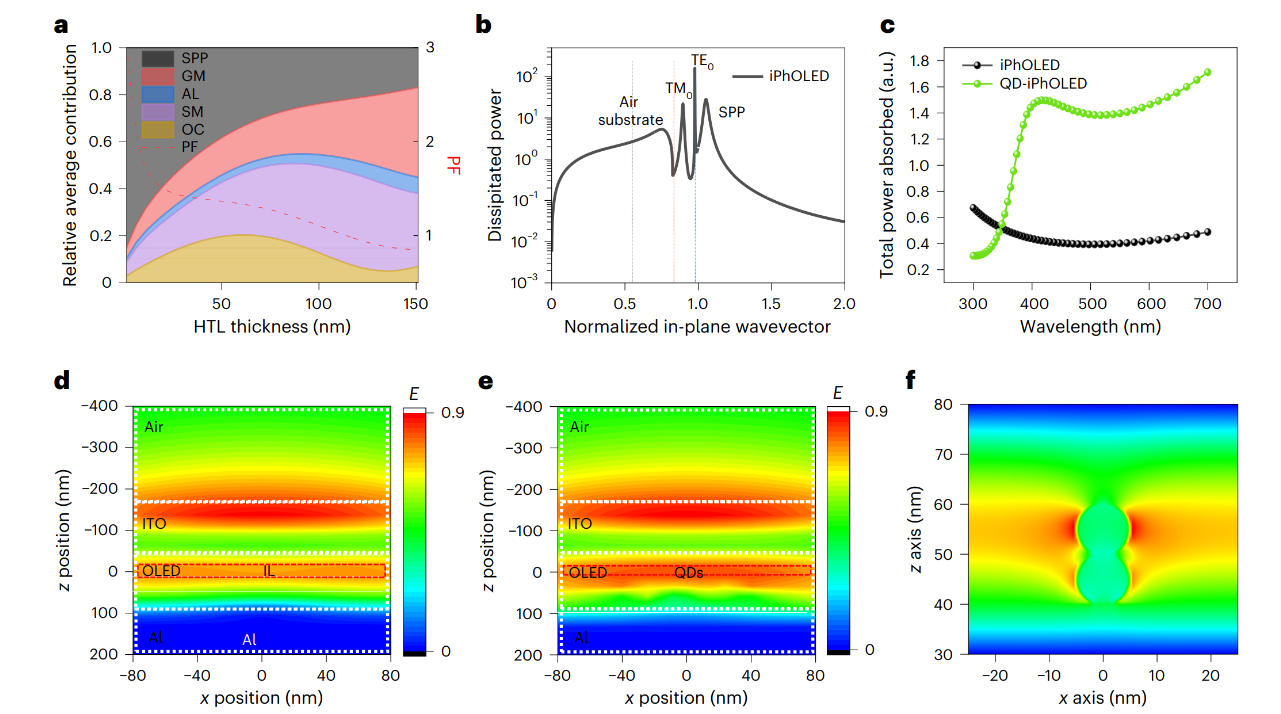
Further analysis of QD-based energy redirection via optical modelling
Publication details
Authors: Thi Thuy Truong, Hai Truyen Dang, Nisha Vergineya S, Malte C. Gather, Jang Hyuk Kwon
Journal: Nature Photonics
Year: 2026
Published: 15 September 2026 Nature
DOI: 10.1038/s41566-026-02001-2
Article: Nature Photonics article
Fluxim tools used
Setfos — OLED optical simulation, including:
modal analysis of air, substrate, waveguide and SPP modes
power-dissipation analysis
optical outcoupling calculations
ETL, HTL and interlayer thickness optimization
evaluation of interlayer refractive-index effects
incorporation of measured optical constants and emission data
Why it matters
The QD interlayer increased peak EQE from 15.67% to 20.95% while maintaining strong performance at high luminance.
Setfos analysis quantified the substantial optical losses of the reference OLED, including approximately 37.8% coupled to SPP modes.
The work demonstrates a route for recovering plasmonic losses without relying on metallic nanoparticles, which in the comparison devices reduced efficiency.
FAQs
How was Setfos used in this research?
Setfos was used for optical modal analysis, power-dissipation calculations, outcoupled-radiance simulations and layer-thickness optimization. Experimentally measured refractive indices and emission data were incorporated into the simulations.
Did Setfos simulate the individual quantum dots?
No. The explicit 3D electromagnetic fields surrounding the QD nanostructures were calculated using Lumerical FDTD. Setfos modelled the multilayer OLED optical behaviour and its modal losses.
What improvement was achieved with the QD interlayer?
The optimized green QD-iPhOLED achieved a peak EQE of 20.95%, compared with 15.67% for the reference device. The paper also reports more than a fivefold improvement in operational stability.