
This 2026 Nanomaterials review maps theoretical modeling of colloidal quantum dot optoelectronics from atomistic calculations of electronic structure, surface defects and carrier dynamics to device-scale modeling of solar cells, photodetectors and QLEDs.
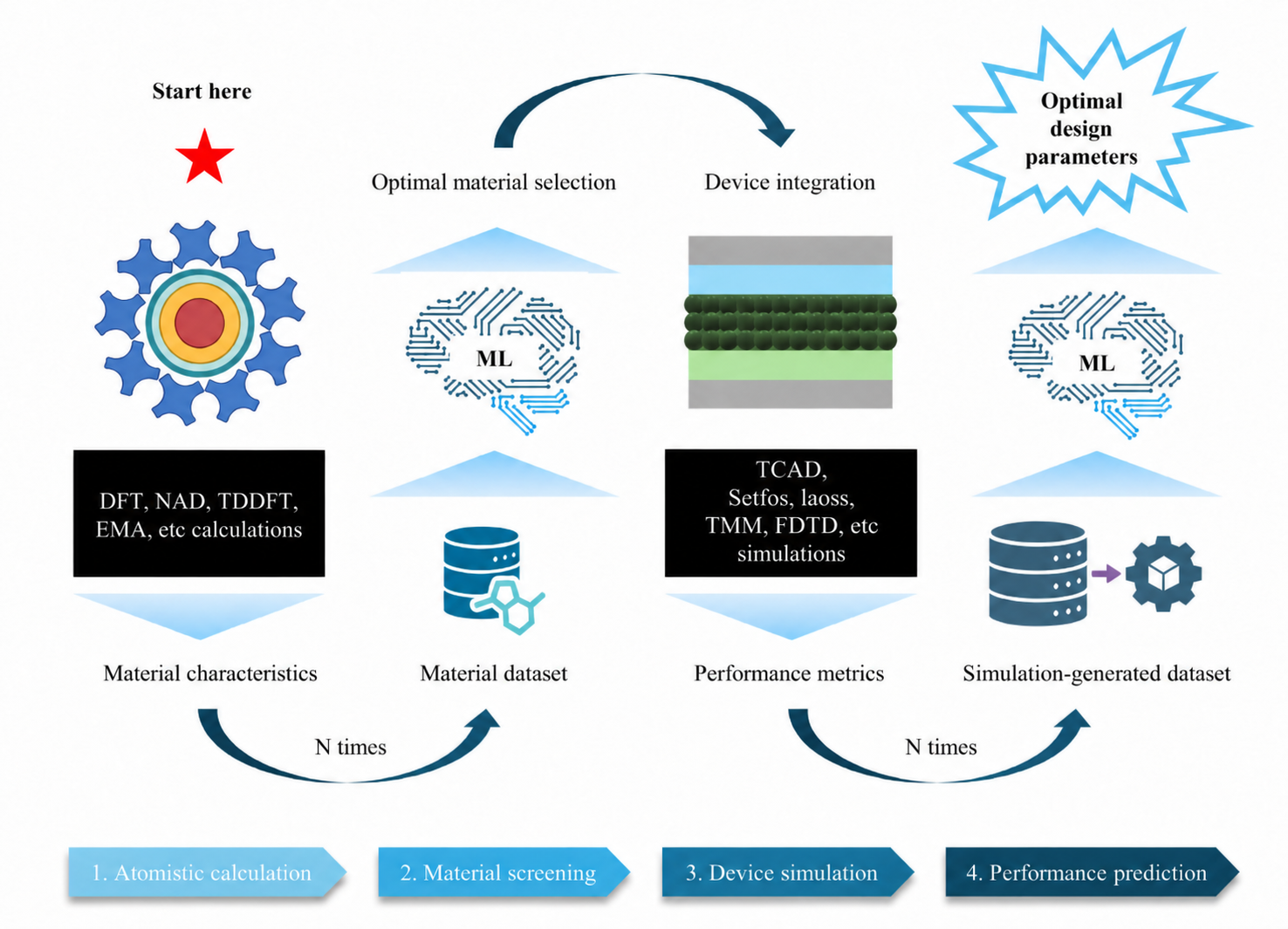
Envisioned multiscale integrated computational framework for the future rational design of CQD-based optoelectronic devices.
A central conclusion is that predictive CQD design requires multiscale workflows connecting material properties, charge transport, recombination, optical behavior and experimental validation.
The review highlights previous studies using Fluxim software. Setfos was used for transient/rate-equation modeling of CQD photodetectors and optical-mode simulation of QLEDs. LAOSS (Laoss) was used to model microlens arrays and investigate dipole-orientation-dependent light extraction in QLEDs.
Publication details
Authors: Phung Phuong Uyen and Byeongsu Kim
Journal: Nanomaterials
Year: 2026
Volume: 16
Article: 1338
DOI: https://doi.org/10.3390/nano16211338
PDF: https://www.mdpi.com/2079-4991/16/21/1338/pdf
Access: Open access, CC BY
Fluxim tools used
Setfos — /setfos
Cited in previous CQD studies for transient photocurrent/rate-equation modeling and QLED optical-mode and cavity simulations.
Laoss — /laoss
Cited for large-area optical simulation of microlens-array QLEDs, including MLA geometry and emitter dipole orientation.
The review itself did not perform new Fluxim simulations.
Why it matters
Connects atomistic CQD properties with measurable device performance.
Shows how simulation can identify transport, recombination and optical losses before further fabrication.
Highlights the growing need for integrated, experimentally validated and ML-assisted CQD modeling.
FAQs
What does multiscale modeling mean for CQD devices?
It means linking material-level models of quantum dots, surfaces and defects with device-level models of transport, recombination, optical fields and measurable performance.
How is Setfos relevant to CQD research?
The review cites Setfos studies covering transient CQD photodetector simulation and optical modeling of QLED architectures.
How is Laoss relevant to QLEDs?
The review highlights LAOSS simulations used to optimize microlens arrays and understand how emitter orientation influences QLED light extraction.
Fluxim-related studies cited by the review
Parmar, D. H., Rehl, B., Atan, O., Hoogland, S., & Sargent, E. H. (2023). Transient measurements and simulations correlate exchange ligand concentration and trap states in colloidal quantum dot photodetectors. ACS Applied Materials & Interfaces, 15(51), 59931–59938. https://doi.org/10.1021/acsami.3c14611 PubMed
Park, S., Sim, S., Lee, H., Lee, H. J., Park, J. W., Park, J. S., Bae, W. K., & Lee, H. (2025). Effect of microlens arrays on light extraction efficiency in red and green quantum-dot light-emitting diodes. Micro and Nano Engineering, 29, 100325. https://doi.org/10.1016/j.mne.2025.100325 ScienceDirect
Li, M., Li, R., Wu, L., Lin, X., Xia, X., Ao, Z., Sun, X., Chen, X., & Chen, S. (2024). Ultrabright and stable top-emitting quantum-dot light-emitting diodes with negligible angular color shift. Nature Communications, 15, 5161. https://doi.org/10.1038/s41467-024-49574-6