
Research Paper — Machine learning unlocks impedance analysis for perovskite solar cells
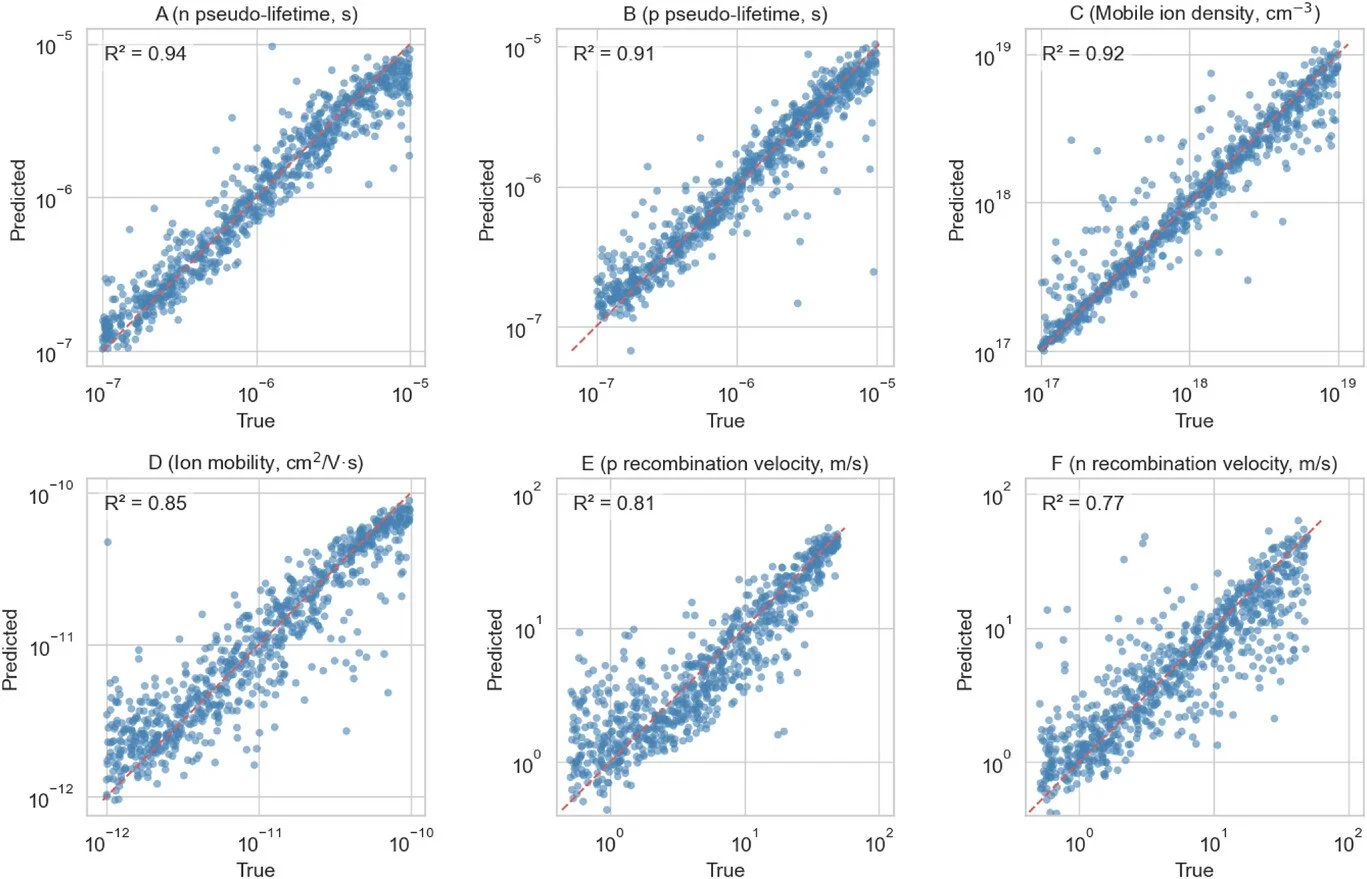
This study combines drift-diffusion simulations and interpretable machine learning to solve the long-standing inverse problem of impedance spectroscopy in perovskite solar cells. Using Setfos, large datasets of simulated impedance spectra were generated to train models that predict recombination and ionic parameters from measurements. The results show that open-circuit conditions are optimal for extracting recombination losses, while short-circuit measurements better probe ionic transport. The approach enables accurate reconstruction of experimental spectra and provides a practical pathway to extract physically meaningful device parameters.
Publication details
Authors: Mahmoud Nabil, Isel Grau, Ricardo Grau-Crespo, Said Hamad, Juan A. Anta
Journal: Advanced Energy Materials
Year: 2026
Fluxim tools used
Drift-diffusion simulations were performed using Setfos v5.5, which generated large datasets of impedance spectra under varying physical parameters. These simulations enabled training of machine learning models that map impedance features to physical quantities such as ion mobility, ion density, and recombination velocities. Setfos was central to both the data generation and validation workflow, demonstrating its capability for advanced EIS interpretation and inverse modeling.
Why it matters
Enables direct extraction of physical parameters from impedance measurements
Bridges simulation and experiment for perovskite device characterization
Reduces ambiguity in interpreting EIS data for complex ionic-electronic systems
FAQs
How does machine learning improve impedance analysis?
It learns the mapping between spectral features and physical parameters, avoiding manual fitting and ambiguity.
Why are both open-circuit and short-circuit measurements needed?
They probe different physics: recombination dominates at open circuit, while transport dominates at short circuit.
What parameters can be reliably extracted?
Ion density, ion mobility, and surface recombination velocities can be predicted with high accuracy.