
Research Paper — Ultrathin C60 contacts for perovskite-silicon tandems
Summary
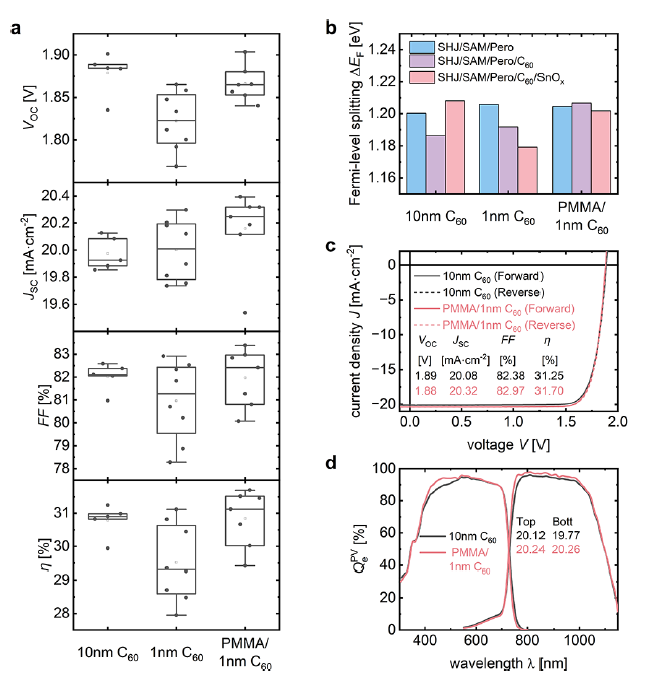
Researchers from Forschungszentrum Jülich, RWTH Aachen University, and the University of Duisburg-Essen show that reducing the C60 electron-selective contact to 1 nm can cut parasitic absorption losses in perovskite-silicon tandem solar cells. With SnOx as buffer layer, carrier collection remains largely unaffected, but exposed perovskite suffers ALD damage that lowers VOC. A thin PMMA protection layer suppresses that loss, enabling a best tandem efficiency of 31.70%. The supporting information states that Setfos was used for electrical modelling of the single-junction devices that helped interpret the thickness-dependent electrical behaviour.
Publication details
Authors Gaosheng Huang, Nan Sun, Niklas Scheer, Samah Akel, Qing Yang, Benjamin Klingebiel, Karsten Bittkau, Andreas Lambertz, Rüdiger-A. Eichel, Florian Hausen, Thomas Kirchartz, Uwe Rau, and Kaining Ding
Journal ACS Energy Letters
Year 2026
DOI 10.1021/acsenergylett.5c04082
PDF link Open-access ACS article via DOI 10.1021/acsenergylett.5c04082
Fluxim tools used
Setfos — electrical modelling of single-junction PSCs used to analyse illumination-dependent ideality-factor behaviour and C60-thickness effects.
Why it matters
Shows that ultrathin 1 nm C60 can reduce parasitic absorption losses in tandem stacks and improve JSC.
Clarifies that SnOx can preserve collection with discontinuous C60, but ALD damage on exposed perovskite must be controlled.
Demonstrates a practical route to 31.70% tandem efficiency using PMMA protection plus ultrathin C60.
FAQs
Q1. What is the main result of the paper?
A 1 nm C60 contact combined with a PMMA protection layer enabled a best tandem efficiency of 31.70% while improving JSC relative to the thicker-C60 reference.
Q2. Why is ultrathin C60 useful?
Because C60 absorbs in the same spectral region as the perovskite top cell, reducing its thickness lowers parasitic absorption and can recover current otherwise lost in the tandem stack.
Q3. How was Setfos used?
According to the supporting information, Setfos was used for electrical simulations of single-junction PSCs to study illumination-dependent behaviour and extract ideality-factor trends linked to C60 thickness.