
Summary
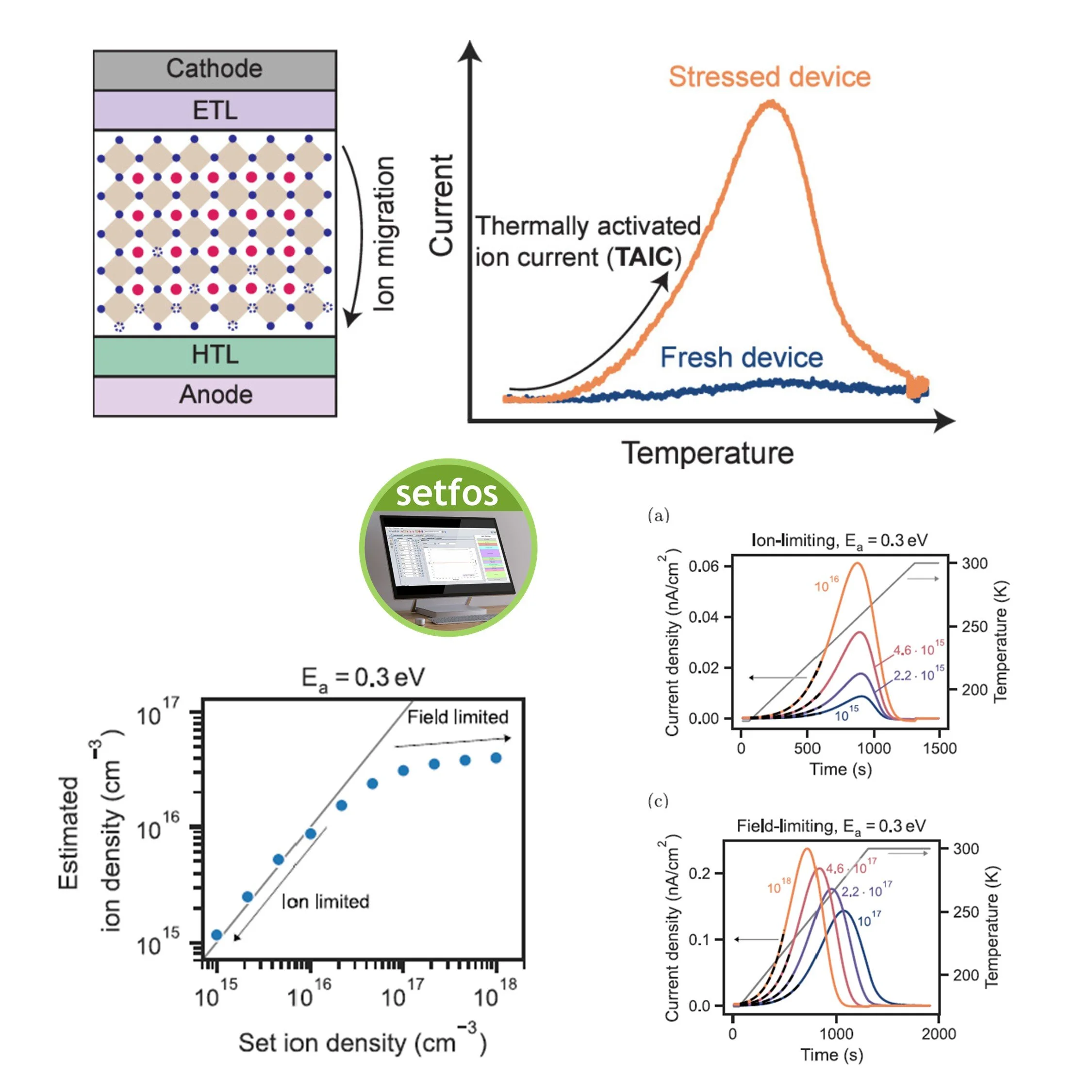
Researchers introduced thermally activated ion current (TAIC) measurements as a new way to extract mobile-ion density, diffusion coefficient, and activation energy from perovskite solar cells in a single temperature sweep. Applied to MAPbI3 and triple-cation devices, the method showed rising ion densities under Voc stress and lower ion mobility in the triple-cation architecture. Setfos was used for one-dimensional drift-diffusion simulations that validated the TAIC interpretation, distinguished ion-limited from field-limited cases, and supported the assignment of different ionic migration processes.
Publication details
Authors Moritz C. Schmidt, Agustin O. Alvarez, Riccardo Pallotta, Biruk A. Seid, Jeroen J. de Boer, Jarla Thiesbrummel, Felix Lang, Giulia Grancini, Bruno Ehrler
Journal ACS Energy Letters
Year 2026
DOI 10.1021/acsenergylett.5c02224
PDF https://pubs.acs.org/doi/pdf/10.1021/acsenergylett.5c02224
Fluxim tools used
Why it matters
TAIC provides an intuitive way to distinguish ionic processes and extract key ion-transport parameters from a single temperature sweep.
The work shows that triple-cation devices have lower diffusion coefficients and higher activation energy than MAPbI3 devices, consistent with suppressed ion migration.
Setfos simulations were central for validating the method and interpreting when TAIC can reliably quantify ion density.
FAQs
What did the researchers measure with TAIC?
TAIC was used to extract mobile-ion density, diffusion coefficient, and activation energy from perovskite solar cells during a controlled temperature sweep.
Which Fluxim tool was used in this study?
The study explicitly reports that the drift-diffusion simulations were carried out with Setfos by Fluxim.
What was the main difference between MAPbI3 and triple-cation devices?
The triple-cation cells showed a higher activation energy and a lower diffusion coefficient at 300 K, indicating slower ion migration than in MAPbI3 devices.