
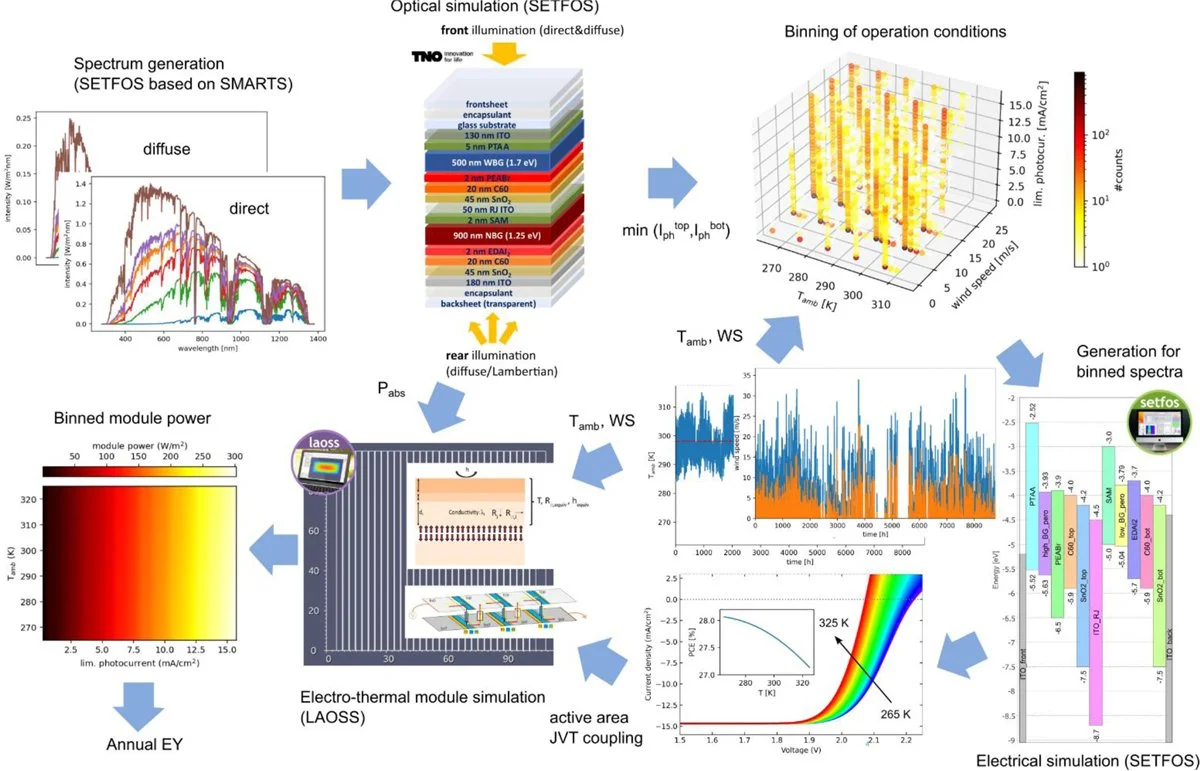
Researchers from Fluxim, Fraunhofer ISE, and TNO present a physics-based workflow for predicting the annual energy yield of bifacial all-perovskite tandem modules under real outdoor conditions in Freiburg, Germany. Using Setfos and Laoss, they show that bifaciality can increase energy yield already at moderate albedo, that lower top-cell band gaps are advantageous at higher rear illumination, and that realistic cell-to-module losses have a stronger effect on yield assessment than full temperature dependence alone.
Publication details
Authors: Urs Aeberhard, Andreas Schiller, Roger Häusermann, Roman Hiestand, Balthasar Blülle, Markus Kohlstädt, Mehrdad Najafi, Sjoerd Veenstra, Beat Ruhstaller
Journal: EPJ Photovoltaics
Year: 2026
OPen Access DPF: 10.1051/epjpv/2026005
Supporting Docs
Why this research matters
Shows how bifaciality, band-gap selection, and real outdoor conditions interact in all-perovskite tandem modules.
Quantifies the gap between cell-level promise and module-level performance after resistive and thermal losses.
Demonstrates how physics-based simulation can guide tandem module design before large-scale fabrication.
Fluxim tools used
FAQs
Q1. Which Fluxim tools were used in this paper?
Setfos was used for optical and opto-electronic device simulation, and Laoss was used for electro-thermal module simulation.
Q2. What is the main scientific conclusion?
The study finds that bifacial operation can improve annual energy yield already at moderate albedo, while lower top-cell band gaps become increasingly beneficial at higher rear irradiation. It also finds that accurate treatment of upscaling losses is more important than full temperature dependence for reliable yield quantification in this framework.
Q3. What are the main limitations noted by the authors?
The authors note that the framework could be refined by including cloud-cover effects, temperature dependence of intrinsic material parameters such as optical constants, and degradation models for quantitative comparison with measured outdoor data.