
Research Paper — Amorphous multilayers improve reverse-bias stability in perovskite solar cells
Summary
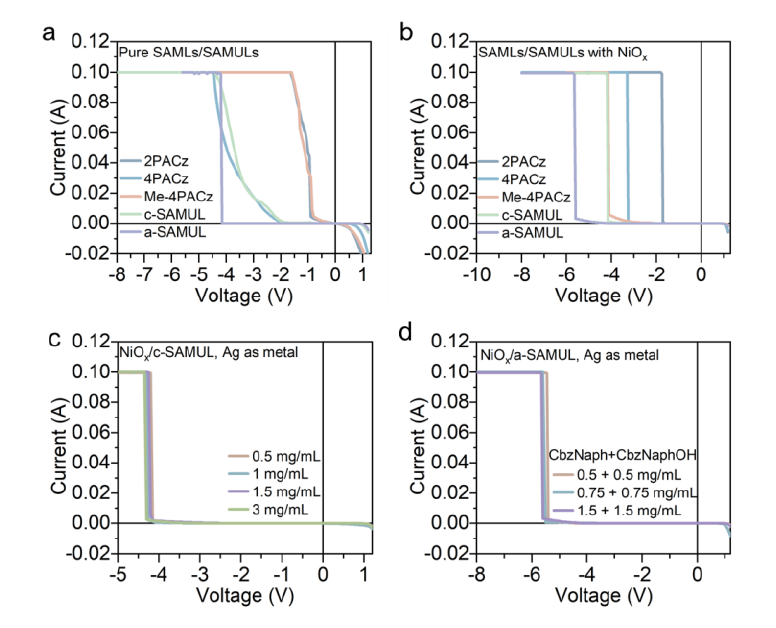
Amorphous self-assembled multilayers (SAMULs) are introduced to address reverse-bias instability in perovskite solar cells. The approach improves interfacial adhesion and reduces ion migration, enabling efficiencies above 25% alongside significantly enhanced stability. Device simulations using Setfos support the experimental findings, linking material properties to improved device robustness.
Publication details
Authors: Xiaofeng Huang et al.
Journal: Nature Energy
Year: 2026
Fluxim tools used
Setfos was used to simulate device physics, including charge transport, recombination, and ion migration effects. The simulations (see Supplementary Table 4–5) quantify how SAMUL properties—such as thickness, dielectric constants, and mobile ion density—impact reverse-bias stability and device performance, directly linking material design to device-level behavior.
Why it matters
Enables stable operation under reverse bias, a key failure mode in PV modules
Demonstrates how interfacial design controls ion migration and degradation
Combines experiment and simulation for predictive device engineering
Keywords
perovskite solar cells, reverse-bias stability, SAMUL, self-assembled monolayers, amorphous interfaces, ion migration, degradation mechanisms, device simulation, Setfos, interface engineering, charge transport, recombination, NiOx, C60, photovoltaic stability, high-efficiency PSC
FAQs
What is reverse-bias stability and why is it important?
Reverse bias can occur in modules under partial shading and can cause rapid degradation. Improving stability under these conditions is critical for real-world deployment.
What is the advantage of SAMULs over conventional SAMs?
SAMULs form amorphous, thicker interlayers that improve adhesion and suppress ion migration, leading to higher breakdown voltages.
How does simulation support the findings?
Setfos simulations quantify how material parameters influence charge transport and ion dynamics, validating the experimental trends.