
Research Paper — AI-driven parameter extraction in perovskite solar cells
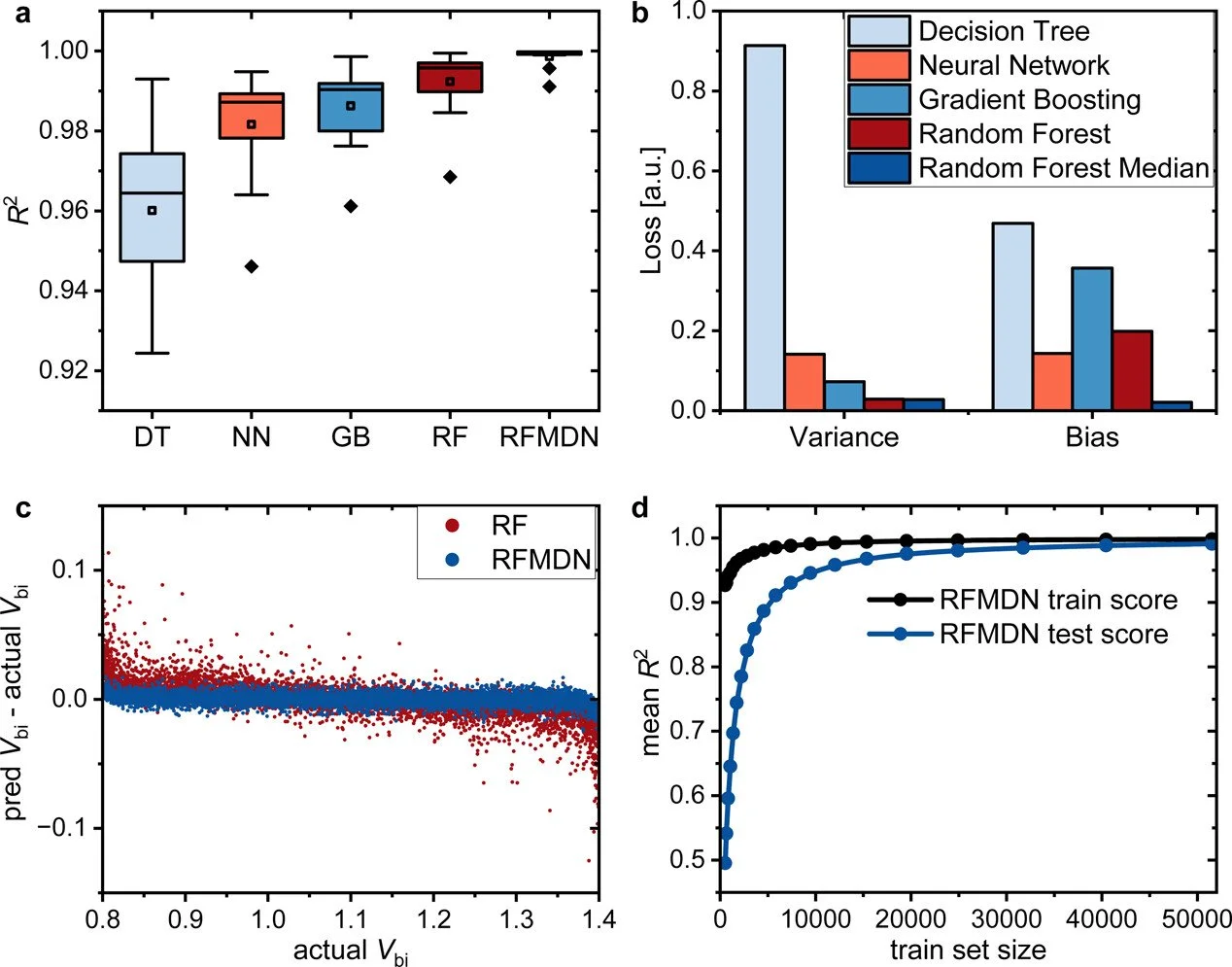
This work introduces an AI-assisted method to rapidly predict key physical parameters of perovskite solar cells from device performance data. By training on datasets generated with physics-based simulations, the approach replaces slow iterative fitting with near-instant predictions. Setfos simulations provide the physical foundation, enabling accurate mapping between device physics and measurable outputs.
Publication details
Authors: Jonas Diekmann, Zitong Yang, Nurlan Tokmoldin, Ziwei Liu, Francisco Peña-Camargo, Zhuofan Xiong, Paria Forozi Sowmeeh, Hongsheng Li, Qiuqiang Kong, Xiaoliang Ju, Felix Lang, Safa Shoaee, Dieter Neher, Martin Stolterfoht
Journal: ACS Energy Letters
Year: 2026
Fluxim tools used
The work relies on Setfos for generating the simulation dataset used to train the AI model. Setfos provides the physics-based drift-diffusion simulations that underpin the parameter–performance relationships learned by the AI.
Why it matters
Reduces parameter extraction time from hours to seconds
Enables high-throughput analysis of perovskite devices
Bridges physics-based simulation and AI-driven optimization
Keywords
perovskite solar cells, parameter extraction, AI modeling, machine learning, drift-diffusion simulation, device modeling, Setfos, photovoltaic characterization, inverse modeling, performance prediction, data-driven modeling, high-throughput screening, degradation analysis, digital twin, simulation dataset, neural networks
FAQs
Q1: What problem does this paper solve?
It replaces slow iterative fitting methods with fast AI-based parameter prediction.
Q2: Why are simulations needed for AI training?
They provide physically consistent datasets linking parameters to device performance.
Q3: How accurate is the method?
The model shows strong agreement with conventional fitting approaches while being significantly faster.