
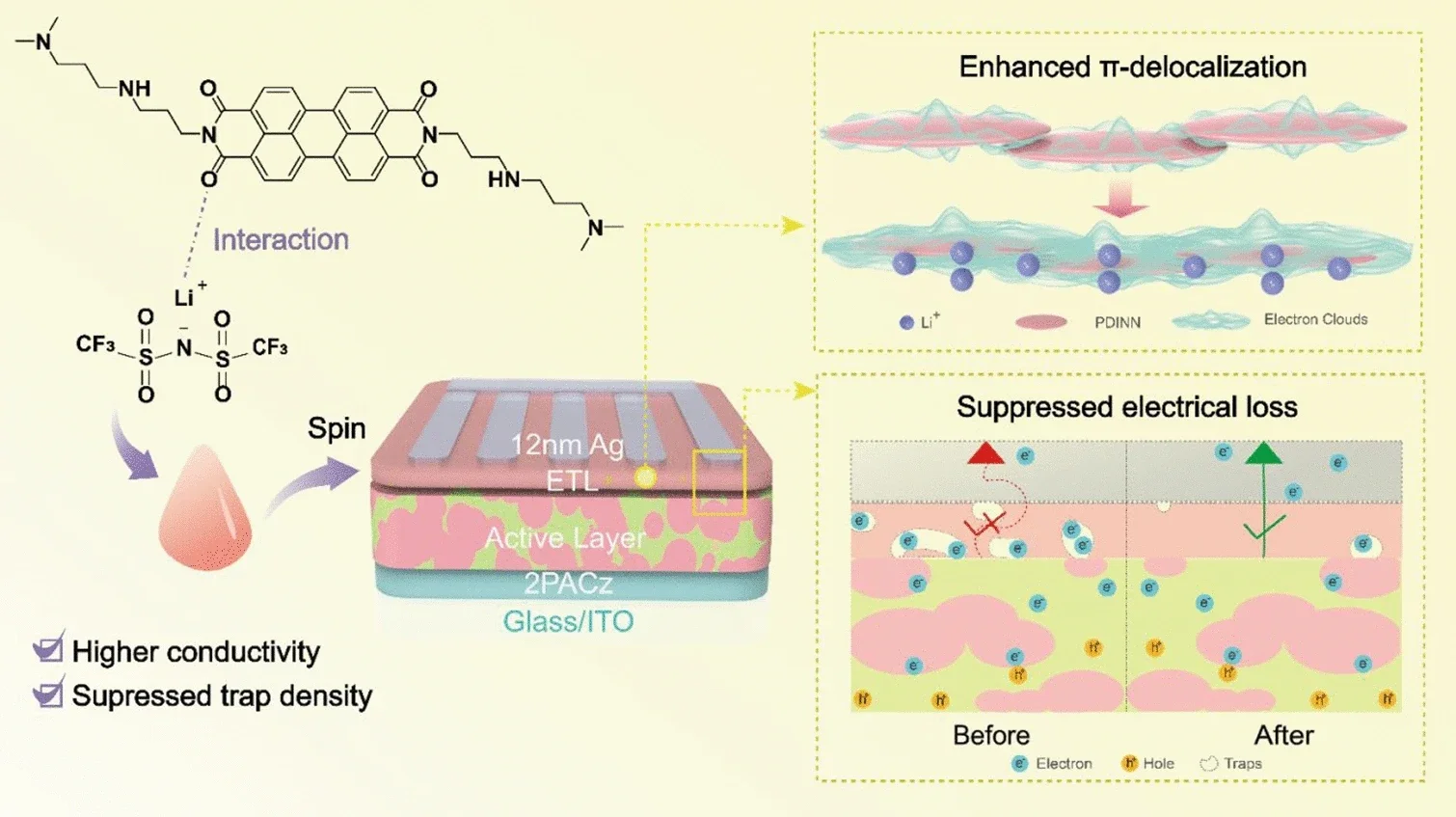
This study reports semitransparent organic photovoltaic devices enabled by doped electron-transport materials (ETMs). By tuning ETM electronic structure and reducing trap-assisted recombination, the devices aim to improve charge extraction while maintaining transparency—balancing optical transmission with power conversion efficiency. Transient techniques (TPC/TPV) are used to probe carrier dynamics, recombination, and extraction behavior, supporting the link between ETM doping, reduced trapping, and improved device operation.
Semitransparent OPVs are attractive for windows and tandem concepts, but optimizing both efficiency and transparency is challenging. This work investigates how controlled doping of electron-transport materials can enhance charge transport and suppress trap-driven losses.
Fluxim Tools Used
Transient characterization (TPC/TPV) was performed with Fluxim Paios, enabling time-resolved insight into extraction and recombination processes in the studied device stacks.
Mo, Y., Wang, J., Chen, H. et al. Enhancing π-Delocalization and Suppressing Traps via Doping in Electron Transport Materials for Efficient Semitransparent Organic Photovoltaics. Nano-Micro Lett. 18, 247 (2026). https://doi.org/10.1007/s40820-026-02083-1