
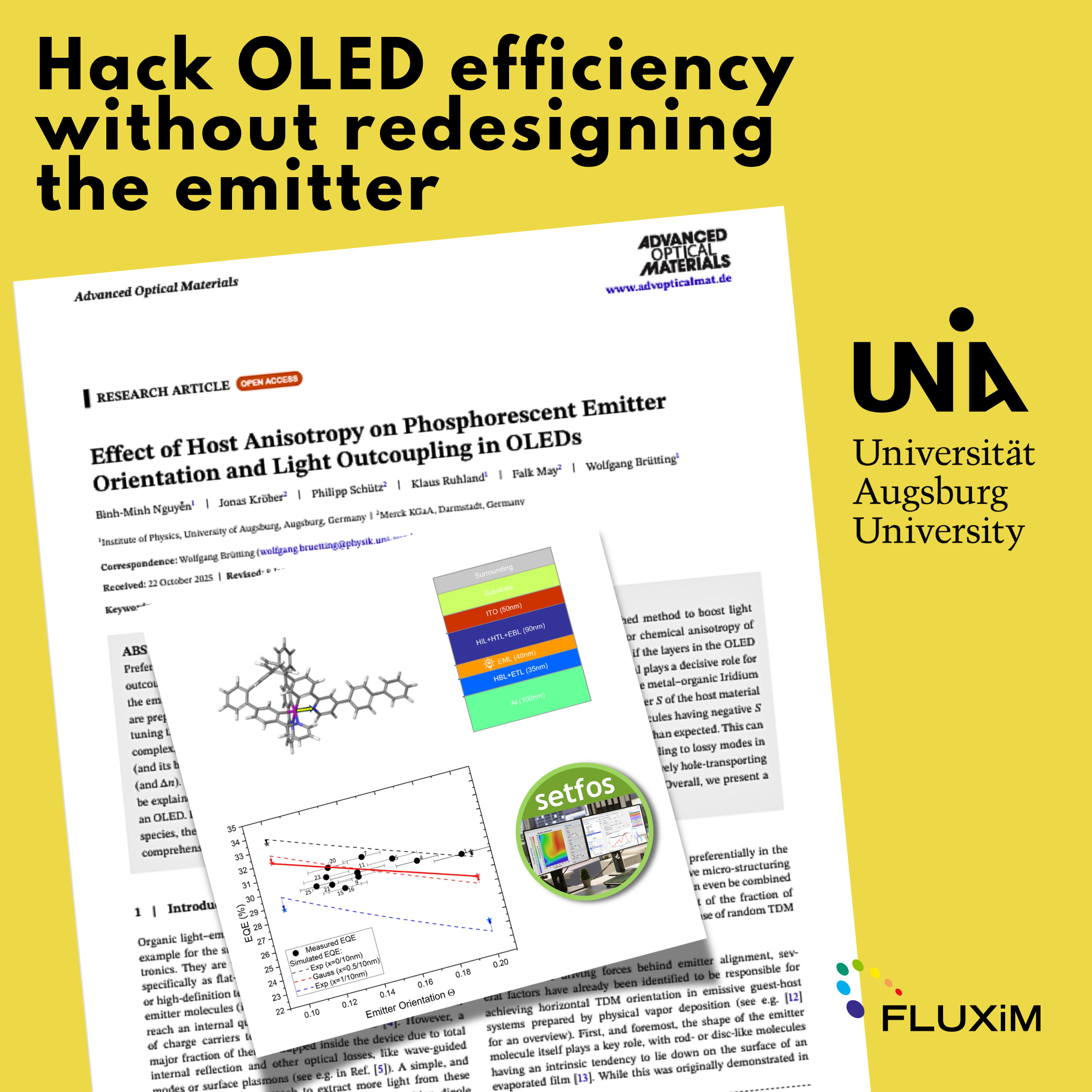
Want to hack OLED efficiency without redesigning the emitter? Just make the host lie flatter. This work reveals that the optical anisotropy of cohost materials—specifically their birefringence and nematic order—directly imprints onto phosphorescent Ir emitter orientation via anisotropic London dispersion forces, turning host engineering into a powerful alignment lever.
In this Advanced Optical Materials study, Bình‐Minh Nguyễn, Wolfgang Brütting and colleagues dope a single cage-like yellow Ir(ppy)₃-derived emitter into 25 cohost mixtures and measure emitter transition dipole moment orientation via angular dependent PL with ellipsometry-determined host anisotropy.
The key result: Cohosts with negative birefringence/negative nematic order parameter (lying molecules) drive the emitter's orientation parameter down to θ ≈ 0.11–0.12 from ~0.20, rivaling the best phosphorescent systems.
Setfos simulations predict substantial EQE gains from better emitter alignment, but experiments show only modest improvement (~1–2% absolute) because host birefringence redirects light into trapped modes and e/h cohost ratios shift the emission zone—revealing host anisotropy as a double-edged sword for light outcoupling.
Simulations of birefringent stacks confirm layer anisotropy can swing outcoupling efficiency by ~9–14% at fixed emitter orientation, validating the core insight: optimal OLED design must jointly tune host alignment, emission-zone position, and birefringence across the full stack.
Publication details
Authors: Bình-Minh Nguyễn et al.
Journal: Advanced Optical Materials
Year: 2026
DOI: 10.1002/adom.202600002
Fluxim tools used
Phelos – angular-dependent photoluminescence for dipole orientation
Setfos – optical simulation and outcoupling analysis
Why it matters
Enables controlled tuning of emitter orientation via host design
Shows limits of orientation-driven EQE improvements
Highlights need to co-optimise optics, transport, and recombination zone
Keywords
OLED, emitter orientation, transition dipole moment, birefringence, optical anisotropy, light outcoupling, phosphorescent emitters, host materials, guest-host systems, ADPL, wave-optical simulation, EQE, recombination zone, dispersion interactions, thin films
FAQs
Q1: Why is horizontal dipole orientation important?
It increases the fraction of light that escapes the device instead of being trapped in waveguided modes.
Q2: Does better orientation always improve OLED efficiency?
No. Host birefringence can increase optical losses, reducing the net benefit.
Q3: How can this be measured and modelled?
Using ADPL measurements (Phelos) and optical simulations (Setfos) to link material properties with device performance.