
Summary
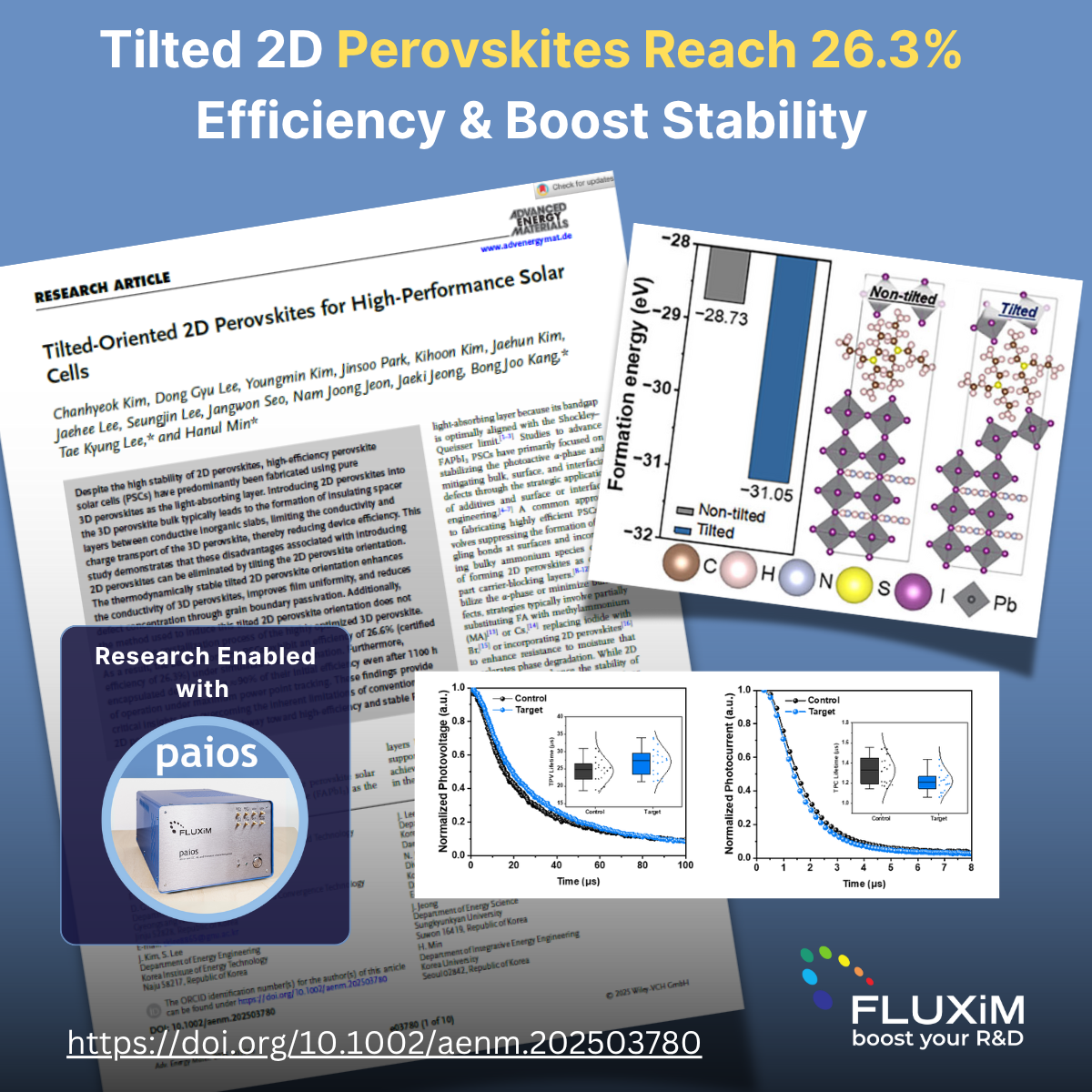
Researchers achieved 26.6 % efficiency (certified 26.3 %) in formamidinium lead iodide (FAPbI₃) perovskite solar cells by introducing tributylsulfonium iodide (TBSI) into a 2-methoxyethanol:chlorobenzene trimming solvent. This process induces a tilted 2D orientation (~22°) that enhances in-plane charge transport while suppressing non-radiative recombination. The optimized devices maintained ≈ 90 % of their initial performance after 1100 h of maximum-power-point tracking.
Paios transient analysis (TPV, TPC, photo-CELIV) confirmed longer carrier lifetimes and higher mobility, validating the orientation-controlled transport mechanism.
Publication details
Authors: C. Kim, D. G. Lee, Y. Kim, J. Park, K. Kim, J. Kim, J. Lee, H. Lee, J. Seo, N. Jeon, H. Jeong, S. Kang*, B. Lee*, J. Min*
Journal: Advanced Energy Materials (2025)
DOI: 10.1002/aenm.202503780
PDF: Available from publisher website
Fluxim tools used
Paios — Measured TPV, TPC, and photo-CELIV to quantify carrier lifetime, extraction speed, and mobility in tilted-2D perovskite devices. These results directly supported the claim that the induced orientation enhances charge transport and stability under continuous illumination.
Why it matters
Demonstrates that tilted-2D engineering overcomes the usual trade-off between 2D stability and 3D conductivity.
Provides a practical path to >26 % efficient perovskite solar cells with long operational lifetimes.
Paios transients confirm physical mechanisms beyond static characterization.
Keywords
perovskite solar cells, 2D/3D perovskites, tilted orientation, TBSI, FAPbI₃, defect passivation, charge transport, transient photovoltage, transient photocurrent, photo-CELIV, Paios, stability, MPPT, ISOS-L-1, simulation, Fluxim, Advanced Energy Materials
FAQs
What makes the tilted-2D structure unique?
It promotes in-plane charge transport while maintaining moisture and thermal stability typical of 2D perovskites.
Why was Paios essential?
It revealed faster carrier extraction and reduced recombination, validating that the tilt-induced orientation genuinely improved device physics rather than just morphology.
How durable are these cells?
After 1100 h of maximum-power-point tracking, the devices retained roughly 90 % of their initial efficiency—among the most stable FAPbI₃ cells reported.