
November brings new research highlights, product updates and opportunities to meet the Fluxim team. In this newsletter, we look at Laoss 4.4 and its new multi-electrode simulation capabilities, share four recent customer publications using Paios and Setfos, and preview our participation at WCPEC-9 in Korea. We also have an upcoming webinar on hybrid halide perovskites and a new Setfos 6.1 webinar recording to share.
Laoss 4.4: Simulating Multi-Electrode Devices
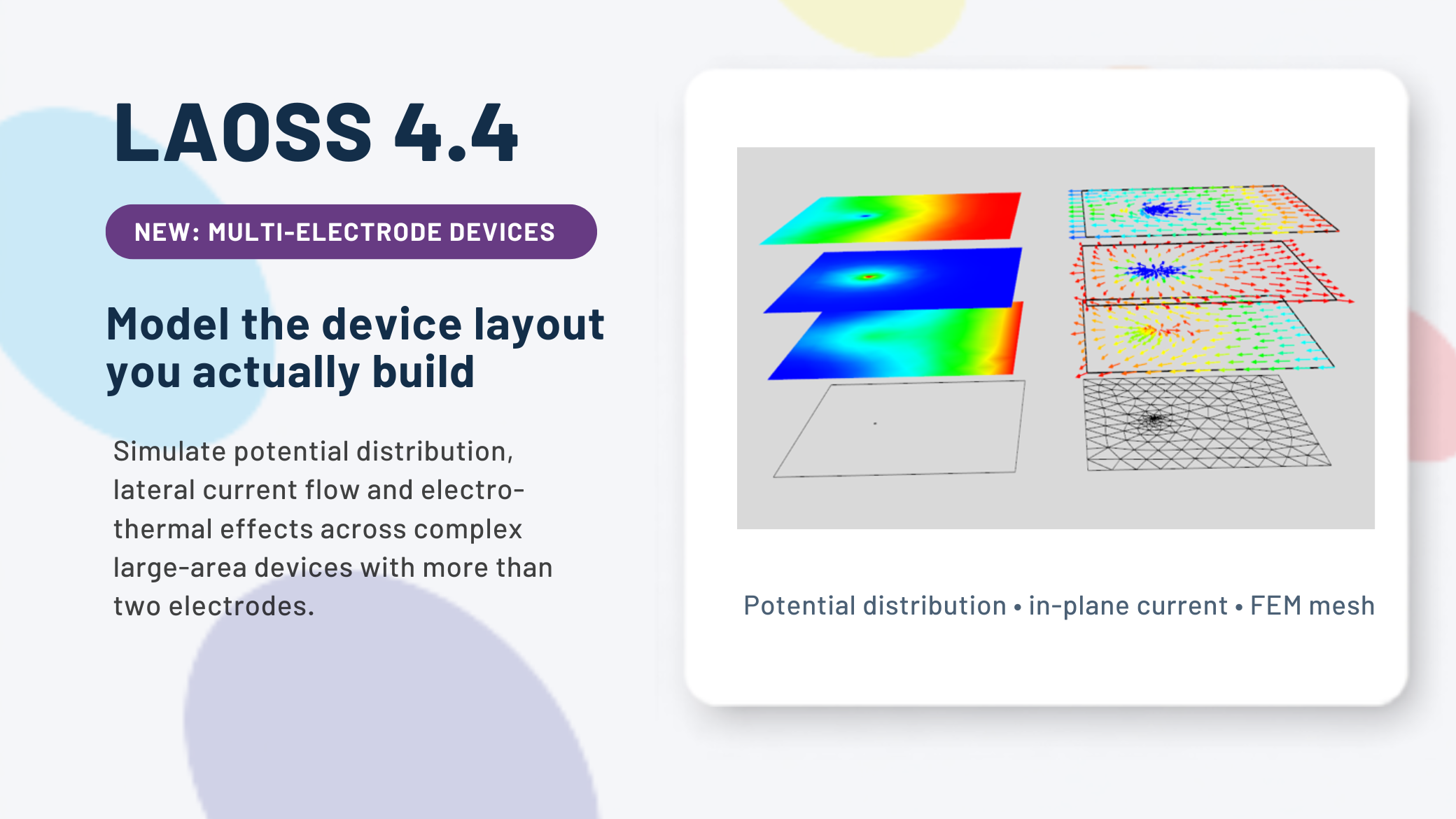
Moving from a small test cell to a large-area device brings new challenges. Electrode resistance, non-uniform current distribution and local defects can all affect performance in ways that are difficult to predict from measurements on small devices.
With Laoss 4.4, researchers can now simulate devices with more than two electrodes, making it possible to investigate more complex architectures, including tandem and multi-junction solar cells, segmented contacts and OLED panels.
The updated electrothermal model helps researchers understand how electrode conductivity, contact positions and local defects influence current flow, voltage distribution and device performance.
For example, in a tandem solar cell, Laoss can now model the intermediate electrode separately and investigate how its sheet resistance or a local shunt affects the overall device.
The aim is to identify potential performance losses before building the device.
Recent Customer Publications
It is always interesting to see how researchers are using our tools to investigate device physics and improve performance. Here are four recent publications covering OLED lifetime, perovskite X-ray detectors and semitransparent solar cells.
Can Magneto-Electroluminescence Predict Blue OLED Lifetime?
How can researchers estimate OLED lifetime without waiting for devices to degrade?
In a recent Nature Communications paper, Ji and colleagues investigated whether magneto-electroluminescence (magneto-EL) measurements could provide an early indication of operational lifetime in blue phosphorescent OLEDs.
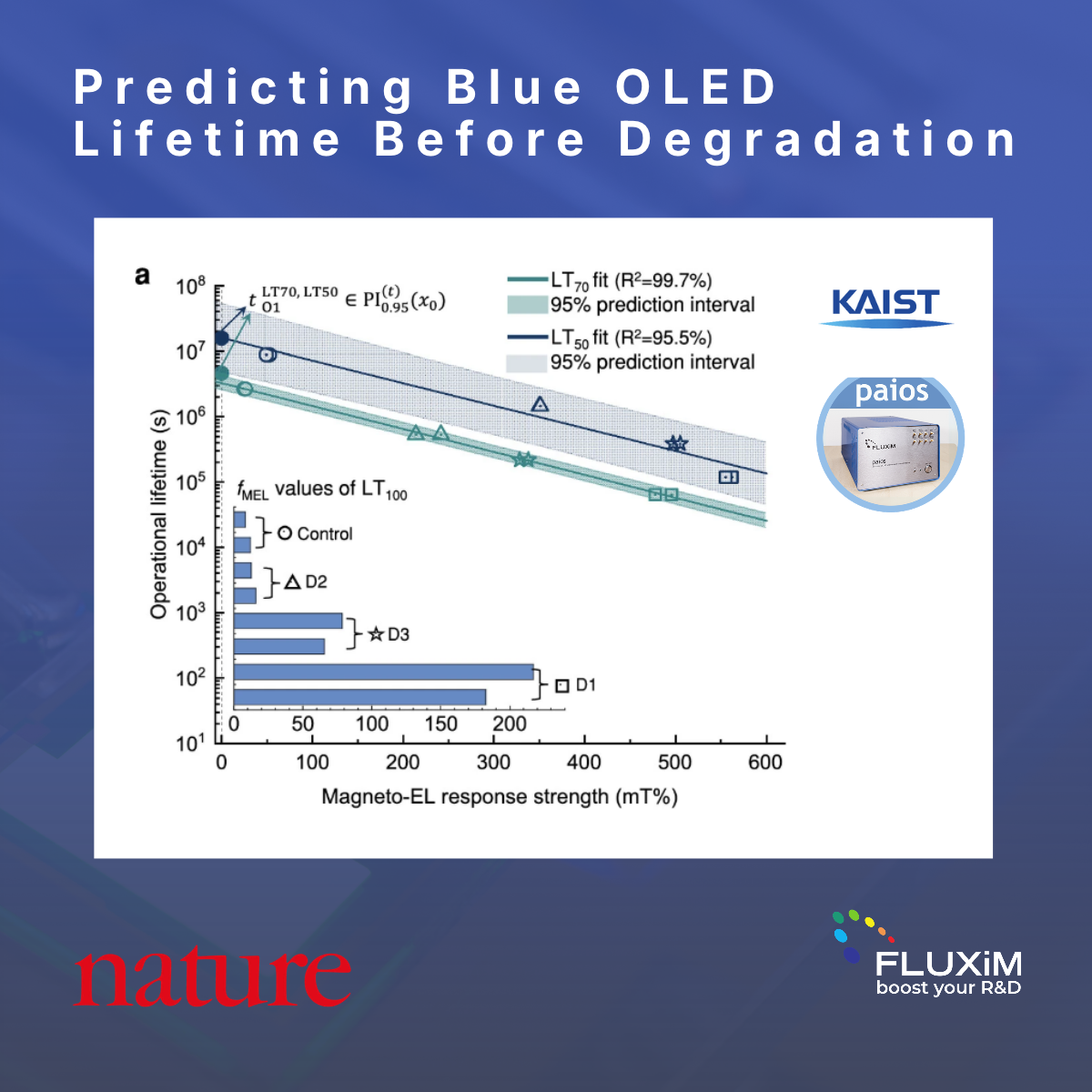
They found a strong correlation (R² > 0.95) between the magneto-EL response and the logarithm of device lifetime. Within the investigated devices, lower initial response values were associated with longer operational lifetimes.
The results suggest that magneto-EL could offer a useful non-destructive approach to assessing OLED stability before lengthy ageing tests.
The authors also acknowledge Fluxim's Moonkang Heo for technical assistance with Paios equipment. This is what we do at Fluxim, we don´t just supply products but we give world class support.
Ji et al., Nature Communications.
The three publications below come from the same research group at the Italian National Research Council (CNR-IMM), led by Alessandra Alberti and colleagues. What makes their work particularly interesting is the range of applications they investigate using Setfos, from perovskite X-ray detectors to semitransparent solar cells and agrivoltaics. Across these studies, Setfos helps the team better understand device physics, investigate performance limitations and explore new device designs. A good example of how simulation can support research across very different applications.
Setfos Helps Explain Ion Migration in Perovskite X-ray Detectors
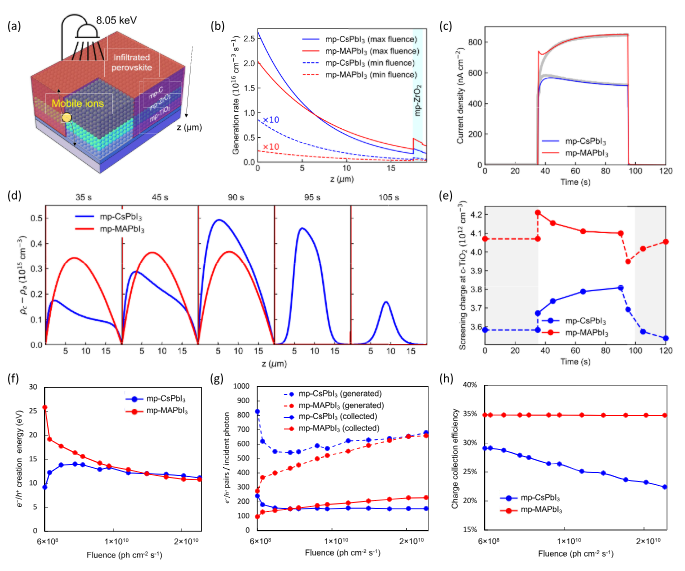
Researchers at CNR-IMM and INFN have developed self-powered perovskite X-ray detectors combining fast response with high radiation tolerance.
Their MAPbI₃-based detector achieved a response time of 3 ms and withstood a cumulative X-ray dose of 18,643 Gy over 17 hours under nitrogen without significant degradation.
Setfos was used to simulate charge transport, trapping and ion migration, helping explain differences in the electrical response of MAPbI₃ and CsPbI₃ detector structures.
The study highlights the potential of mesoporous perovskites for X-ray detection, while showing how simulation can help identify the underlying transport mechanisms.
Alberti et al., ACS Applied Electronic Materials.
Simulating 16.91% efficient semitransparent perovskite solar cells
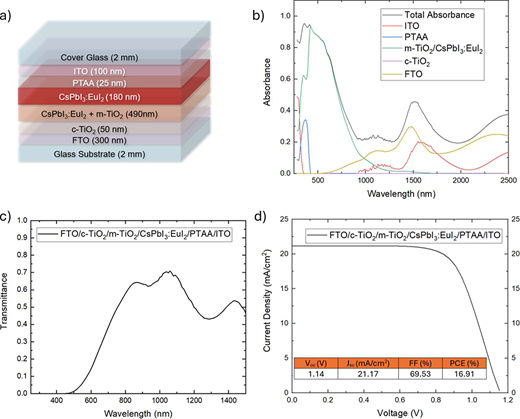
Semitransparent solar cells offer interesting opportunities for building-integrated photovoltaics and agrivoltaics, where both electricity generation and light transmission are important.
Researchers at CNR-IMM and the University of Messina investigated a semitransparent perovskite solar cell using a porous gig-lox TiO₂ electron transport layer.
Using Setfos, the team simulated the optical and electrical behaviour of the device, predicting a power conversion efficiency of 16.91% alongside 18% average visible transmittance.
The results demonstrate how optoelectronic simulation can help balance efficiency and transparency when designing semitransparent solar cells.
Spampinato et al., The Journal of Physical Chemistry C.
Semitransparent Perovskite Solar Cells for Agrivoltaics
Can solar cells generate electricity while still allowing enough light through for crops to grow?
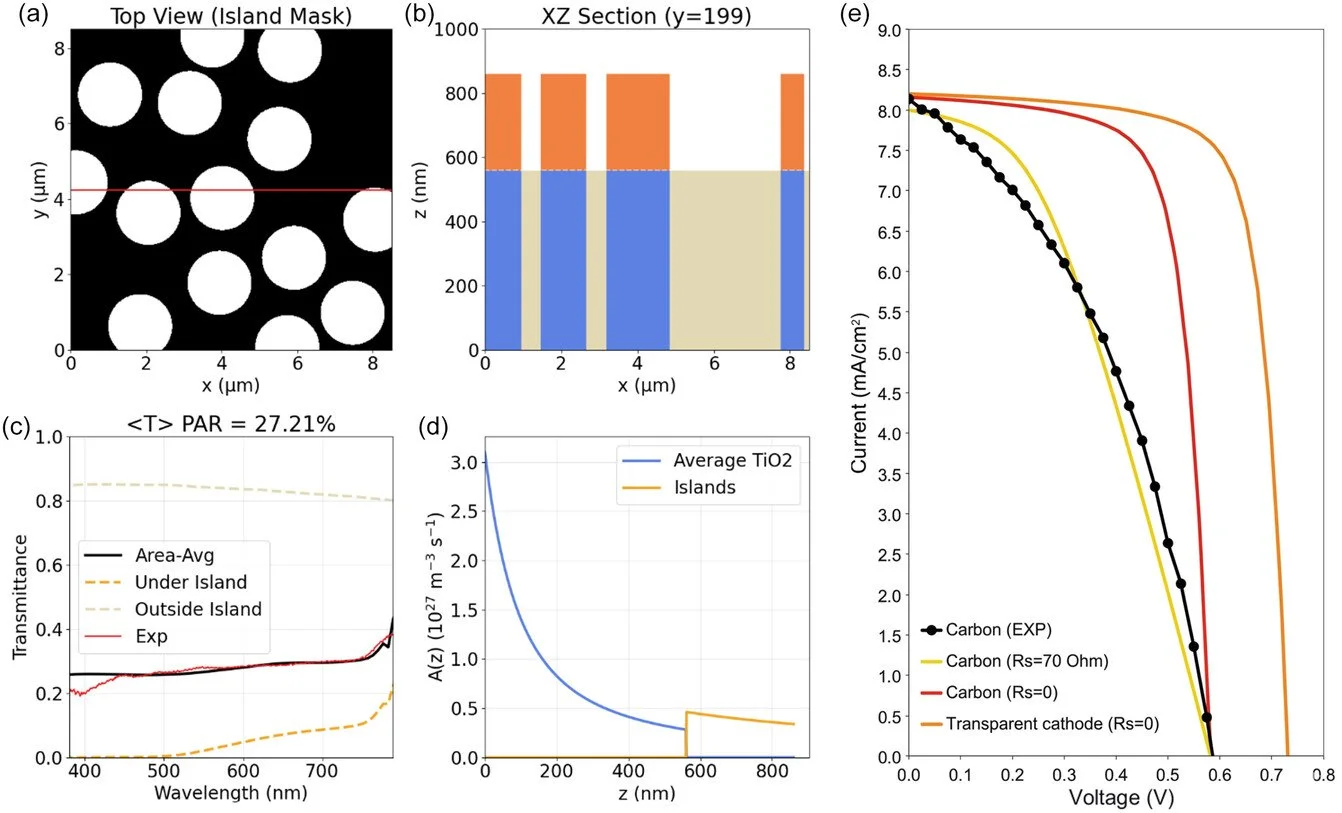
A recent study from the Italian National Research Council investigated quasi-neutral-colour semitransparent perovskite solar cells designed for agrivoltaic applications.
By combining a custom 3D optical model with Setfos drift-diffusion simulations, the researchers investigated how device structure and electrode properties affect performance.
Their experimental carbon-electrode test device achieved 1.94% efficiency, while simulations predicted up to 4.50% for a configuration with an ideal transparent electrode.
Initial plant-growth experiments also showed encouraging results, with no significant deterioration in lettuce growth or measured nutritional parameters under the tested conditions.
Valastro et al., Advanced Energy and Sustainability Research.
Meet Fluxim at WCPEC-9
15–20 November 2026 | Daejeon, South Korea
The 9th World Conference on Photovoltaic Energy Conversion (WCPEC-9) brings together the global PV research community to discuss advances in solar cell materials, device architectures, characterization and simulation.
Fluxim will be there, and we look forward to meeting researchers working on perovskite solar cells, tandem photovoltaics and device stability.
Invited talk by Prof. Beat Ruhstaller
Fluxim's Founder and CEO, Prof. Beat Ruhstaller, has been invited to present:
Advanced Characterization and Simulation of Perovskite Single-Junction and Tandem Solar Cells
Session 3-2: Perovskite Solar Cells & Modules — Advances in Scalability and Reliability.
Visit us at Booth W-25
Meet Beat and Moonkang Heo, together with our Korean distributor IS-Soft Co., Ltd.
We will have fully operational Litos Lite and Paios systems at the booth, giving visitors an opportunity to see our measurement and characterization tools in action.
Whether you are working on solar cell stability, ion migration, charge transport or tandem device optimization, come along to discuss your research and see how our tools could support your work.
Booth W-25 | 15–20 November | Daejeon, South Korea
Webinar 22: Hybrid Halide Perovskites
From Photovoltaic to Neuromorphic Computing
Tuesday, 17 November 2026 | 10:00–11:00 CET
For our 22nd Fluxim Research Webinar, we are pleased to welcome Dr. Mohammadreza Golobostanfard, Senior Researcher at the University of Turku, Finland.
Hybrid halide perovskites are attracting increasing interest beyond photovoltaics, particularly for applications in memristors and neuromorphic computing.
In this webinar, Dr. Golobostanfard will explore how these versatile materials are being investigated for applications ranging from solar energy conversion to emerging computing technologies.
His research covers perovskite solar cells, perovskite/silicon tandems, layered halide perovskites and memristors.
If you are working on perovskite materials, ion migration or emerging optoelectronic devices, this is an opportunity to explore how the same material systems are finding new applications.
Missed Our Latest Setfos Webinar?
Explore Advanced PV Simulation Workflows in Setfos 6.1
Recorded 30 October 2026
If you missed our recent Setfos 6.1 online workshop, the recording is now available.
The session demonstrates practical simulation workflows for researchers working on thin-film, perovskite, silicon and tandem solar cells. Topics include multiple light sources, bifacial PV, tandem EQE characterization, tunnelling, reverse-bias effects, parameter fitting and device loss analysis.
Through worked examples, including TOPCon silicon cells and perovskite tandems, the session shows how to set up models, optimize layer thicknesses and identify the optical and electrical losses that limit device performance.
Whether you are an experienced Setfos user or new to optoelectronic device simulation, the recording provides practical guidance and an introduction to some of the latest simulation capabilities.
Subtitles are available in Simplified Chinese, Korean and Japanese.
For a step-by-step guide to modelling ion migration and fitting ionic parameters using impedance spectroscopy, read the Setfos tutorial on ionic properties in perovskite solar cells mentioned during the demonstration.
Want to discuss your measurement or simulation workflow?
Working on OLEDs, perovskite solar cells, tandem PV, photodetectors or stability studies?
Send us a short description of your research challenge, and we will connect you with the right Fluxim specialist.
Contact: sales@fluxim.com