
Simulating self-heating, tunneling and multiple light sources in Setfos
Setfos is the optoelectronic device simulation software developed by Fluxim AG in Switzerland for OLEDs, solar cells, photodetectors and other thin film semiconductor devices. It combines thin film optics with drift-diffusion charge transport in a single model, so optical and electrical behavior are solved together rather than in separate tools. This page covers what Setfos can simulate today, from coupled thermal effects and tunneling to contact-free small signal characterization, and what is in development.
What Setfos simulates
Setfos is built from modules that can be combined freely. The absorption module handles coherent and incoherent thin-film optics, computes absorption profiles and layer specific absorption. Advanced optics adds scattering at textured interfaces and at particles, birefringence and quantum dot down conversion. The emission module covers spectral emission, mode analysis and optical quenching, so energy lost to evanescent, substrate guided and film guided modes can be quantified. Drift-diffusion is the most complex module, covering electronic charges, excitons, mobile ions, traps and recombination in steady state, AC and transient mode.
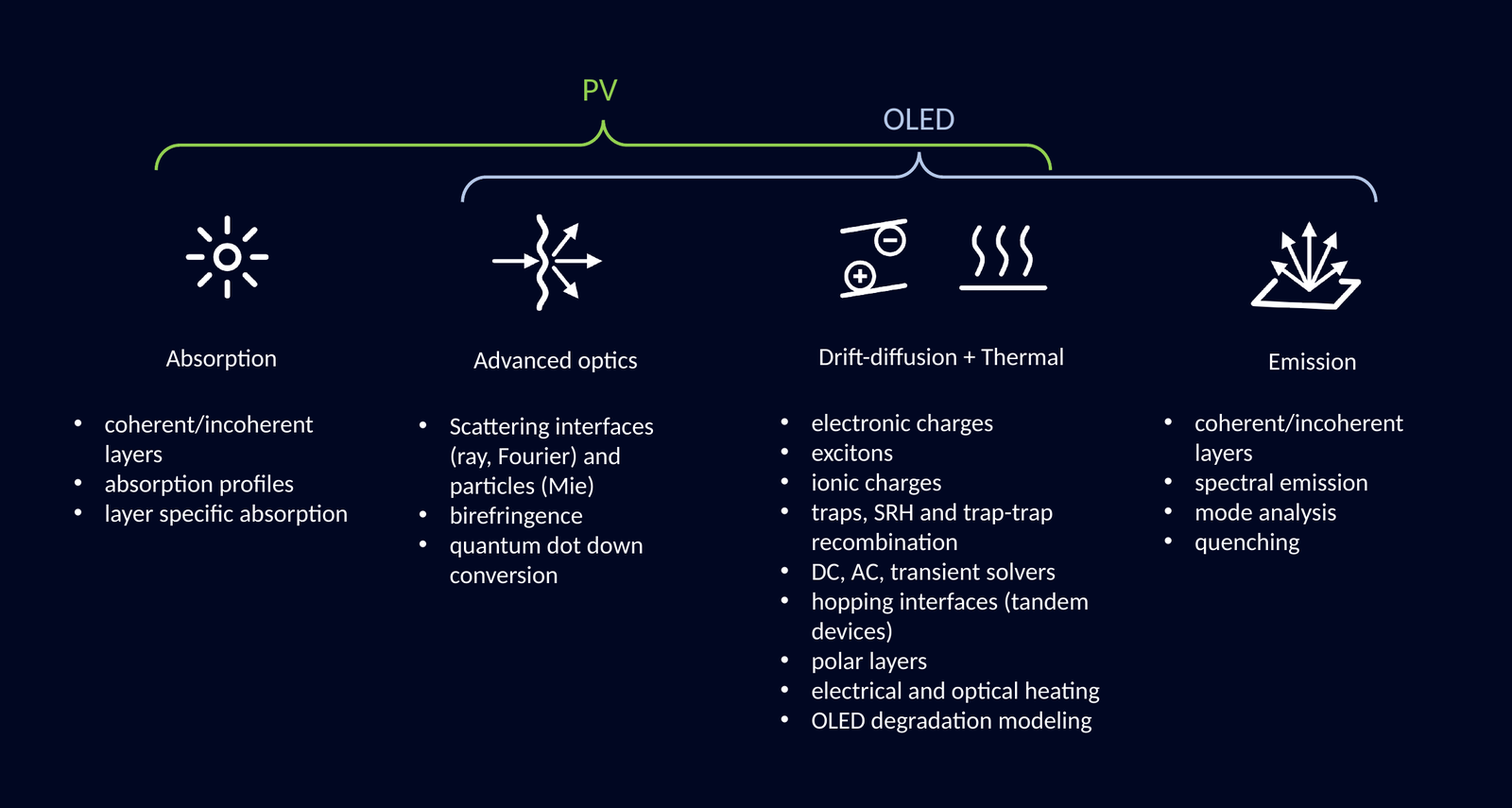
The Setfos modules and what each one solves. Optical and electrical modules can be combined freely in a single simulation.
Setfos simulation capabilities at a glance
Setfos combines optical, electrical and thermal models to investigate OLEDs, solar cells, photodetectors and other thin-film semiconductor devices. The table below summarizes its main simulation capabilities and research applications.
| Capability | What Setfos simulates | Research applications |
|---|---|---|
| Optical simulation | Thin-film absorption, emission, optical modes and light outcoupling. | OLEDs, solar cells and photodetectors. |
| Electrical simulation | Drift-diffusion, charge recombination, traps, excitons and mobile ions. | Device optimization and loss analysis. |
| OLED degradation | Defect generation, voltage rise and luminance decay over operating time. | OLED degradation mechanisms and lifetime studies. |
| Thermal simulation | Heat generation, heat transport and coupled electro-thermal effects. | OLED self-heating and thermal device behaviour. |
| Tunneling | Band-to-band, intra-band and trap-assisted tunneling. | TOPCon solar cells and semiconductor tunnel junctions. |
| Multiple light sources | Independent illumination spectra, incident angles and diffuse fractions. | Bifacial, tandem and indoor photovoltaics. |
| IMPLS | Modulated photoluminescence amplitude and phase. | Contact-free characterization and exciton-quenching studies. |
Setfos runs on Windows, macOS and Linux. Every action in the user interface is mirrored in a synchronized simulation script, so a simulation can be set up in the interface, driven from a script, or written by a large language model and passed straight to the simulation kernel.
Multiple light sources for bifacial and indoor PV
Since Setfos 6.1 a simulation can define as many light sources as needed, each with its own spectral intensity, incident angle and diffuse fraction, all sweepable and optimizable. Earlier versions assumed a single source, typically the sun. That makes bifacial solar cells, realistic indoor lighting scenarios with several lamps, and tandem EQE characterization straightforward. Sources can also be addressed individually in transient and IMPS or IMVS simulations, so a steady background illumination can be combined with a pulsed source at a different wavelength and angle.
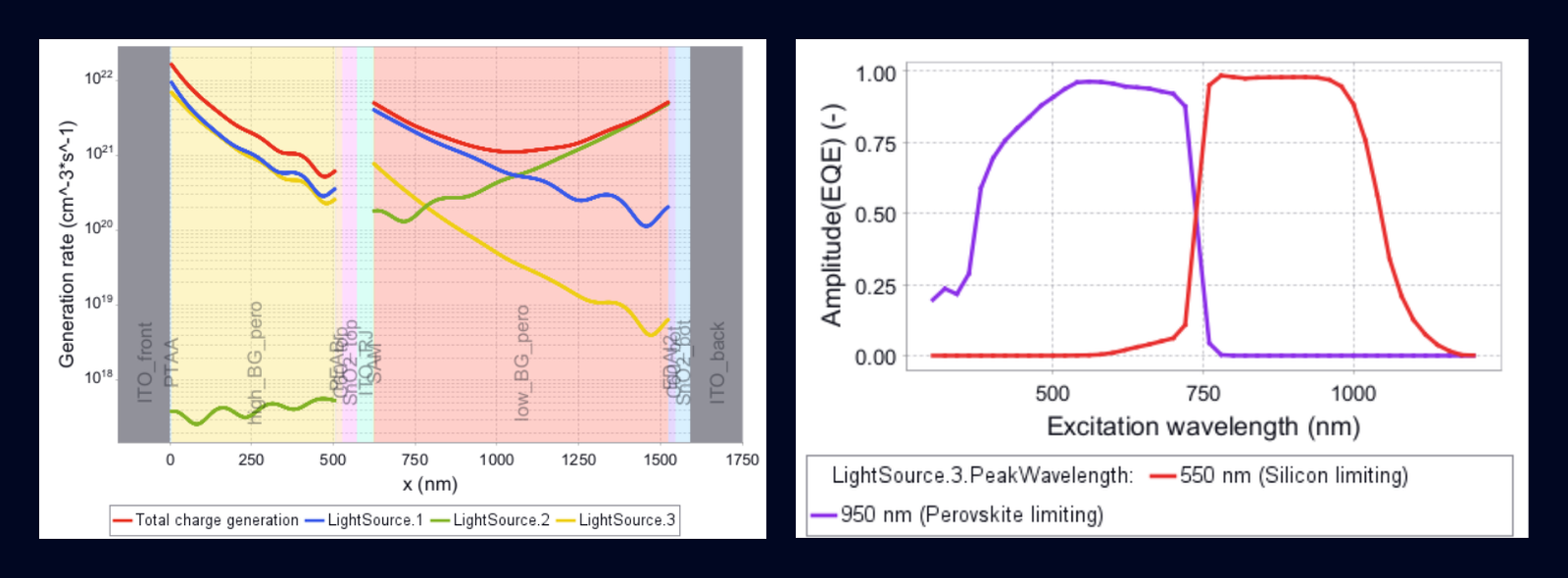
Left, charge generation resolved per light source across a tandem stack. Right, simulated tandem EQE with the bias light set to make one or the other sub-cell limiting.
Working on tandem or bifacial solar cells?
Explore optical and electrical simulation, including multiple illumination sources and tunneling models, for your photovoltaic research.
Request a Free Trial →Tunneling and TOPCon solar cells
Setfos covers three tunneling mechanisms: band-to-band tunneling, intra-band tunneling within the same band, and trap-assisted tunneling. Together they allow simulation of devices whose performance depends on tunneling rather than on drift and diffusion alone. The tunnel oxide passivated contact (TOPCon) silicon solar cell is the reference case, where a thin oxide suppresses surface recombination while still allowing selective carrier transport. A ready-made example, TOPCon.parx, ships with the software.
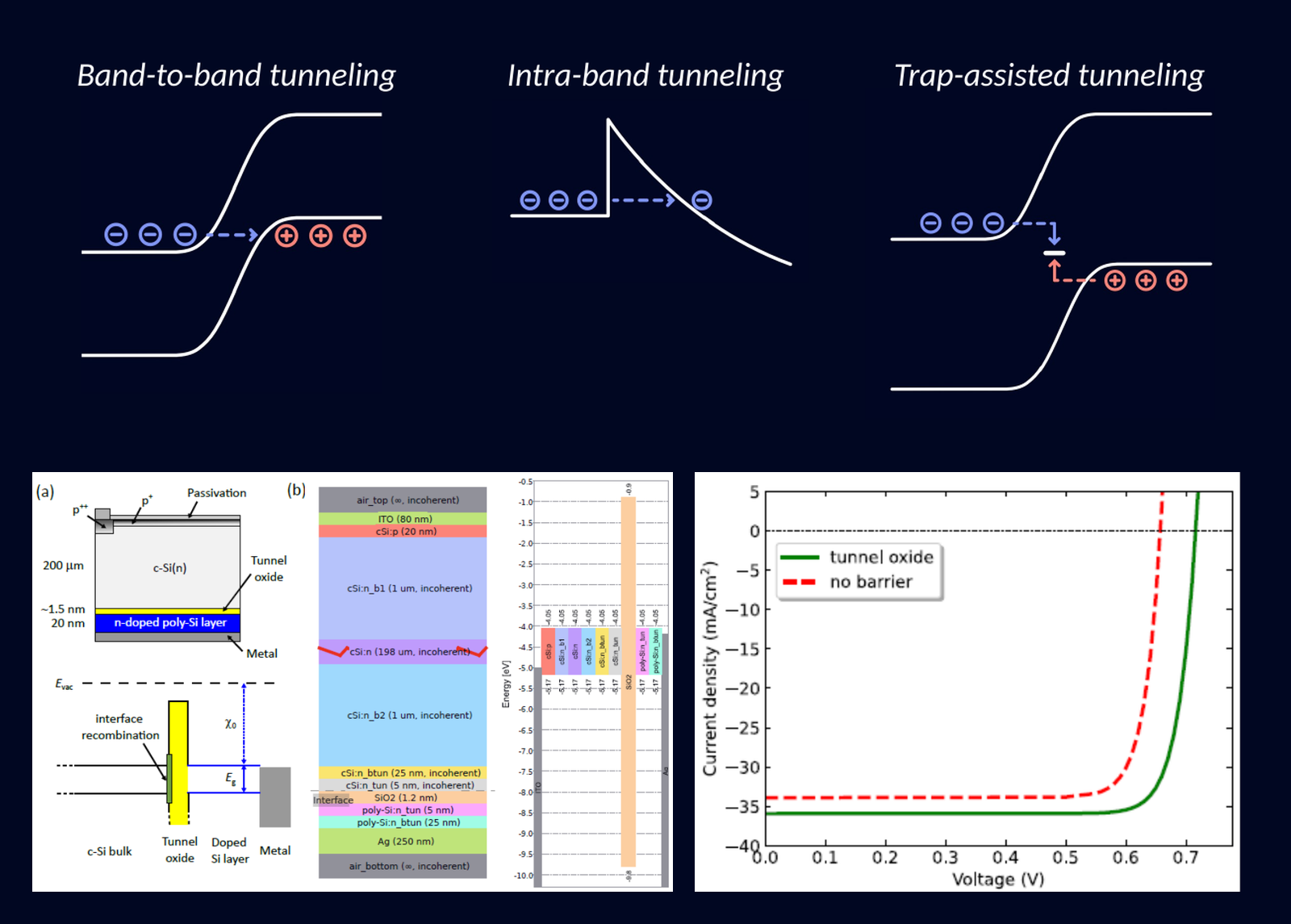
Top, the three tunneling mechanisms Setfos solves. Bottom left, the TOPCon structure and its simulated energy levels. Bottom right, simulated JV curves with and without the tunnel oxide barrier.
Self-heating and coupled thermal simulation
The thermal module solves the heat equation self-consistently with the drift-diffusion equations, so local heating feeds back into the electrical characteristics instead of being estimated afterwards. It covers optical heating, Joule heating and the Thomson-Peltier effect in steady state, AC and transient mode, and also runs stand-alone for pure heat transport studies. Typical uses are self-heating in pulsed OLEDs, the negative capacitance seen at high driving voltage, thermal runaway, heat generation in solar cells and thermoelectric devices.
OLED degradation modeling
The OLED degradation model reproduces the voltage rise under constant current drive and the matching luminance decay. Degradation is modeled as the local generation of defects over operating time, with trap formation coupled to excitonic processes such as triplet-triplet annihilation and triplet-polaron quenching. Beyond the measurable observables, it exposes recombination profiles, trap densities and the radiative to non-radiative ratio, showing why a device degrades rather than only that it does.
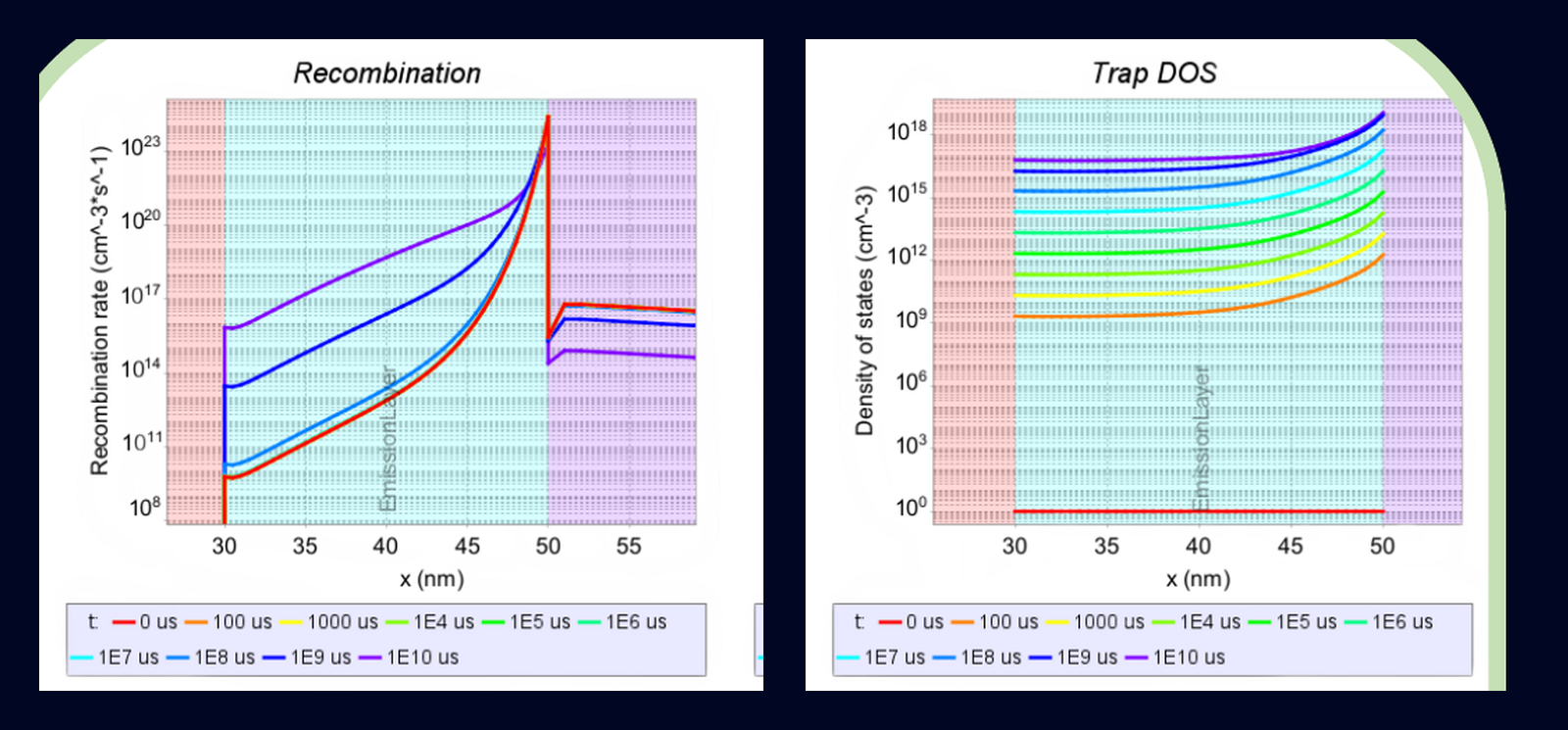
Recombination rate and trap density of states across the emission layer as operating time increases. The rising trap density is what drives the luminance decay.
Simulating OLED degradation or self-heating?
Investigate how charge transport, thermal effects and degradation mechanisms affect OLED performance. Explore Setfos simulation capabilities for your research with a free trial.
Request a Free Trial →IMPLS for contact-free characterization
IMPLS, intensity modulated photoluminescence spectroscopy, completes the small signal matrix alongside impedance, admittance, IMPS and IMVS. Small signal light goes in, a small signal photoluminescence signal comes out, and phase and amplitude carry the physics. It serves as a contact-free alternative to IMPS and IMVS for solar cell characterization, and as a way to analyze exciton quenching in OLEDs. Measured OLED data matched simulation and confirmed that photoluminescence quenching at higher bias comes from triplet-polaron quenching. On perovskite films, the simulated phase shift proves sensitive to mobile ion mobility without contacting the film at all.
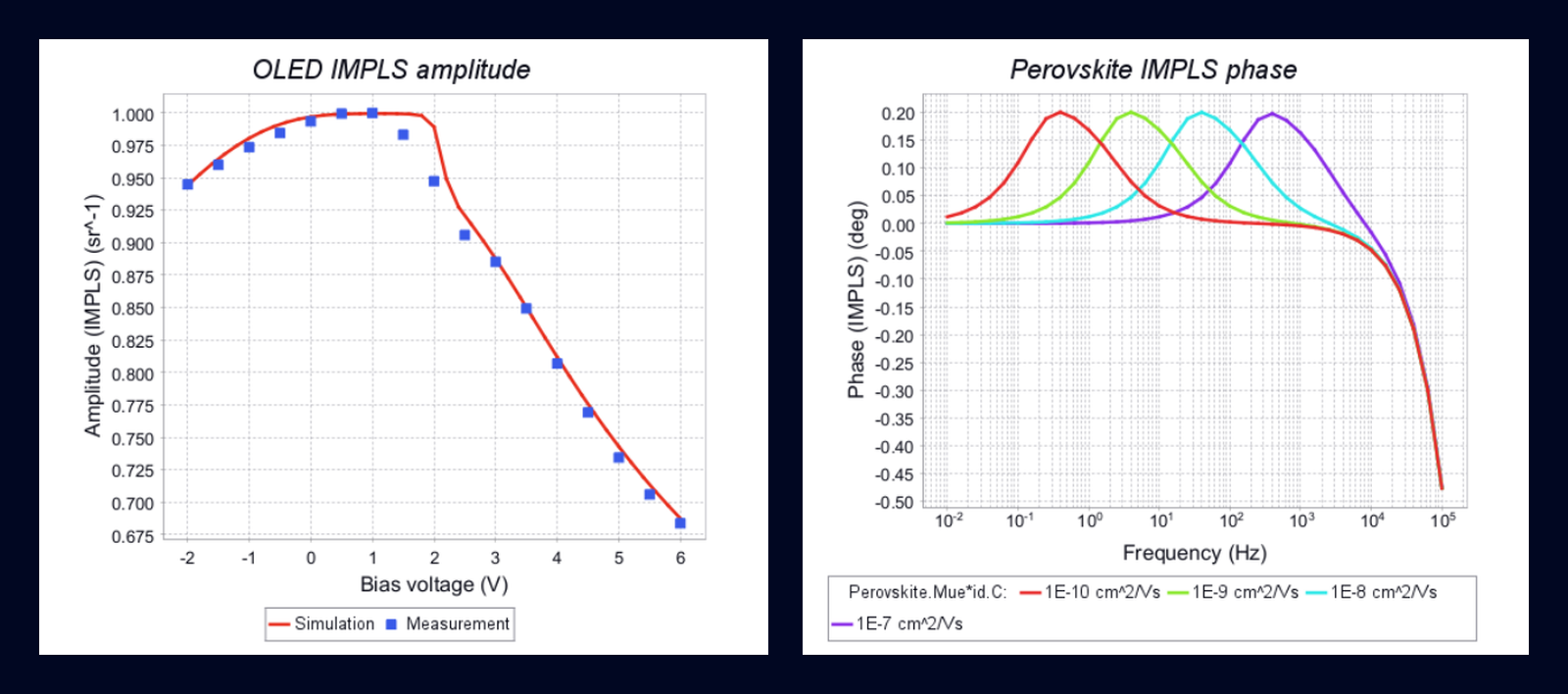
Left, IMPLS amplitude against bias voltage for an OLED, simulation against measurement. Right, simulated IMPLS phase for a perovskite film at four different mobile ion mobilities.
Interested in IMPLS simulation?
Explore how Setfos can help you model intensity-modulated photoluminescence measurements and investigate your device's response. Evaluate Setfos for your research with a free trial.
Request a Free Trial →Material parameters inside the software
A material database runs as an application inside Setfos. Search and filter refractive index datasets by material class or tag, sort by refractive index, then drag and drop a dataset straight onto a layer in the stack. New parameter sets published by Fluxim download automatically, and you can tag and manage your own datasets alongside them, which removes a large part of the manual literature work that normally precedes a simulation.
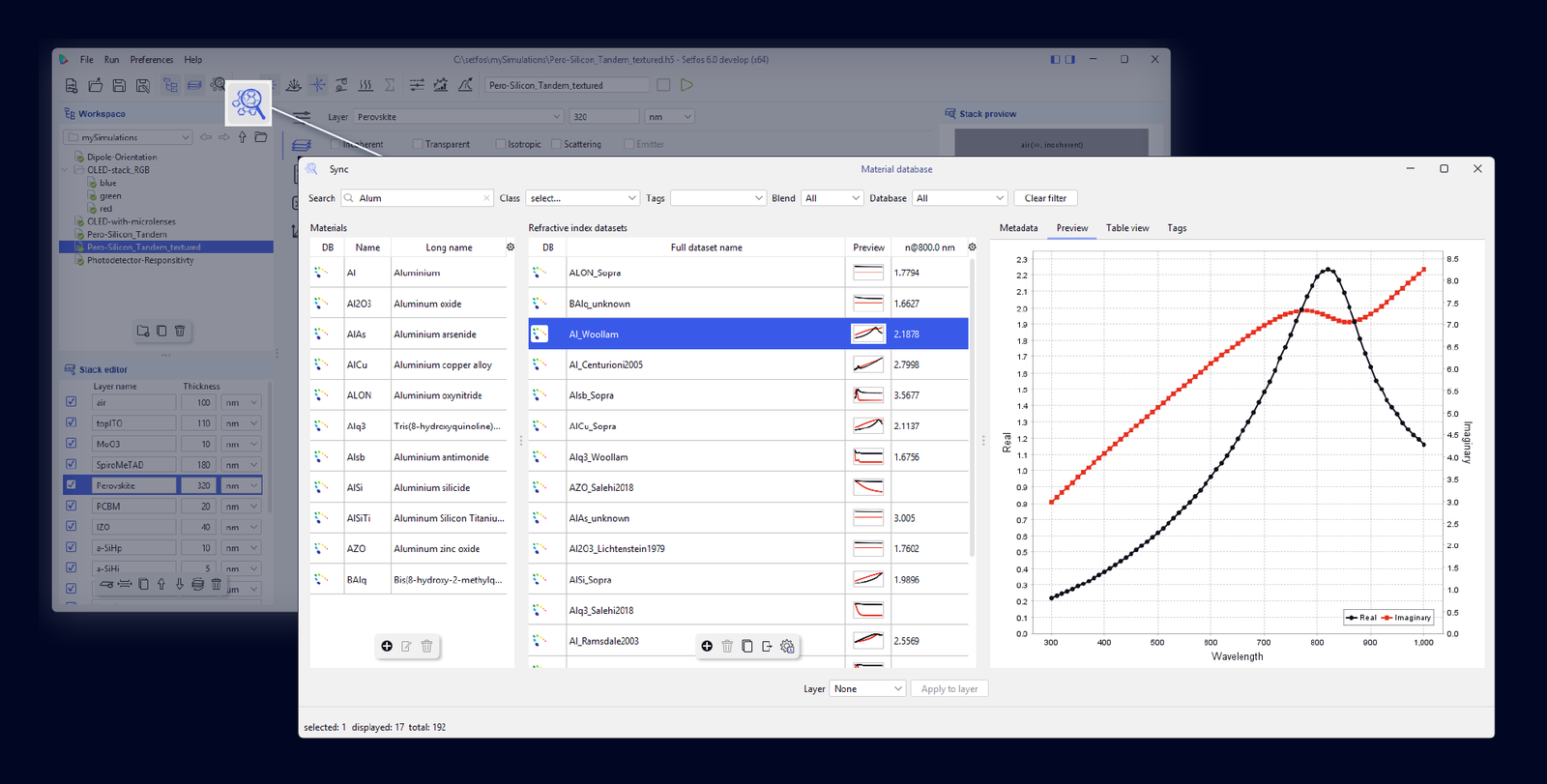
The material database inside Setfos. Filter by class or tag, compare refractive index, preview n and k, then drag a dataset onto a layer.
Frequently asked questions
What is Setfos used for
Setfos simulates thin film optoelectronic devices. It is used for OLEDs, organic and perovskite solar cells, tandem and inorganic photovoltaics, photodetectors and general semiconductor device studies, combining optical and electrical physics in one model.
Which operating systems does Setfos run on
Setfos runs on Windows, macOS and Linux. It is designed to be fast, flexible and platform independent, so it runs on a standard laptop.
Can Setfos simulate bifacial solar cells
Yes. Since Setfos 6.1 an unlimited number of light sources can be defined, each with its own spectral intensity, incident angle and diffuse light fraction, which is what bifacial solar cell simulation requires. The same capability covers indoor photovoltaics with several lamps.
Can Setfos model self-heating in OLEDs
Yes. The thermal module solves the heat equation self-consistently with the drift-diffusion equations, capturing self-heating in pulsed OLED operation, its effect on effective capacitance and thermal runaway. It supports steady state, AC and transient simulation.
Which tunneling mechanisms does Setfos support
Setfos supports three tunneling mechanisms: band-to-band tunneling, intra-band tunneling within the same band, and trap-assisted tunneling. Together they allow simulation of devices such as TOPCon silicon solar cells whose performance depends on a tunnel oxide layer.
What is IMPLS and why does it matter
IMPLS stands for intensity modulated photoluminescence spectroscopy. A small signal modulated light source excites the device and the modulated photoluminescence is detected, giving phase and amplitude spectra. Because no electrical contact is needed, IMPLS characterizes solar cell films and perovskite layers that cannot easily be contacted, and it resolves exciton quenching mechanisms in OLEDs.
Can Setfos be driven by a script or by an AI assistant
Yes. Every action in the Setfos user interface is mirrored in a synchronized simulation script. That script can be written by a large language model and run directly through the simulation kernel without opening the interface.
Does Setfos include material parameter data
Setfos includes a built-in material database of refractive index datasets that can be searched, filtered, tagged and dragged onto a layer, with automatic download of new datasets published by Fluxim.
Setfos in published research
Researchers use Setfos to simulate optoelectronic devices and investigate their underlying physical mechanisms. The following peer-reviewed publications demonstrate applications in OLED degradation and perovskite solar-cell research.
Drift-diffusion modeling of blue OLED degradation
This study uses Setfos to model blue OLED degradation caused by exciton-polaron annihilation. It compares drift-diffusion modelling with a rate-equation approach and investigates how defect formation in different device layers influences luminance loss and voltage rise.
Setfos capabilities demonstrated:
Drift-diffusion, OLED degradation,
exciton-polaron annihilation and
layer-resolved defect modelling.
Evidence for localized trap formation during TADF OLED degradation
This study combines experimental measurements and device simulations to investigate degradation mechanisms in TADF OLEDs.
The researchers examine trap formation at the interface between the hole-transport and emissive layers and its contribution to OLED efficiency loss.
Setfos capabilities demonstrated:
OLED degradation modelling, charge transport,
trap formation and comparison with
experimental measurements.
Ion-induced field screening as a dominant factor in perovskite solar cell operational stability
This study investigates the influence of mobile ions on the operational stability of perovskite solar cells.
Setfos simulations contribute to the analysis of internal electric fields and charge extraction, helping explain performance losses associated with ionic effects.
Setfos capabilities demonstrated:
Drift-diffusion, mobile-ion modelling
and perovskite solar-cell simulation.
Explore more Setfos research publications →
Can Setfos simulate your device?
Explore how Setfos can support your research in OLEDs, solar cells and other optoelectronic devices. Evaluate its optical, electrical and thermal simulation capabilities with a free trial.
Request a Free Trial →