
Setfos 6.1 is here with multiple light sources and IMPLS
What is new in 6.1
Multiple light sources
IMPLS simulation
Trap-assisted tunneling
More optical outputs
Drift-diffusion refinements
Faster fitting and optimization workflows
Examples
The Setfos 6.1 slide deck
Seven new tutorial examples
Getting the release
How to get Setfos 6.1
System requirements
Background And everything you already rely on
New release
Setfos 6.1 is here, and there is a lot in it. Several light sources in a single simulation, so bifacial cells and indoor lighting are no longer a workaround. IMPLS, for when you want to characterize a device without contacting it. And the Hurkx model, which rounds out the tunneling options.
Seven new tutorial examples come with it, covering bifacial all-perovskite tandems, TOPCon cells, GaAs tunnel junctions and J–V loss analysis, among others.
If your licence is current, you can update directly from Setfos in just a few clicks.

Getting Setfos 6.1
Help > Check for new version
Email us →
Request a trial →
What is new in 6.1
Multiple light sources
Setfos 6.1 lets you define multiple light sources, each with its own spectral intensity, incident angle and diffuse-light contribution, independently incident from the top or bottom. This enables simulations of bifacial solar cells, realistic indoor-PV illumination environments and advanced tandem characterization, including tandem EQE.
Light-source parameters can be swept and optimized, and individual sources can be controlled in transient, IMPS and IMVS simulations. A parametrized Gaussian illumination spectrum is also included.
IMPLS simulation
Intensity-modulated photoluminescence spectroscopy (IMPLS) is now available in Setfos. The contact-free technique complements IMPS and IMVS for investigating solar-cell dynamics and can also be used to analyze exciton quenching in OLEDs. It is supported in the coupled absorption–drift-diffusion–emission workflow.
Trap-assisted tunneling
The Hurkx model for trap-assisted tunneling has been added alongside Setfos' existing band-to-band and intra-band tunneling models. The new GaAs tunnel-junction tutorial demonstrates its application.
More optical outputs
Emission simulations now post-process angular color shift and CIE XYZ tristimulus values. Absorption simulations output the normalized parallel component of the electric field, providing insight into thin-film interference and electromagnetic-field penetration through the stack. PL quantum yield is available as an output for coupled AB-EM and AB-DD-EM simulations.
Drift-diffusion refinements
The bimolecular recombination law is extended with a user-defined exponent. Drift and diffusion current contributions can be output individually. The degradation model accepts a saturation limit on the number of generated defects.
Faster fitting and optimization workflows
Optimization target groups can now be duplicated, reducing repetitive setup when creating comparable fits.
Feature highlights
The Setfos 6.1 slide deck
Eight slides covering the new light-source definitions, IMPLS, tunneling models and optical outputs, together with the relevant plots and screenshots.
Seven new tutorial examples
Every example is included with the software, ready to open and run. Section numbers refer to the Setfos 6.1 tutorial document.
| Intensity-modulated PL spectroscopy of an OLED fullOLED-IMPLS.parx |
§ 8.11 |
| Intensity-modulated PL spectroscopy of a perovskite film Perovskite-IMPLS.parx |
§ 3.3 |
| EQE of a perovskite-silicon tandem solar cell Tandem-perovskite-silicon-EQE.parx |
§ 3.4.10 |
| Bifacial all-perovskite tandem Bifacial-all-perovskite-tandem.parx |
§ 3.4.11 |
| J–V loss analysis of an all-perovskite tandem all-perovskite-tandem-JV-loss-analysis.parx |
§ 3.5.1 |
| Tunnel oxide passivated contact solar cells TOPCon.parx |
§ 7.5.1 |
| Doping-induced tunnel junctions for III-V tandem solar cells GaAs-tunnel-junction.parx |
§ 7.5.2 |
How to get Setfos 6.1
Current Setfos licence
Update from inside Setfos
Start Setfos and select Help > Check for new version. If your licence covers Setfos 6.1, you can update directly from there.
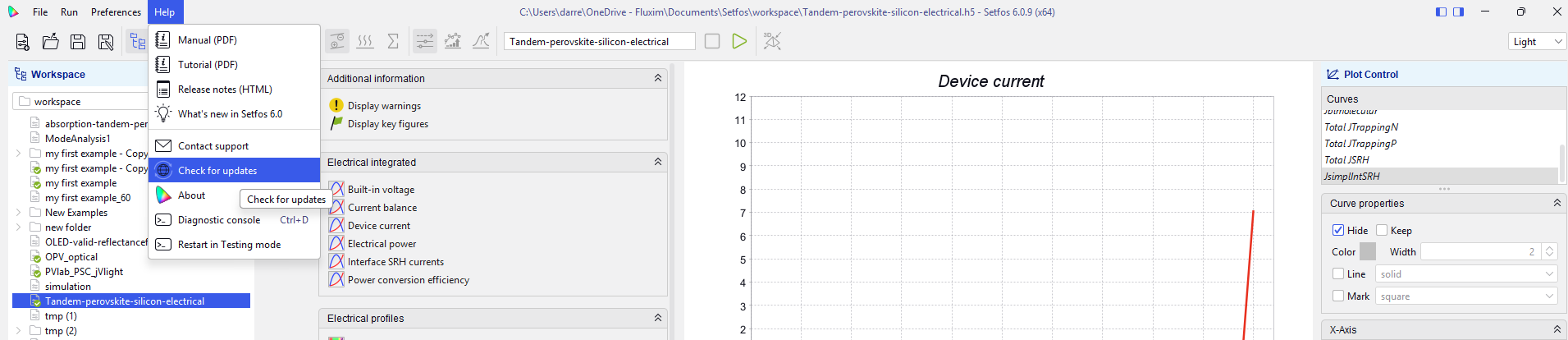
No upgrades available on your Setfos
Talk to us about upgrading
If your version of Setfos does not offer version 6.1, email us and we will check your licence and explain the available upgrade options.
New to Setfos
Request a free trial licence
Evaluate Setfos 6.1 on your own device architecture with a free one-month trial. Run the bifacial tandem, IMPLS and tunnel-junction examples, or build your own device with support from our application scientists.
Setfos 6.1 runs on Windows 11 and Windows 10 (64-bit), Linux (64-bit), and macOS 11 or newer on Intel or Apple Silicon. A Gemalto/Sentinel USB dongle is required.
And everything you already rely on
Setfos has more than two decades of development behind it, while Fluxim's research tools have been used in over 600 scientific publications.
Five modules
Absorption, emission, advanced optics, drift-diffusion and thermal.
Fitting and optimization built in
Extract physical parameters from measured DC, AC and transient data, then optimize the stack automatically.
Real device physics
Mobile ions, arbitrary trap distributions per layer, SRH, radiative and Auger recombination, injection barriers, excitons, quenching and degradation over time.
Pairs with your measurements
Combine Setfos with measurement data from Paios, Phelos and Litos, and transfer optical simulation results to Laoss for large-area and module-scale simulations.
Questions about Setfos 6.1? Write to info@fluxim.com and one of our researchers will help you get started.
The Fluxim Team
Frequently asked questions
Is the Setfos 6.1 upgrade free
If your licence covers this release, yes. Open Setfos and select Help > Check for new version, and 6.1 will be offered to you. If it is not offered, your licence does not cover 6.1 and you should email sales@fluxim.com to discuss the available upgrade options.
What is IMPLS and how does it differ from IMPS and IMVS
IMPLS stands for intensity-modulated photoluminescence spectroscopy. It measures the photoluminescence response to modulated illumination, whereas IMPS measures photocurrent and IMVS measures photovoltage. Because IMPLS requires no electrical contacts, it can be applied to a film that is not yet a complete device. In light-emitting devices it gives access to exciton quenching.
Can Setfos simulate bifacial solar cells
Yes. Setfos 6.1 allows multiple light sources to be defined independently incident from the top or bottom of the stack, each with its own spectral intensity, incident angle and diffuse-light contribution. A bifacial all-perovskite tandem is included as tutorial example 3.4.11.
What is the Hurkx model
The Hurkx model describes trap-assisted tunneling, where carriers recombine through defect states with the assistance of a high electric field. In Setfos 6.1 it joins Setfos' existing band-to-band and intra-band tunneling models.
Which operating systems does Setfos 6.1 support
Windows 11 and Windows 10 in 64-bit, Linux in 64-bit, and macOS 11 or newer on both Intel and Apple Silicon. A Gemalto/Sentinel USB dongle is required.