
Stability testing needs more than a few devices. With a single SMU or basic MPP tracker, you measure only one device with the first and have no control of the atmosphere with the other. A common pitfall of both is non-compliance with ISOS protocols.
For many labs, the challenge is not only measuring performance loss. It is building a stability workflow that is reproducible, scalable and matched to the device type. Solar cells, OLEDs and LEDs all degrade under different stress conditions, but they share the same basic need: controlled testing across enough samples to make the results meaningful.
This is where Fluxim's stability platforms fit into the workflow.
For PV researchers working on perovskite and organic devices, Litos Lite runs parallel JV, MPP tracking and ISOS protocol-compliant stressing on up to 56 devices at once — so you get statistics, not anecdotes.
For PV, OLED, LED and broader optoelectronic device researchers, Litos provides controlled lifetime testing for degradation analysis under electrical, optical and thermal stress.
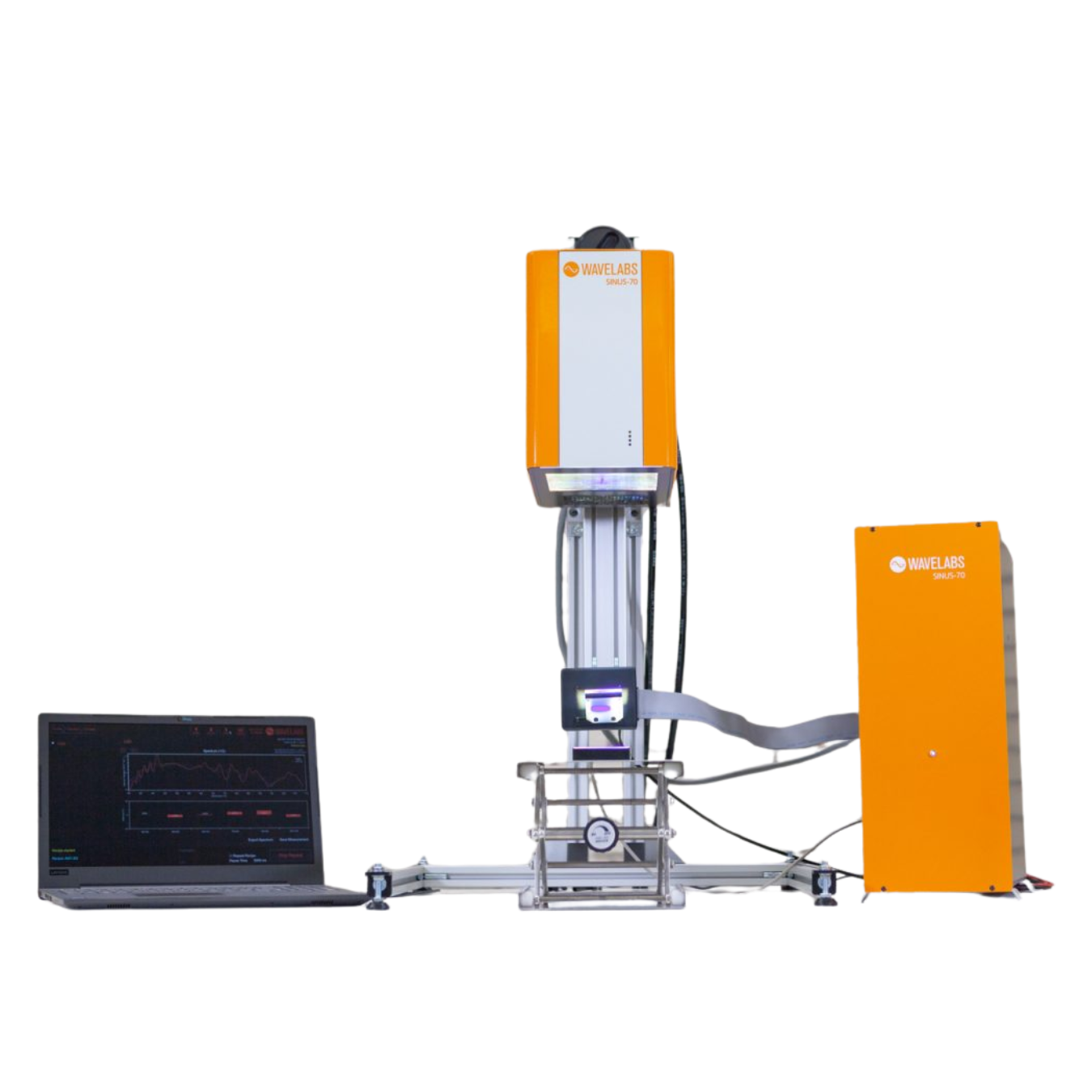
Solar Simulator offer
Wavelabs Sinus 70 Advanced available: plug-and-play with Litos Lite and SPM. €34,000 instead of €41,000.
Parallel JV and ISOS stability testing with Litos Lite
Parallel ageing with Litos Lite reduces the need for repeated manual switching on a single SMU. Devices can be stressed and measured under comparable conditions, helping you build larger datasets and separate real degradation trends from device-to-device variation.

Litos Lite runs parallel ageing experiments on up to 56 devices at once under identical, controlled conditions. Built for perovskite, perovskite/silicon tandem and organic solar cells, it combines JV scans, MPP tracking and stability stressing in one workflow, from early material screening to long-term operational stability testing.
Up to 56 independent channels (±9.5 V, up to 50 mA each); per-device MPP, constant-V or constant-I stressing
Up to 16 perovskite/silicon tandems,
up to 4 mini-modules at 400 mA and ±19 V - including 4-wire sensing option
Peltier temperature control 25–85 °C with cycling; N₂-flushable, glovebox-compatible holders with built-in T/RH sensors
Custom sample holders matched to your exact device layout
How the SPM software runs your campaign
Why professional, software matters: less manual setup, reproducible measurement routines, and ISOS-labelled plots straight out of the software.
The Suite for Parallel Measurement (SPM) is the dedicated software environment for Litos Lite. It supports the full workflow — sample definition, automated setup, live monitoring, analysis and export — so a measurement becomes a reproducible experiment rather than a manual routine.
Pre-loaded ISOS protocol measurements
Measurement cycling: loop runs, sweep temperature and JV scan rate, set stress conditions per device
Python API to embed third-party hardware — a shutter, hotplate or your own light source
Adjustable perturb-and-observe MPP tracking, with CSV / JSON export
Upgrade options for existing Litos Lite users
Already using Litos Lite? Many existing systems can be upgraded with new sample-holder options, and some installations can also benefit from the latest SPM software improvements.
Recent updates include a redesigned GUI, a Python step for integrating external hardware into measurement routines, and more customizable MPP tracking settings. This can help older Litos Lite setups support more flexible, automated and reproducible stability-testing workflows.

Want to know what is possible with your current or planned Litos Lite setup? Talk to Dr. Antonio Cabas Vidani, Product Manager of Litos Lite, about sample-holder options, SPM software improvements and possible upgrade paths.
Discuss your Litos Lite setup →This opens an email to sales@fluxim.com.
Trusted by leading PV labs
These groups use Litos Lite to generate the operational-stability data behind their publications.
Litos Lite is in active use at Stanford, Georgia Tech, the University of Pavia, CSIC, Tampere, MIT, Princeton, and the University of Queensland, and is cited in Joule, Matter, Advanced Energy Materials and other journals.

"Litos Lite has been highly valuable for systematic stability testing and parallel JV/MPP tracking under controlled conditions. Its compatibility with standardized ISOS protocols allows for meaningful lifetime analysis across multiple devices, which is critical in our studies on device degradation and operational stability."
Prof. Paola Vivo, Tampere University, Finland (2 x Litos Lite with Sinus 70)
"We are saving hours of work by measuring many samples at one time. We had no time to build our own setup — so this was a great purchase."
Prof. Juan-Pablo Correa-Baena, Georgia Tech (Litos Lite with Sinus 70)
"A great choice for my lab for monitoring the stability of our perovskite solar cells under different conditions. Great communication with Fluxim for installation, training and support. Highly recommended."
Prof. Giulia Grancini, University of Pavia (Litos Lite with Sinus 70)
Limited offer: Wavelabs Sinus 70 Advanced solar simulator
We have a single Wavelabs Sinus 70 Advanced available from stock, ready to ship. Litos Lite is pre-configured to control it through SPM, and an LED source holds its spectrum steady across a long stability run — no Xenon bulbs, no mid-experiment drift. The same pairing is in use with Litos Lite at many of our customer labs including the University of Pavia, Georgia Tech, Tampere, MIT, Stanford. If you are interested, be quick, there is only one available.
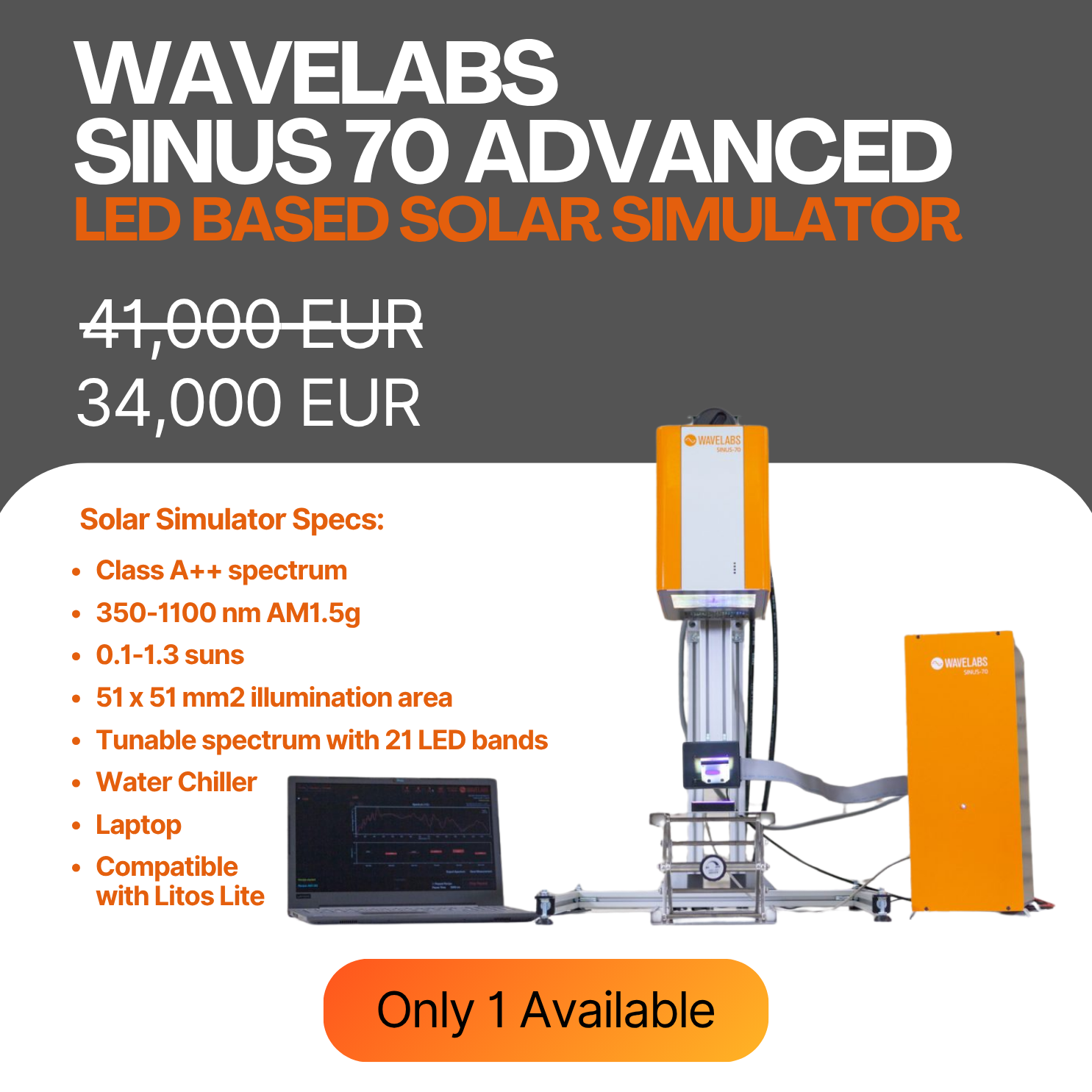
Litos for OLED, LED and solar-cell degradation studies
Why it matters: not every stability workflow is only about high-throughput PV testing. OLEDs, LEDs and mixed optoelectronic devices also need controlled ageing experiments to understand degradation mechanisms.

Litos is Fluxim’s stress-test platform for degradation analysis of OLEDs, LEDs and solar cells. It is designed for controlled lifetime measurements, automated ageing experiments and in-depth stability studies under defined electrical, optical and thermal stress conditions.
Litos is operated via Fluxim’s Characterization Suite software and can be configured for PV, LED or combined workflows. It is especially useful when researchers need to follow how device performance changes over time, not just measure an initial JV or IVL curve.
version with 16 or 32 individual stressing channels available
4 chambers with individual control
Temperature control from 0–85 °C
PV, LED and combined configurations available
Compatible with bottom- and top-emitting devices
Photodiodes for in-situ emission tracking in the LED version
Constant-current, constant-voltage and MPP-tracking operation (4-quadrant operation)
Integrated white and UV LED illumination in the PV version
Up to 1.5 suns-equivalent illumination for accelerated solar-cell testing
more automation using python scripting (temperature sweeps, light cycling...)
Optional in-situ EL, PL or UV-vis measurements with additional spectrometer modules
Litos can be combined with Paios for advanced in-situ DC, AC and transient experiments
For OLED and LED researchers, Litos helps track emission decay and device ageing under defined stress conditions. Combining temperature and driving current stress allows the lifetime prediction at any working point using accelerated lifetime analysis. For PV researchers, independent white and UV illumination together with individual 4-quadrant stress for all pixels enables long-term stability testing of organic and perovskite solar cells, including ISOS ageing protocols.
Comparing Litos and Litos Lite
Litos Lite and Litos are both Fluxim stability-testing platforms, but they are built for different device types and workflows. Choose Litos Lite when you need high-throughput ageing and ISOS-compatible stability testing for solar cells across many channels. Choose Litos when you need controlled degradation studies for OLEDs, LEDs or solar cells, especially when chamber-level control and advanced characterization with Paios are important.
| Question |
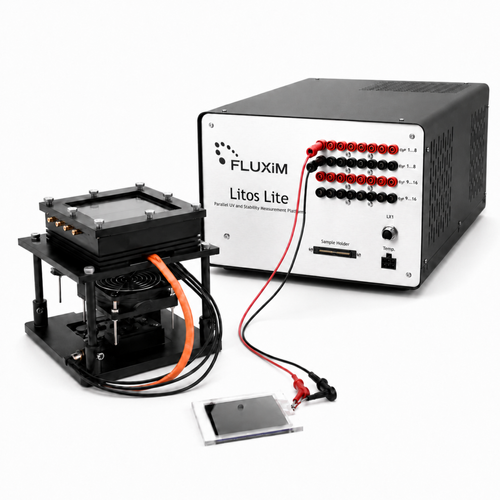 Litos Lite
Solar-cell stability testing
Litos Lite
Solar-cell stability testing
|
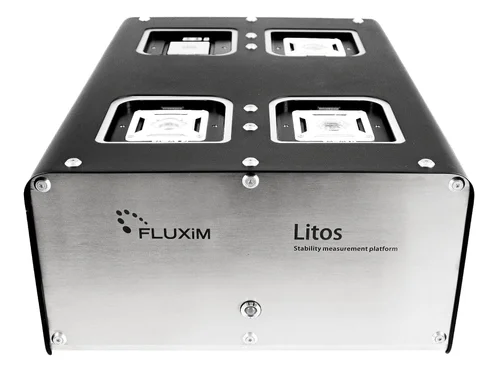 Litos
OLED, LED and solar-cell degradation analysis
Litos
OLED, LED and solar-cell degradation analysis
|
|---|---|---|
| Best fit |
High-throughput PV ageing Parallel ageing, JV scans, MPP tracking and ISOS-compatible stability testing for perovskite, perovskite/silicon tandem and organic solar cells. |
Mechanism-focused degradation Lifetime and degradation studies for OLEDs, LEDs and solar cells under controlled electrical, optical and thermal stress. |
| Device types and sample size | Lab-scale solar cells, tandem solar cells and selected mini-module configurations. Litos Lite supports up to 56 standard solar-cell devices, up to 16 tandem devices, or up to 4 mini-modules depending on configuration. | OLEDs, LEDs and solar cells with custom sample layouts. Litos supports samples up to 2 inches, with an illumination area of around 3 cm². |
| Parallel channels | Up to 56 independent channels for standard lab-scale solar-cell layouts. Other configurations support up to 16 tandem devices, 8 high-current channels, or 4 mini-module channels. | 16 or 32 individual stressing channels distributed across 4 chambers. Depending on configuration, this means up to 4 or up to 8 devices per chamber. |
| Chambers and sample environment | Single custom sample-holder concept with glovebox-compatible and N2-flushable options. Sample holders are tailored to the selected channel configuration and device layout. | 4 independent chambers with individual temperature and illumination control; chambers can be flushed with N2. Each chamber can be equipped for solar cells or either bottom- or top-emission LEDs. |
| Illumination | Designed for solar-cell testing with external illumination, including Wavelabs solar simulators and other light sources integrated through software where supported. | White and UV LED illumination for accelerated testing of solar cells and optoelectronic devices. |
| Measurement workflow | Parallel ageing, JV scans, MPP tracking, constant-voltage or constant-current stressing, temperature cycling and ISOS-compatible reporting through SPM software. | Constant-current, constant-voltage and MPP-tracking stress tests, intermittent IV/IVL characterization, in-situ spectral measurements where configured, and automated degradation experiments through Characterization Suite software. |
| Advanced characterization | Focused on high-throughput stability data, parallel statistics, reproducible ageing workflows and software-controlled illumination. | Can be connected with Paios for deeper degradation analysis, including IV(L), transient measurements, impedance spectroscopy, CV, IMPS and IMVS. |
| When to choose it | Choose Litos Lite if your main question is: How do many solar-cell devices age under comparable conditions? | Choose Litos if your main question is: Why does this device degrade, and which stress condition accelerates or reveals the mechanism? |
Exact channel count, sample layout and compatible stress conditions depend on the selected configuration. Fluxim can help choose the setup that best matches your devices and research workflow.
Discuss your stability workflow
Fluxim offers two stability-testing platforms depending on your device type and workflow. Litos Lite is built for parallel JV, MPP tracking and ISOS protocol-based stability testing of many solar cells at once. Litos is designed for controlled lifetime and degradation studies of OLEDs, LEDs and solar cells.
Use Litos Lite when your main goal is high-throughput PV stability testing across many devices. Use Litos when you need a flexible stress-test platform for OLEDs, LEDs, solar cells or combined optoelectronic degradation studies.
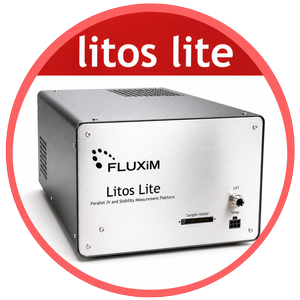
Litos Lite for PV stability testing
Parallel JV, MPP tracking and ISOS stability testing for perovskite, organic and tandem solar cells. Built for statistically meaningful data across many devices.
- Up to 56 devices in parallel
- JV scans, MPP tracking and ISOS routines
- Custom holders for your sample layout
- Glovebox-compatible options available
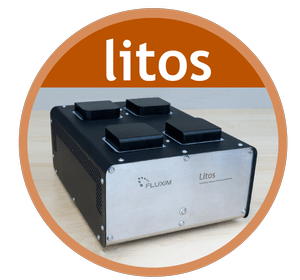
Litos for OLED, LED and solar-cell degradation
Controlled lifetime testing and degradation analysis for OLEDs, LEDs and solar cells under defined electrical, optical and thermal stress conditions.
- 16 or 32 individual stressing channels
- 4 chambers with individual control
- PV, LED and combined configurations
- Optional Paios integration for deeper degradation analysis