
CS 4.5 is here and June brings new research highlights
This month’s newsletter includes two recent customer papers using Paios and Setfos to investigate charge injection, recombination, halide segregation and ion-density changes. We also cover the new CS 4.5 release, upcoming PV events and recent webinar recordings.
CS 4.5 is here
Why it matters: less manual post-processing, clearer intermediate results, and smoother workflows for Paios, Phelos and Litos users.
In many labs, the measurement itself is no longer the main bottleneck. The challenge is getting from raw data to a result that can be trusted, compared and acted on.
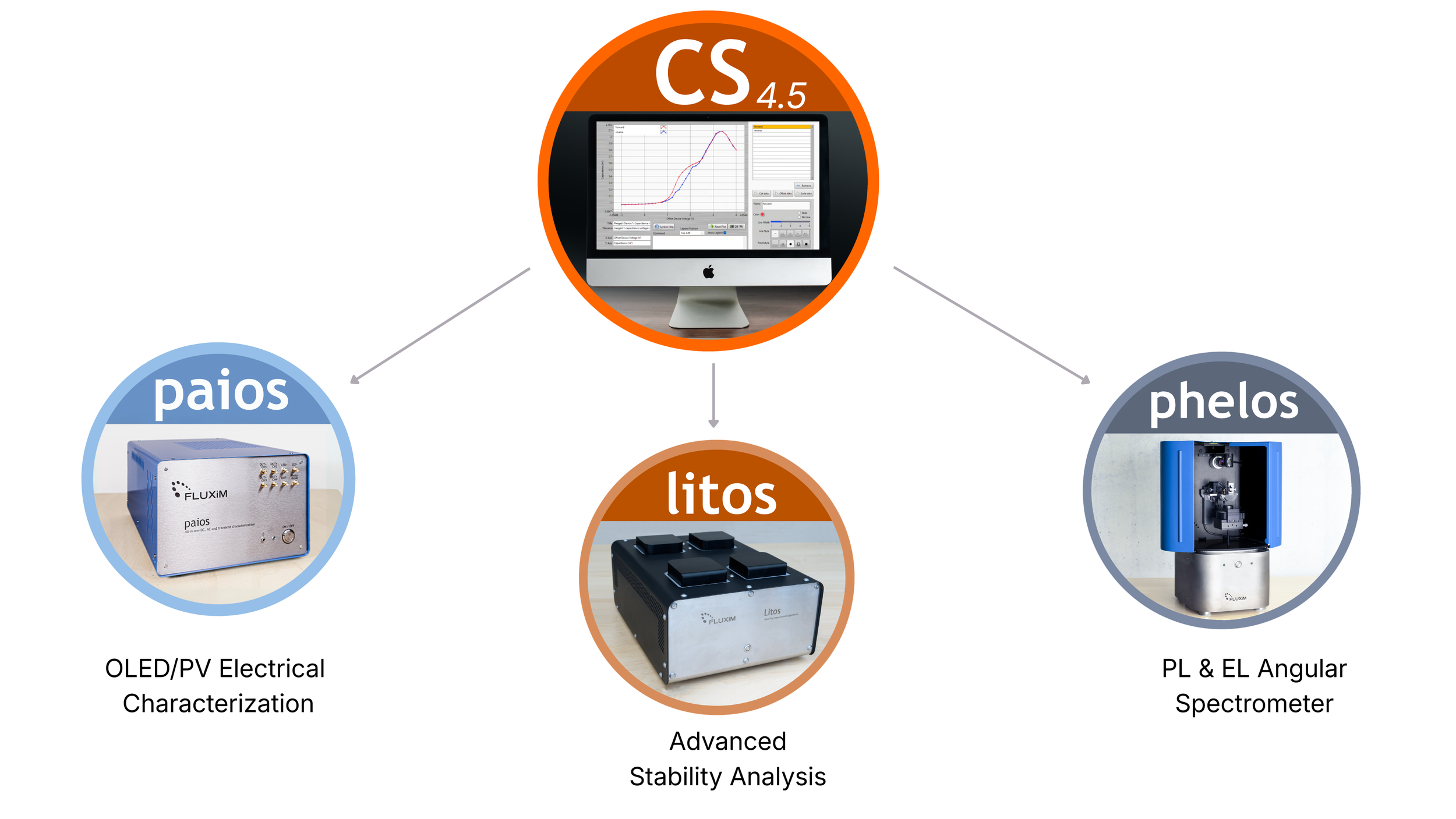
That is the focus of Characterization Suite (CS) 4.5. If you are not familiar, CS is the engine that drives our measurement instruments, Paios, Litos and Phelos.
With this latest release, we have updated the entire software environment. The result is not just a longer feature list. It is a more robust workflow for researchers who need to move faster from measurement to interpretation in OLED, solar cell, photodetector and stability studies.
Key updates include:
A refactored 64-bit software foundation with improved memory handling
SQLite-based management of procedures, device parameters and results
New automatic and basic post-processing routines
Extended Paios workflows, including PMT-based EL detection and a new PL mode
More efficient Phelos analysis for normal-direction I-V-L data
Improved long-term stability workflows in Litos, including updated templates, higher time resolution and initial Python API support
For users, this means less time exporting data to external tools just to answer first-order physical questions. CS 4.5 helps you extract relevant quantities faster, compare results more consistently and build a stronger bridge between measurement and interpretation.
Recent customer publications
Our tools continue to support high-level research in OLEDs, perovskite LEDs and perovskite solar cells. These papers show how Fluxim tools are being used to extract real device parameters, not just generate nice plots.
From messy grains to 10.7% EQE NIR-II perovskite LEDs
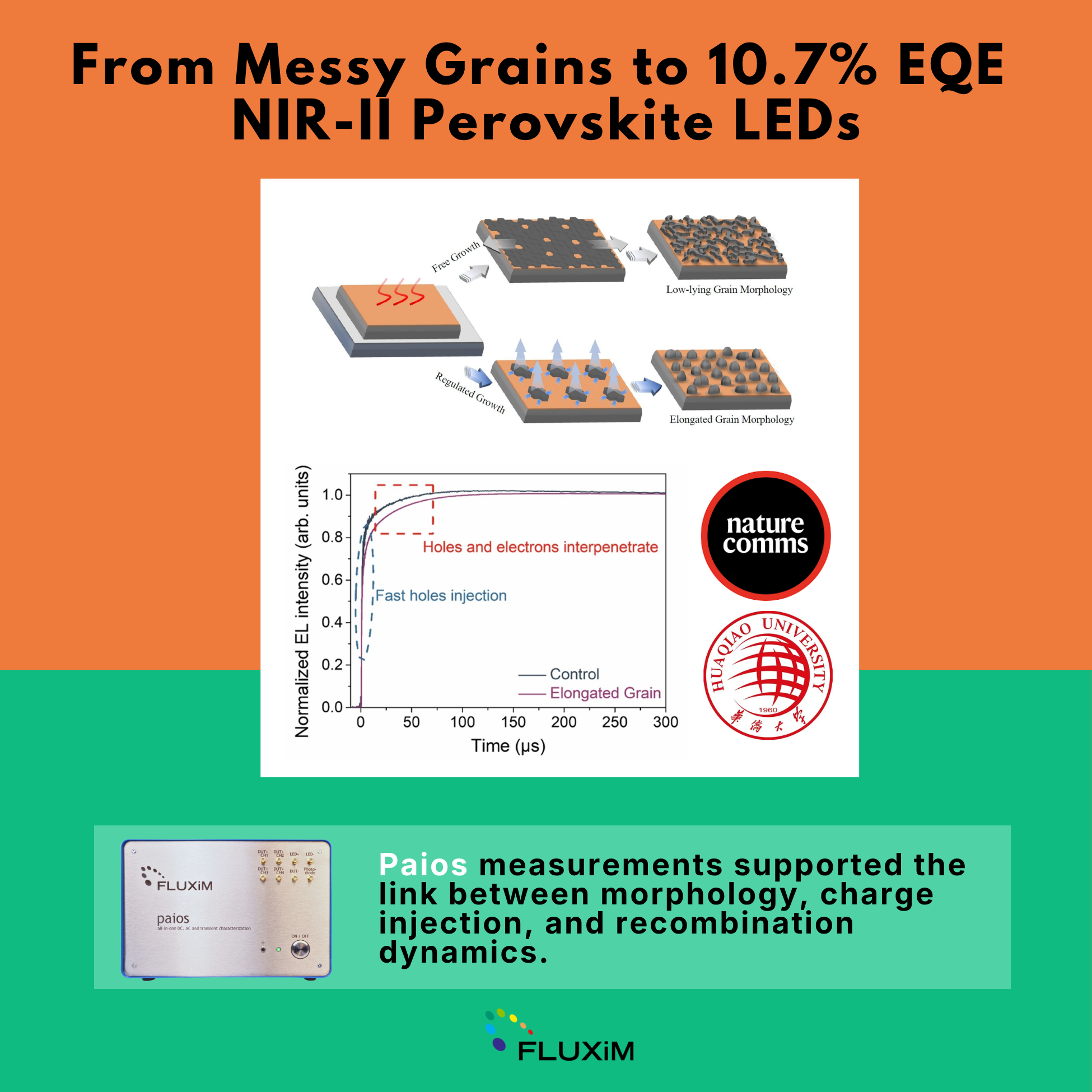
A new Nature Communications paper from Xiang Guan, Yuqing Li and colleagues reports efficient and radiant NIR-II Sn-based perovskite LEDs with 10.7% EQE.
The work shows how a small molecular additive can steer CsSnI-based perovskite films from low-lying dendritic grain networks toward elongated island-like structures. This morphology change improves charge balance, pushes the recombination zone deeper into the bulk and helps reduce excessive hole injection, leakage current and interfacial recombination.
Paios was used for transient electroluminescence, capacitance-voltage and impedance measurements. These measurements supported the interpretation of how charge injection and recombination dynamics change when the perovskite grain morphology is controlled.
Congratulations to the team at Huaqiao University and all collaborators.
Halide segregation drives ion loss in wide-bandgap perovskite solar cells
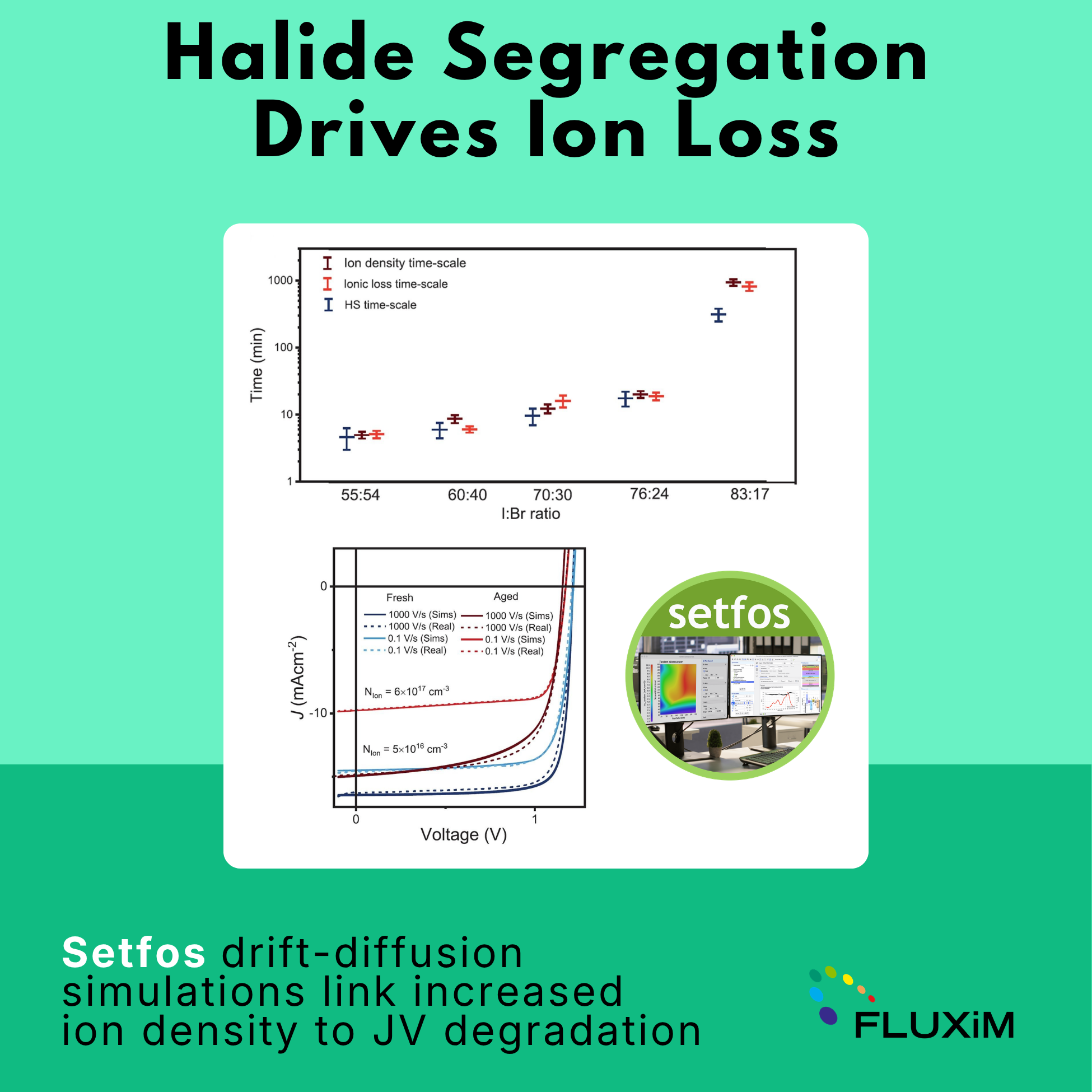
A recent Advanced Energy Materials study investigates how halide segregation affects ion density evolution and ionic performance losses in wide-bandgap perovskite solar cells.
The authors studied pin-type triple-cation wide-bandgap cells across 1.63-1.85 eV and showed that halide segregation, ionic loss and ion-density increase follow closely related timescales. Br-richer 1.85 eV devices degrade within minutes, while lower-bandgap 1.63 eV devices evolve over hours.
Setfos was used for drift-diffusion simulations of fresh and aged 1.85 eV devices. Mobile-ion densities extracted from BACE measurements were fed directly into the model to reproduce the experimentally observed differences between fast-scan and steady-state J-V curves.
The simulations support the central conclusion that increased mobile-ion density accompanying halide segregation can explain the observed degradation through field-screening and extraction losses.
Meet Fluxim in June
June is a good month to discuss indoor PV, perovskite stability, and simulation workflows face to face.
TandemPV Workshop 2026 in Berlin
June 17-19, 2026
Berlin, Germany
The 6th tandemPV Workshop brings together experts from the silicon and thin-film PV communities to discuss tandem architectures, industrial upscaling, reliability, sustainability, characterization and modelling.

Fluxim's Dr. Davide Moia will present a poster titled:
Evaluation of sub-cell losses in perovskite-silicon tandem devices from impedance and current-voltage characterization using a dual-wavelength optoelectronic approach
Thursday, June 18
1:20 PM - 2:50 PM
Poster Session II
IPVC-3 Indoor Photovoltaics Conference 2026
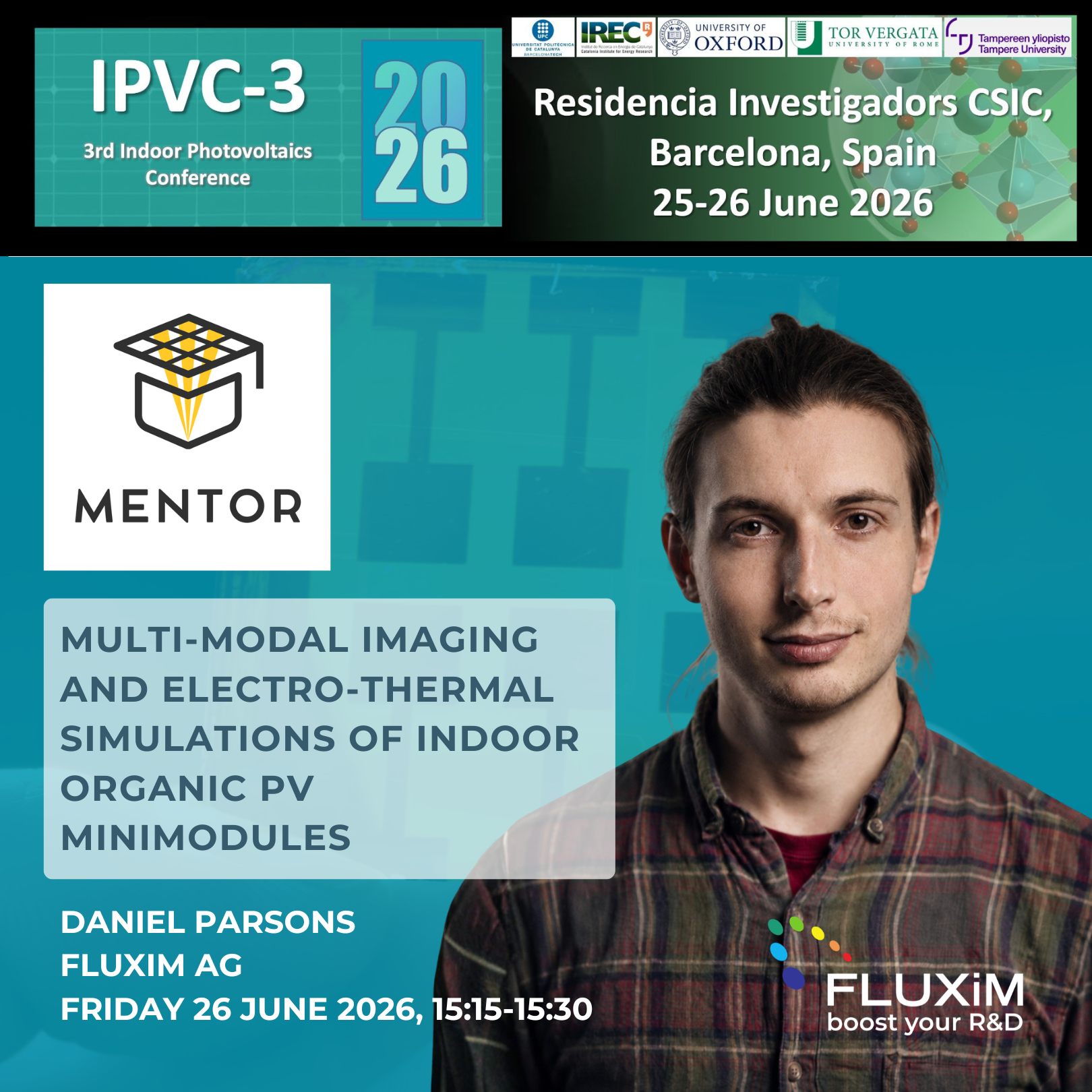
The Indoor Photovoltaics Conference 2026 (IPVC-3) will take place on June 25–26, 2026 in Barcelona, Spain, bringing together leading researchers and industry experts in next-generation photovoltaic technologies.
Indoor photovoltaics are rapidly emerging as a key technology for powering low-energy electronics, IoT devices, and sensors under artificial light conditions.
Fluxim’s Ph.D. student Daniel Parsons will be presenting :
Multi-modal imaging and electro-thermal simulations of indoor organic PV minimodules
Friday 26 June 2026, 15:15-15:30
Daniel will also be giving a 20-minute presentation about Fluxim and our R&D tools at 12pm on the same day.
SimOEP 2026 - Abstract Deadline Extended
The 10th International Conference on Simulation of Organic Electronics and Photovoltaics will take place from September 9-11, 2026 in Winterthur, Switzerland.
SimOEP brings together modelling experts and device physicists from industry and academia working on organic and hybrid materials, OLEDs, photovoltaics, batteries and photodetectors.
The conference focuses on scientific exchange across experimental research, materials synthesis, device engineering and advanced modelling. Topics include charge and heat transport, exciton dynamics, light propagation and simulation approaches from nanometres to centimetres.
The confirmed speaker list is already taking shape, with contributions from the University of Southampton, University of Oxford, CSEM, ICN2, Pusan National University, Hasselt University, Tampere University, Fluxim and ZHAW.
Important dates:
Abstract submission deadline extended: June 19th, 2026
Conference: September 9-11, 2026
Location: ZHAW, Winterthur, Switzerland
If your research connects modelling, measurement and device physics, SimOEP is one of the best places to discuss it in depth.
Missed our recent webinars?
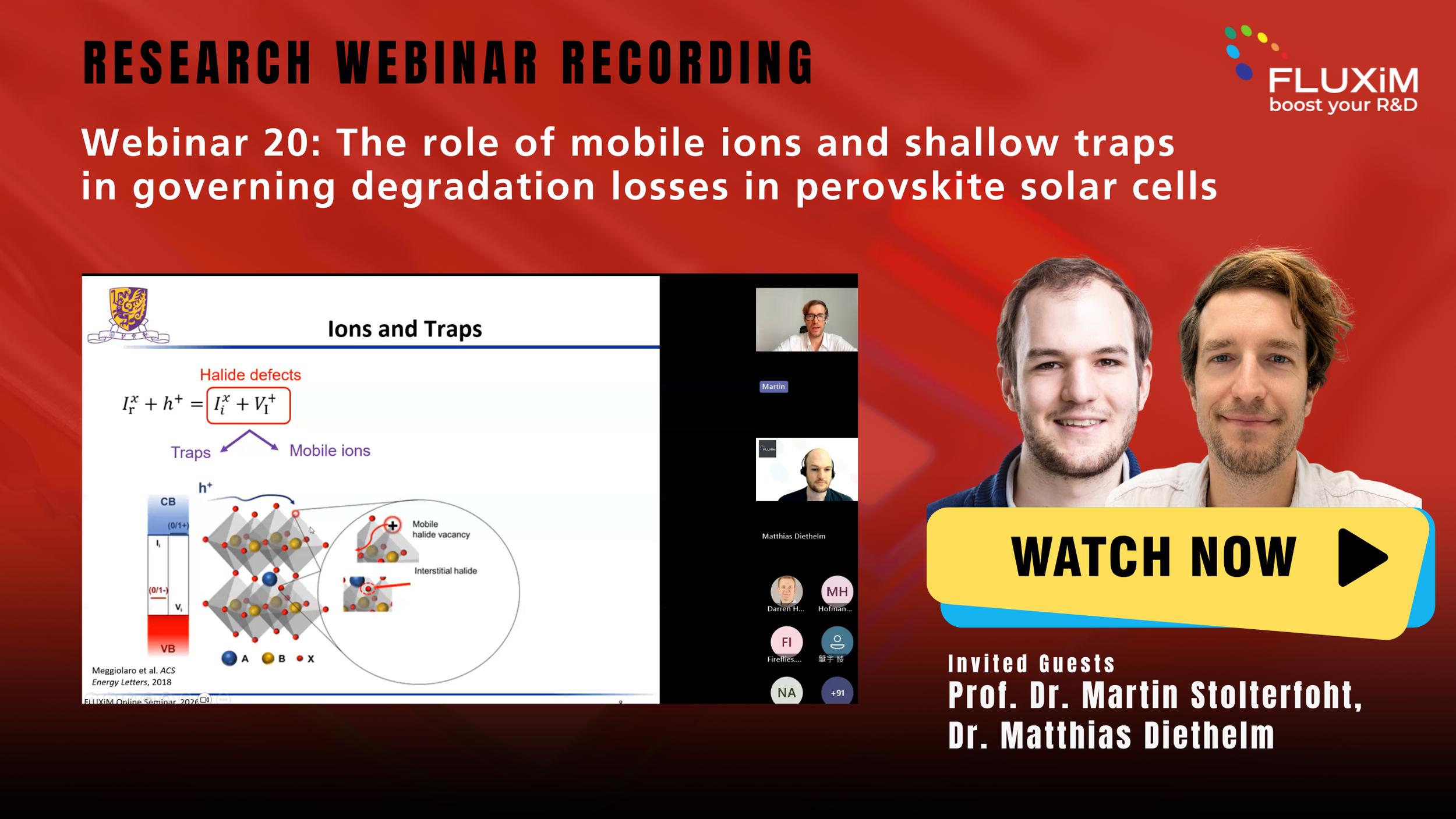
We´ve just this week recorded our 20th episode of the Fluxim research webinar series. Thanks to everyone who has contributed over the last two years, your time is greatly appreciated. If you missed our most recent episodes, no worries, you can watch them both here.

Want to discuss your measurement or simulation workflow?
Working on OLEDs, perovskite solar cells, indoor PV, tandem PV or stability studies?
Send us a short description of your measurement or simulation challenge, and we will connect you with the right Fluxim specialist.
Contact: sales@fluxim.com