
Characterization Suite 4.5 helps researchers get more from Paios, Phelos and Litos
In many labs, the bottleneck is no longer taking a measurement. The real challenge is getting from raw data to a result you can trust, compare, and act on.
The transient measurements of an OLED look interesting but fitting and interpretation take time. A new perovskite solar cell structure shows promise, but the next question is whether the signal is real and reproducible. Stability test runs for days or weeks, but setting up intermediate measurements, temperature changes, or light cycling still adds manual work.
That is the context for Characterization Suite 4.5.
With this release, Fluxim has updated the software environment used with Paios, Phelos, and Litos. The result is not just a longer feature list. It is a more robust workflow for researchers who need to move faster from measurement to interpretation in OLED, solar cell, photodetector, and stability studies.
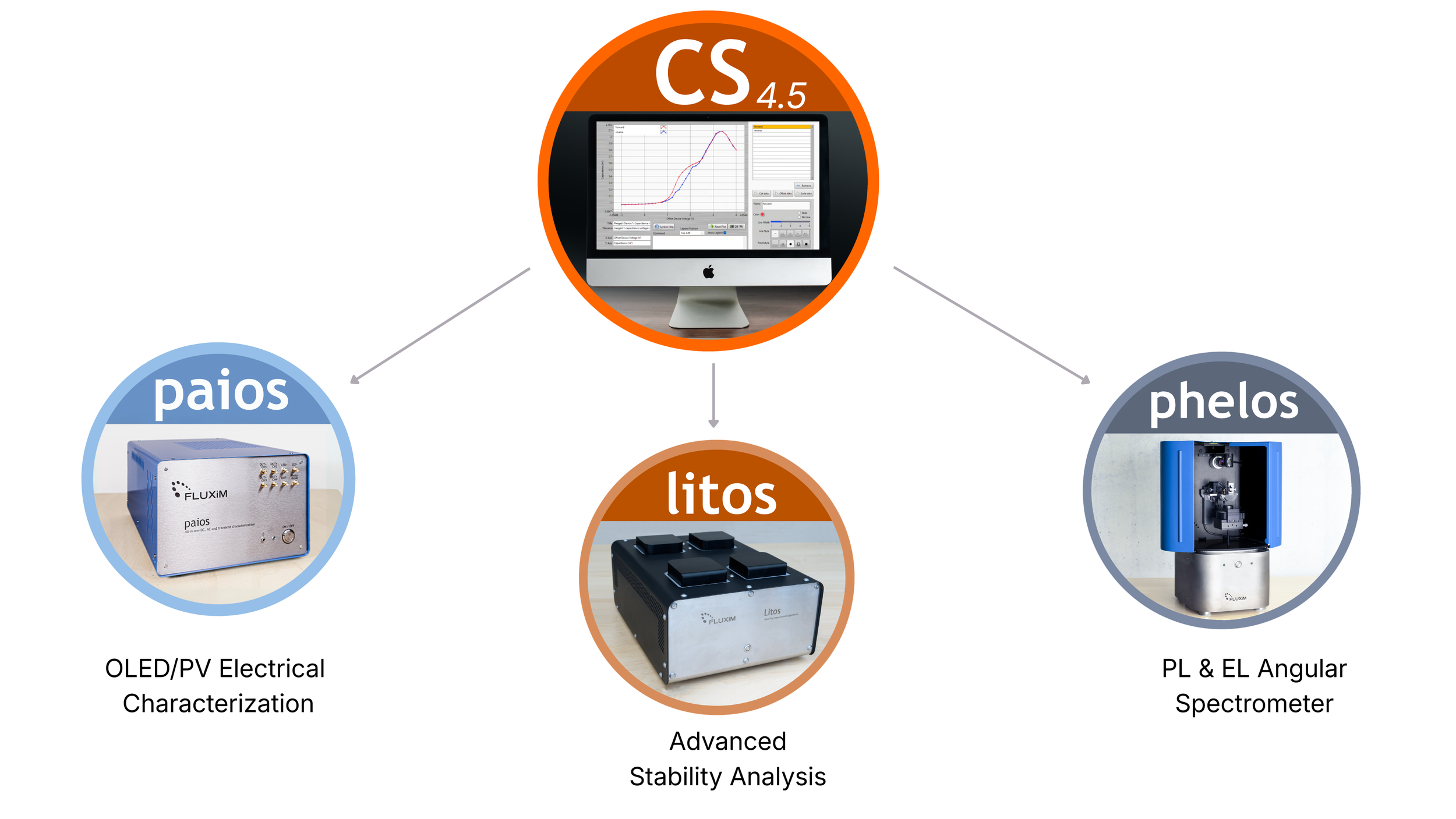
Key updates in CS 4.5
Characterization Suite 4.5 improves the reliability and usability of the software environment for Paios, Phelos, and Litos systems. The release combines a refactored 64‑bit software foundation with expanded post‑processing, new measurement options, and improved automation, helping users to move more efficiently from data acquisition to first interpretation in routine electro‑optical and stability studies.
Updated software foundation: Migration to LabVIEW 64‑bit, refactored architecture, improved memory handling, and SQLite‑based management of procedures and results for increased robustness and maintainability
Enhanced built‑in post‑processing: Additional automatic quantities and fitting routines for transient, AC and DC measurements (including IMPS, MELS, MPLS, TPC/TPV, pseudo‑PCE, and spectral responsivity) to reduce manual data handling
Extended Paios workflows: Support for PMT‑based detection of electroluminescence, new PL Mode, and additional modulated and transient measurement types within the Paios environment
More efficient Phelos analysis: Faster access to normal‑direction I‑V‑L data and improved handling of geometrical factors during post‑processing
Improved long‑term stability studies with Litos: Updated templates, improved overview of intermediate data, higher time resolution, and initial Python API support for automated routines
Detailed updates across Paios, Phelos, and Litos
A major part of CS 4.5 is not immediately visible in a screenshot, but it matters in everyday use. Our measurement software engineers refactored large parts of the codebase, moved to LabVIEW 64-bit, improved memory handling, and introduced SQLite databases for measurement procedures, device parameters, and key results. In practice, that supports a more stable build, easier maintenance, and a better foundation for future development. For end users, that matters because reliable software is what keeps a measurement day productive instead of frustrating.
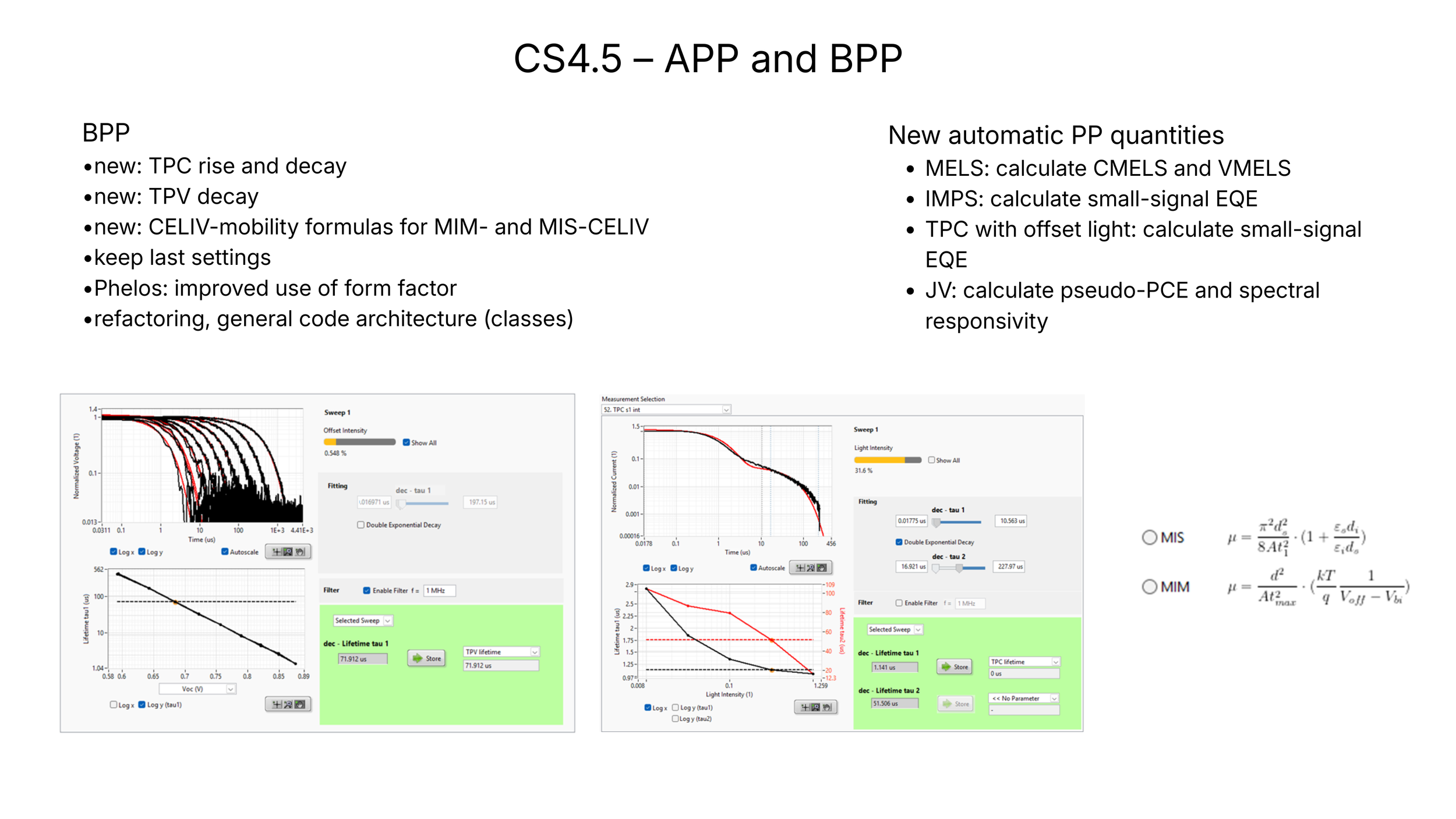
At the same time, CS 4.5 expands what the software does after the measurement. New automatic and basic postprocessing routines help extract relevant quantities with less manual work. The automatically calculated quantities include:
small-signal EQE from IMPS
EQE from TPC including offset light or voltage
pseudo-PCE from white-light measurements
spectral responsivity of photodetectors when characterized with calibrated monochromatic LEDs
Various new fitting routines have been added to the Basic Post-Processing: Characteristic times can be extracted from the TPC rise and decay, recombination lifetimes from the TPV decay, and we added CELIV mobility equations for injection-CELIV and MIS-CELIV. For the user, this means less time exporting data to external tools just to answer first-order physical questions.
Paios use cases - when you need more insight from electro-optical measurements
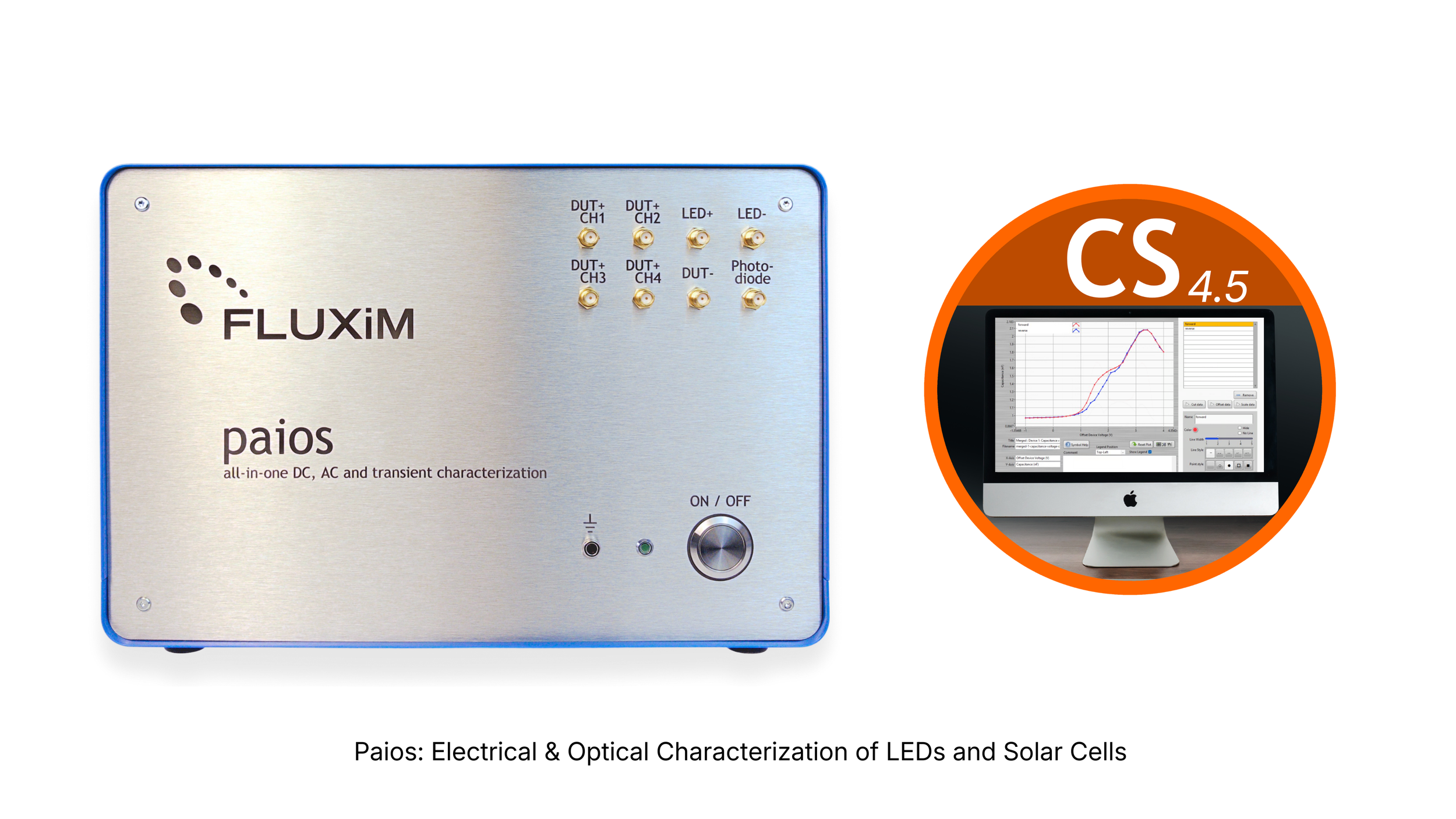
For many Paios users, the core need is straightforward. They want to characterize a device thoroughly without having to patch together multiple tools or manually reconstruct the meaning of every transient.
That is where CS 4.5 adds value.
Use case 1: Resolving weak or fast electroluminescence signals more clearly
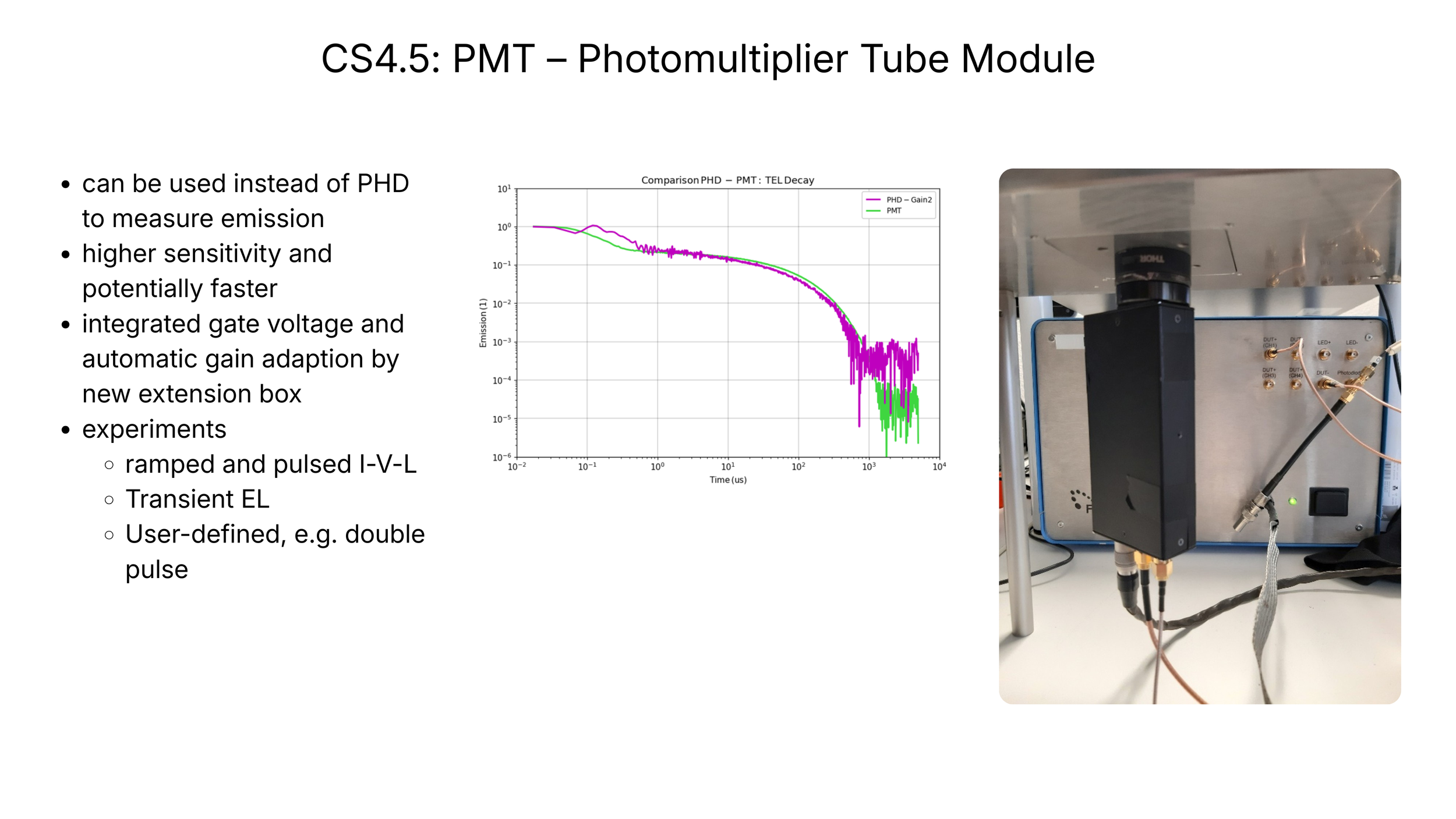
CS 4.5 introduces a Photomultiplier Tube (PMT) module for supported Paios experiments including ramped and pulsed JVL, Transient EL, and user-defined experiments. Compared with the default photodiode, the PMT offers an enhanced dynamic range and improved time and signal resolution. A gated Hamamatsu PMT is currently supported, with integrated gate voltage and automatic gain adaptation via a new extension box. For researchers studying weak or fast emission signals, that gives a better measurement option directly inside the Paios workflow.
Use case 2: Studying photoluminescence without leaving the Paios environment
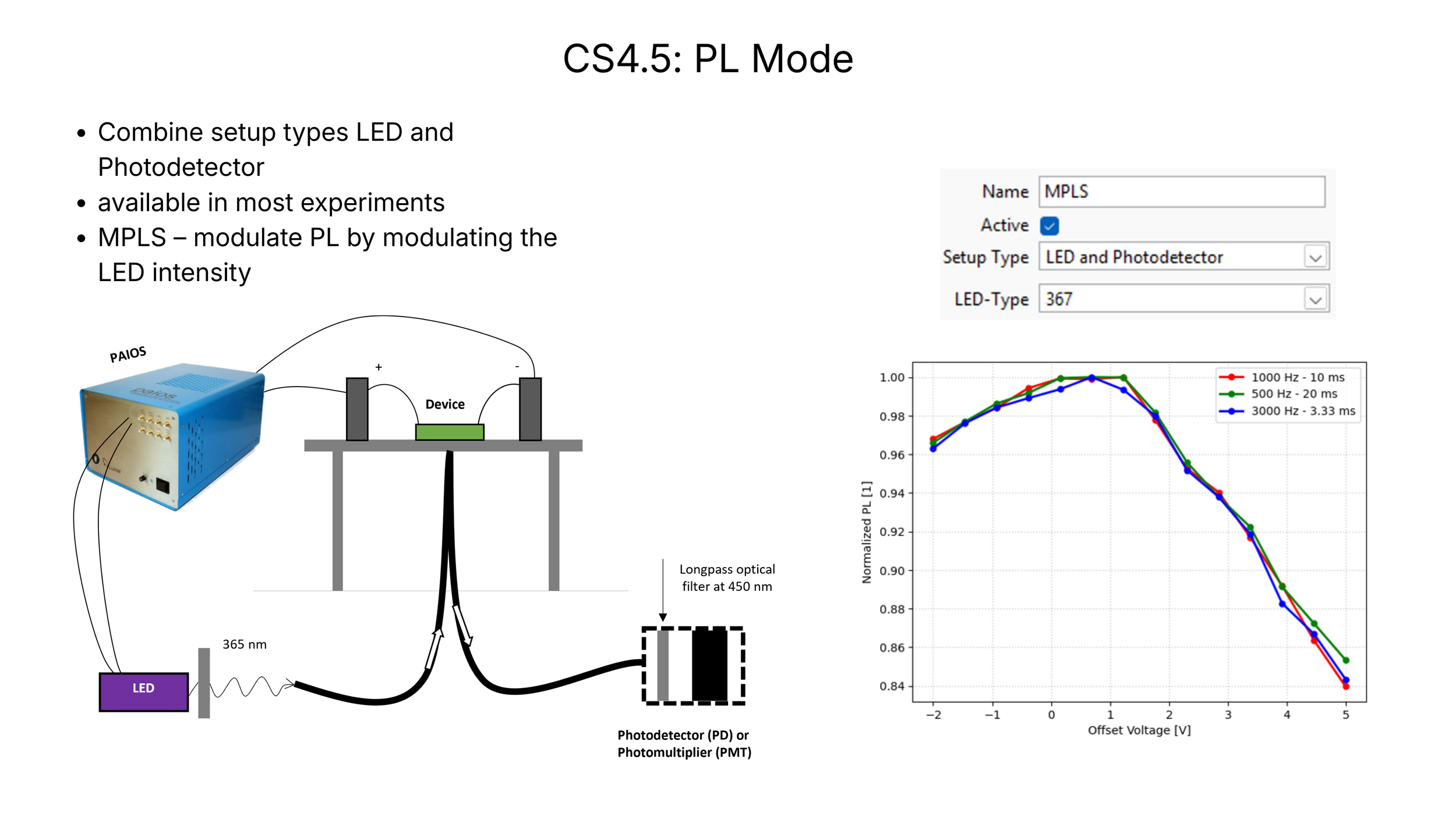
CS 4.5 also introduces a PL (photoluminescence) Mode for the Paios Combo version (PV+LED) by combining the LED and photodetector setup types. PL measurements can be performed in DC, AC, and time domain on thin films, solar cells, and full OLEDs. Hereby the new experiment type Modulated Photoluminescence Spectroscopy (MPLS) may be the most interesting addition. MPLS is useful for OLED-related PL quenching studies and for perovskite-based samples where the modulation-frequency dependence can be used to extract characteristic times associated with slow processes such as ion motion. For end users, the practical benefit is that Paios can now support a broader class of experiments relevant to modern optoelectronic research without requiring a disconnected measurement chain.
Use case 3: Getting first answers faster from transient and AC data
For many groups, the issue is not whether they can record TPC, TPV, IMPS, or related data. The issue is whether the software helps them turn it into interpretable quantities quickly enough to draw conclusions about their device and guide the next production run. CS 4.5 addresses that directly with new automatic quantities and basic postprocessing fitting routines, including small-signal EQE from IMPS, EQE from TPC, and TPC/TPV decay fitting. That makes Paios more useful not only as a measurement platform, but as a first interpretation step for transport and recombination studies.
Phelos use cases - when angular data needs to become practical
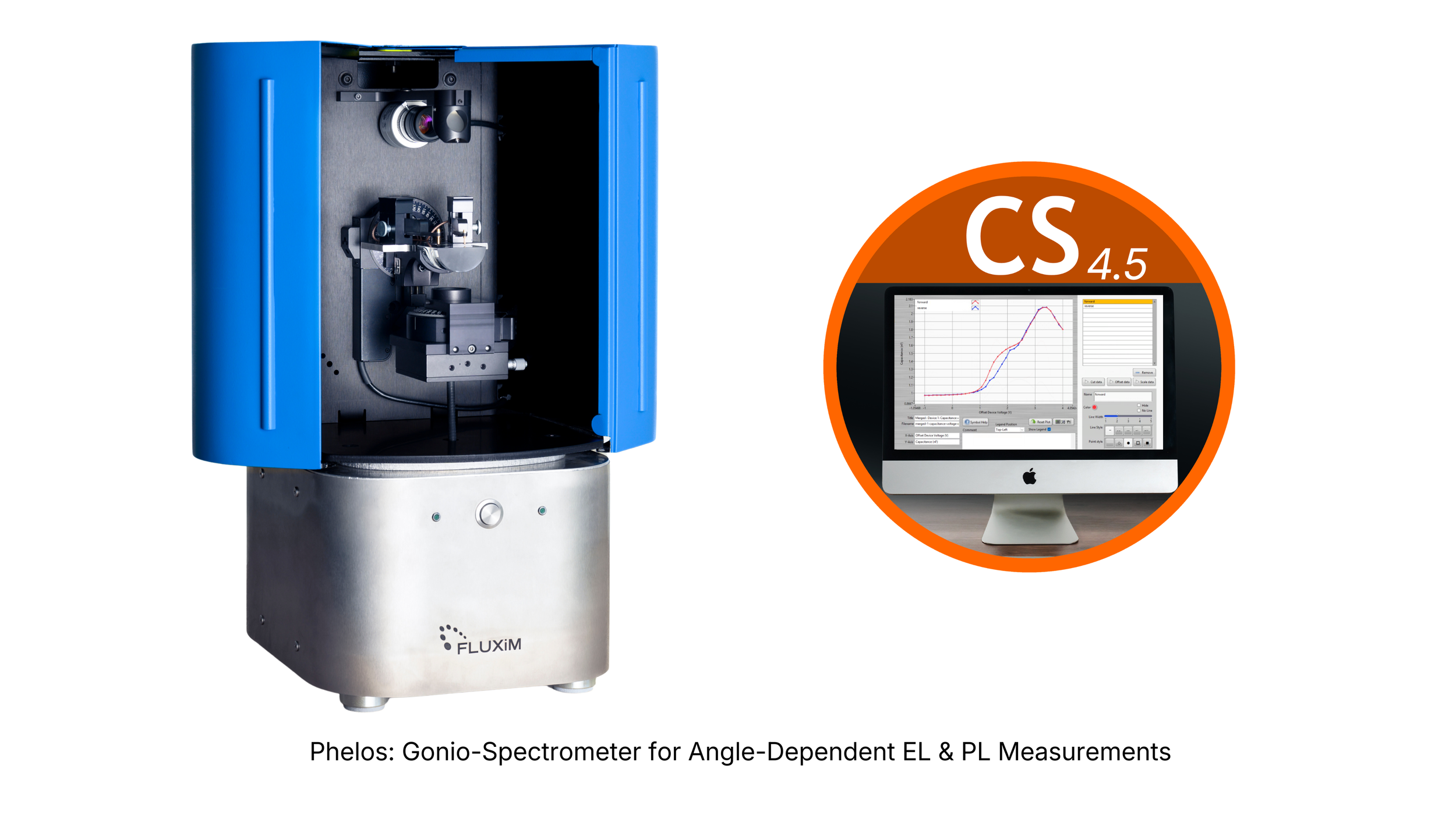
Phelos users often work on fundamental material and device stack design which can be operationally tedious. They want angle-dependent PL or EL data, but they also need fast access to the key quantities that guide device development.
CS 4.5 makes that workflow more direct.
Use case 1: Getting the OLED efficiency curve faster

CS 4.5 introduces a predefined I-V-L measurement at 0° for Phelos. This means users can obtain the OLED efficiency curve without carrying out a full angular sweep, and can then run the full angle-dependent measurement only at selected driving currents. For end users, that is a practical improvement: faster access to normal-direction device performance, followed by angle-dependent characterization only where it adds value.
Use case 2: Reducing geometry-related friction in postprocessing
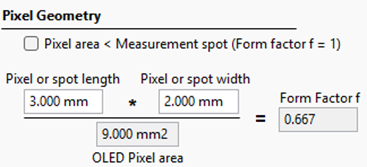
CS 4.5 brings with it further improvements in Basic Postprocessing for Phelos, including easier handling of the form factor, retention of the last settings, and improved evaluation of quantities such as EQE, luminous efficacy, and power efficiency with the geometrical form factor considered. For the user, this reduces the risk of turning an otherwise good angular measurement into a slow manual postprocessing exercise.
Litos use cases - when long stability studies need less manual intervention

For Litos users, the challenge is usually different. A stability system is valuable when it can run long experiments consistently, capture meaningful intermediate data, and reduce the need for repeated manual intervention.
That is exactly where CS 4.5 improves the workflow.
Use case 1: Seeing more of what happens during ageing
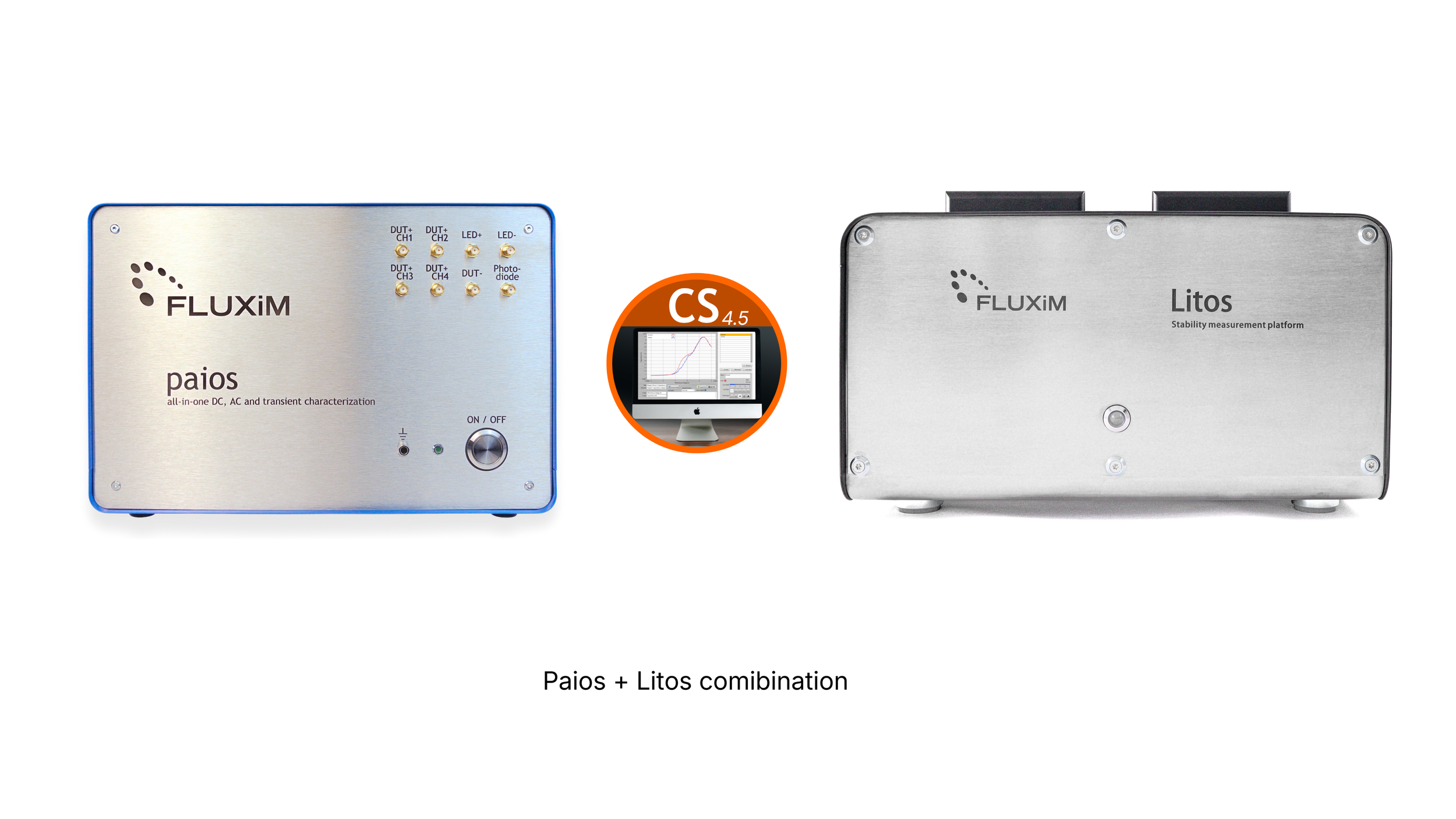
CS 4.5 adds new templates for Litos PV, Litos OLED, and Litos-Paios combinations, together with improvements for intermediate measurements. Users can now use a Show all option for intermediate JV and spectrum measurements, and intermediate measurements can start under stabilized conditions. For labs running extended degradation studies, that makes the recorded history of device evolution easier to inspect and interpret. Furthermore, CS 4.5 can now record data at intervals as short as 1 second which is particularly relevant when starting the aging experiment and checking the initial performance of all pixels.
Use case 2: Automating light cycling and temperature-dependent routines
One of the most user-relevant additions is the first Python API for Litos. It supports workflows such as light cycling and automatic temperature sweeps, including automated IV measurements at different temperatures and, in combination with Paios, automated advanced characterization under controlled temperature variation. For end users, this means less manual intervention and a more programmable experimental platform.
Use case 3: Making combined stability and characterization workflows easier
The release of CS 4.5 enables faster exports via Key Results, improved handling of intermediate measurements, and other practical fixes. These are not flashy changes, but for users running long campaigns they often matter more than headline features. They reduce handling overhead and make it easier to integrate Litos data into the broader characterization workflow.

A software release shaped around how researchers actually work
What makes CS 4.5 relevant is not one single feature. It is a combination of three things.
First, the software foundation is stronger.
Second, more quantities can be extracted directly inside the workflow.
Third, the improvements are tied to real lab tasks.
For a Paios user, that may mean moving from a weak transient EL signal to clearer time-resolved data obtained by a PMT. For a Phelos user, it may mean getting normal-direction I-V-L results first and using full angle-dependent scans more selectively. For a Litos user, it may mean running a longer, more automated stability study with less manual intervention.
Characterization Suite 4.5 strengthens the software behind Paios, Phelos, and Litos for the kinds of tasks researchers deal with every day: resolving difficult signals, reducing manual postprocessing, improving repeatability, and connecting measurement steps more efficiently.
For labs working on OLEDs, solar cells, photodetectors, and device stability, CS 4.5 is a release focused less on novelty for its own sake and more on making advanced characterization workflows easier to run and easier to interpret.
Upgrade now to CS 4.5
Interested in upgrading to Characterization Suite 4.5? Contact us to discuss the best upgrade path for your Paios, Phelos or Litos system. Customers who purchased within the last 12 months receive the update free of charge.