
Researchers at CNR-IMM and the University of Messina developed a semitransparent solar-cell architecture combining CsPbI₃₂ perovskite with a porous gig-lox TiO₂ electron transport layer. Using Fluxim's Setfos simulation software, they modeled optical absorption, light transmission and electrical performance, predicting 16.91% power conversion efficiency and 18% average visible transmittance. The simulated architecture outperformed a conventional TiO₂ reference, highlighting its potential for building-integrated photovoltaics and agrivoltaics.
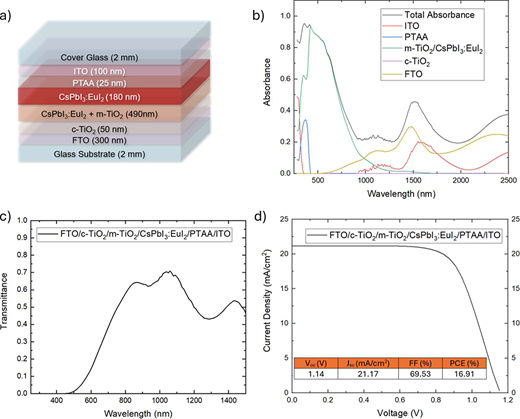
Spampinato et al., The Journal of Physical Chemistry C, 2025, Figure 6, CC BY 4.0.
Publication details
Authors: C. Spampinato, G. Calogero, G. Mannino, S. Valastro, E. Smecca, V. Arena, P. La Magna, C. Bongiorno, E. Fazio, A. Alberti
Journal: The Journal of Physical Chemistry C
Year: 2025 | Volume: 129 | Pages: 16338–16346
Paper: Read the open-access publication
Fluxim tools used
Setfos was used for coupled optical and electrical device simulations, including drift-diffusion transport, transfer-matrix optical calculations, J–V characteristics and transmittance.
Why it matters
Better device design: Simulations predicted 16.91% PCE versus 15.18% for conventional TiO₂.
Transparency and efficiency: The modeled cell maintained 18% average visible transmittance.
Research guidance: Experimentally informed simulations help researchers evaluate device architectures before fabrication.
FAQs
How was Setfos used in this research?
Setfos combined optical transfer-matrix calculations with electrical drift-diffusion simulations to predict solar-cell performance using measured optical and literature-based electrical parameters.
What efficiency was achieved?
The proposed architecture reached a simulated PCE of 16.91%, compared with 15.18% for a conventional TiO₂ reference.
Why is the porous TiO₂ structure important?
Its approximately 50% porosity accommodates perovskite within the electron transport layer, combining light absorption with electron extraction while preserving semitransparency.