
Research Blogs

Five Perovskite Questions Setfos Can Answer From Your Own Measurements
Perovskite papers often describe a result without explaining it. Non-radiative recombination. Hysteresis artifact. Retained 90% of PCE. Five questions where fitting a physical model to your own data identifies the mechanism.

Setfos modeling of halide perovskite solar cells with focus on their mixed ionic-electronic conducting properties: a step-by-step tutorial
Learn how to create a realistic digital twin of a halide perovskite solar cell using Fluxim’s Setfos. This step-by-step guide explains how to combine Paios measurements with drift-diffusion and optical modeling to capture ionic migration, hysteresis, and impedance behavior—helping researchers link device physics to performance and stability.

TADF OLEDs and Hyperfluorescent OLED Simulation with Setfos
Simulation of Organic light‐emitting diodes (OLEDs) using thermally activated delayed fluorescence (TADF). Emission zone analysis and a parameter study. Possible routes for efficiency enhancement.

How to correctly simulate the EQE of an organic tandem solar cell using full optoelectronic simulations
Learn how to accurately simulate the external quantum efficiency (EQE) of organic tandem solar cells with full optoelectronic models in SETFOS. Explore optical and electrical setups, EQE measurement techniques, and design optimizations.

Space Charge Limited Current (SCLC) and Charge Carrier Mobility in Organic Semiconductors
Discover how charge carrier mobility is measured in organic and perovskite semiconductors. This guide explains the Space Charge Limited Current (SCLC) method, with its key advantages, limitations, and applications.
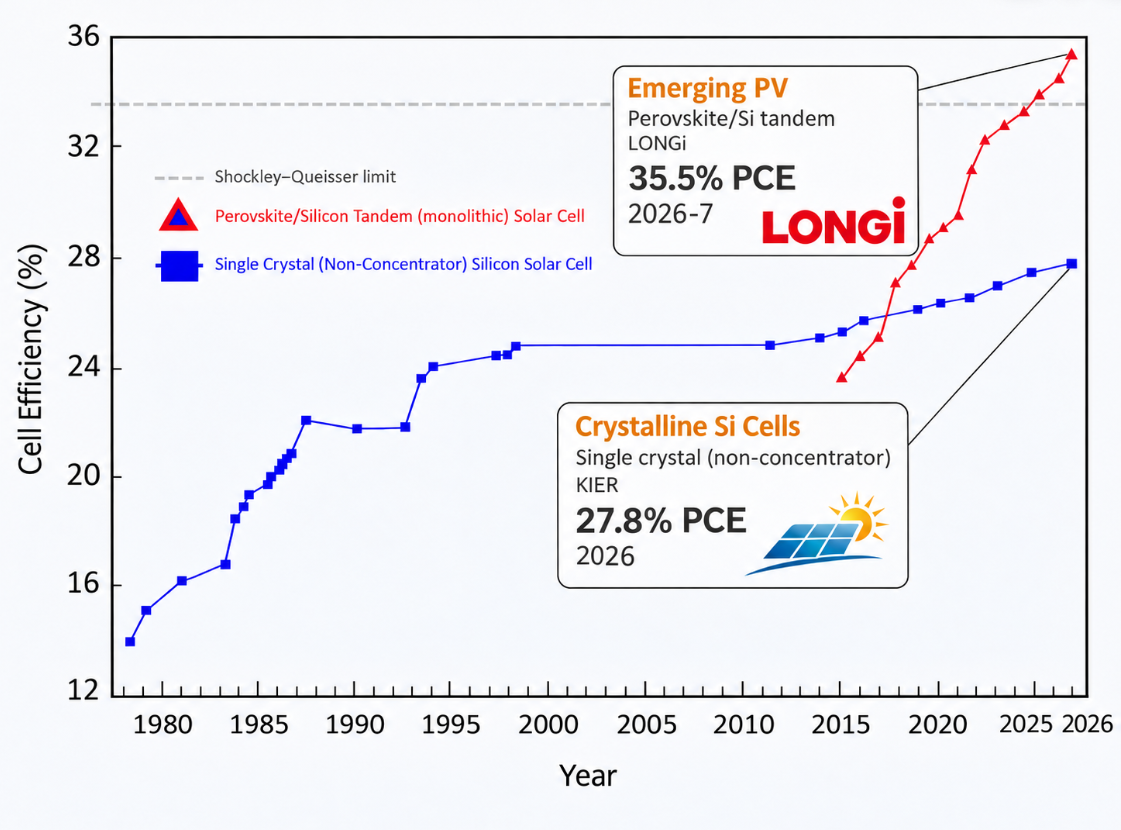
Highest Efficiency Solar Cells: Perovskite Solar Cells (2026 Update)
Discover LONGi's latest 35.5% perovskite–silicon tandem solar cell efficiency record, announced in July 2026. Explore how solar cell simulations help optimise performance and advance multi-junction photovoltaic technologies.

A Tutorial on Drift-Diffusion simulations
This tutorial introduces the fundamental drift-diffusion equations used to simulate charge transport and recombination in OLEDs, photodetectors, and solar cells. As a case study, we analyze the response speed of narrowband organic optical upconversion devices (OUCs), highlighting how mobility and recombination processes affect device performance.

How to Improve Measurement Accuracy of LED and PV Devices with a Common Electrode
Non-metalized contact pads and shared electrodes can undermine the accuracy of solar cell and LED measurements due to high contact resistance, distorting current-voltage (IV) curves and resulting in incorrect maximum-power-point (MPP) and open-voltage circuit (Voc) values. However, solutions exist: metallizing contact pads with gold or silver can reduce resistance issues, and avoiding common electrodes in multi-pixel designs can further enhance measurement accuracy, leading to improved reliability and efficiency in solar cells and LEDs.

Estimation of Charge Carrier Mobility in Solar Cells: An Introduction to CELIV
Dive into the world of mobility in solar cells, and explore how CELIV measurements help determine charge carrier mobility in thin-film solar cells like perovskite and organic solar cells. Learn about various CELIV techniques and their applications in this comprehensive research blog.

How ISOS Protocols Are Used to Assess Perovskite Solar Cell Stability
How can we assess the long-term stability of perovskite solar cells (PSCs)?
This guide summarizes the latest community-driven recommendations for perovskite stability testing—built upon the ISOS protocols originally developed for organic photovoltaics. It outlines tailored aging experiments, explains key ISOS categories (D, L, O, T, LT, etc.), and explores how tools like Litos Lite help ensure reproducible, standard-compliant stability measurements.

How to quantify Non-radiative voltage losses and recombination in solar cells
The open-circuit voltage (Voc) is the electrical potential difference between the two terminals of a solar cell, when there is no external load applied, hence no electric current flows. Correspondingly, this means that, when a voltage equivalent to the Voc is applied to the terminals of the solar cell, the recombination current (Jrec, which typically follows a non-ideal diode equation) and the photocurrent (Jph, the current generated by illuminating the solar cell) are equal, hence the net current is zero (Jrec=Jph at V= Voc).
Solar cells often present also non-radiative recombination mechanisms, in addition to the radiative one, as a result of poor material quality and non-idealities. To increase the Voc and thus potentially the power conversion efficiency, it is necessary to minimize the ΔVoc,nrad. It is, therefore, necessary to quantify the total loss and determine its origin.
Electroluminescence (EL) and photoluminescence quantum yield (PLQY) allow to directly extract the ΔVoc,nrad for thin-film solar cells such as perovskite solar cells, kesterite, perovskite, organic, or quantum dot. solar cells.
After quantifying the losses, the combination of capacitance-voltage (CV), temperature-dependent voltage characteristics (JV-T), and capacitance-frequency (Cf-T) measurements are essential to identify the recombination mechanisms.

HOW To optimize the CIE coordinates of a blue oled by fine tuning the cavity
In this tutorial, we are demonstrating how to use the optical module of Setfos in order to demonstrate how much the color point of a full OLED can be tuned for a given emitter spectrum. Moreover, we compare the efficiency of the color-optimized device with the one that is tuned for the highest outcoupling/radiance and analyze the consequent trade-off between color purity and efficiency.
The same analysis and optimization can be performed for other types of emitters such as quantum dots or perovskites. Despite the narrow emission spectra of these emitters, the optics of such QLEDs and PeLEDs is equal to the well-established OLEDs.

How to reduce loss channels and defects in large-area organic solar cells
Our 2D + 1D software LAOSS is a perfect tool to understand and improve on different upscaling strategies which combine 1D layer stack with 2D lateral simulations. In this blog post, we will discuss the findings by Matthias Diethelm and his colleagues who used LAOSS to simulate centimeter-sized organic solar cells to understand loss channels and macroscopic defects.

EQE optimization For a Top-Emitting OLED
The external quantum efficiency (EQE) is the number of photons emitted by an OLED per number of injected charges. Photons are generated in the device emitting layer (EML), but most of the light is not escaping the device because of thee main loss mechanisms: Total Internal Reflection, Absorption Losses and Surface Plasmon Polaritons (SPPs). In this example, we are showing how to use Setfos to optimize the geometry of an OLED towards high light-outcoupling efficiency.