
Research Blogs

Setfos modeling of halide perovskite solar cells with focus on their mixed ionic-electronic conducting properties: a step-by-step tutorial
Learn how to create a realistic digital twin of a halide perovskite solar cell using Fluxim’s Setfos. This step-by-step guide explains how to combine Paios measurements with drift-diffusion and optical modeling to capture ionic migration, hysteresis, and impedance behavior—helping researchers link device physics to performance and stability.

Space Charge Limited Current (SCLC) and Charge Carrier Mobility in Organic Semiconductors
Discover how charge carrier mobility is measured in organic and perovskite semiconductors. This guide explains the Space Charge Limited Current (SCLC) method, with its key advantages, limitations, and applications.
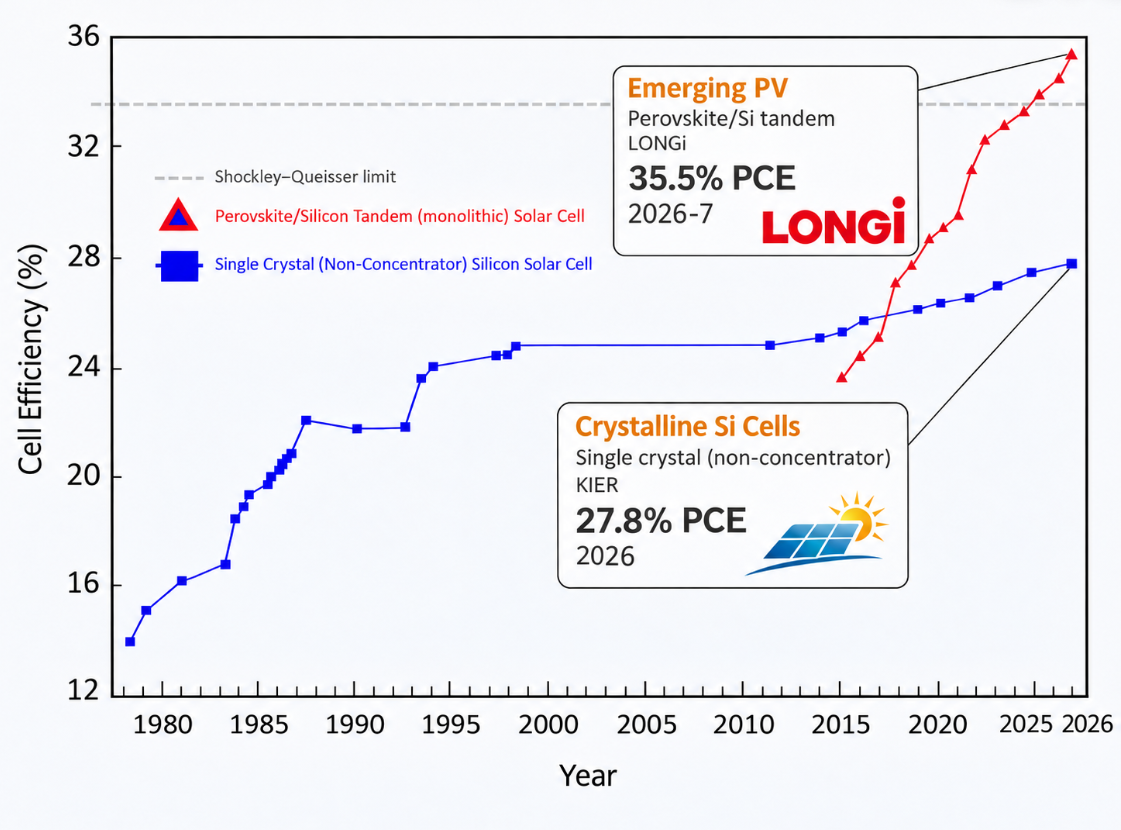
Highest Efficiency Solar Cells: Perovskite Solar Cells (2026 Update)
Discover LONGi's latest 35.5% perovskite–silicon tandem solar cell efficiency record, announced in July 2026. Explore how solar cell simulations help optimise performance and advance multi-junction photovoltaic technologies.

A Tutorial on Drift-Diffusion simulations
This tutorial introduces the fundamental drift-diffusion equations used to simulate charge transport and recombination in OLEDs, photodetectors, and solar cells. As a case study, we analyze the response speed of narrowband organic optical upconversion devices (OUCs), highlighting how mobility and recombination processes affect device performance.

Angular Resolved Photoluminescence and Electroluminescence of light emitting materials
Setfos can analyze angular-dependent PL data collected by Phelos to get information about the properties of an organic emitter, such as the orientation of the dipoles and the width of the emission zone. With this analysis, we are able to optimize the characteristics of our OLEDs for high EQEs.

Estimation of Charge Carrier Mobility in Solar Cells: An Introduction to CELIV
Dive into the world of mobility in solar cells, and explore how CELIV measurements help determine charge carrier mobility in thin-film solar cells like perovskite and organic solar cells. Learn about various CELIV techniques and their applications in this comprehensive research blog.

Quantification of trap states by thermally stimulated current in thin film solar cells
The performance of light-emitting (LEDs) and photovoltaic (PV) devices depends on the quality of the photoactive semiconductor material. The unintentional introduction of defects in the semiconductor material due to material impurities or during the fabrication process causes the deviation from optimal performance.
These defects are referred to as trap states, or in short “traps”, which are energetic states within the bandgap of a semiconductor. In general, traps can occur due to material impurities (in the bulk) or at the interfaces between layers of different materials.
In the following blog post, we will present how to characterize the trap states with the technique called thermally stimulated current (TSC). We also propose a method to reliably interpret the TSC results based on drift-diffusion simulations.

How ISOS Protocols Are Used to Assess Perovskite Solar Cell Stability
How can we assess the long-term stability of perovskite solar cells (PSCs)?
This guide summarizes the latest community-driven recommendations for perovskite stability testing—built upon the ISOS protocols originally developed for organic photovoltaics. It outlines tailored aging experiments, explains key ISOS categories (D, L, O, T, LT, etc.), and explores how tools like Litos Lite help ensure reproducible, standard-compliant stability measurements.

Fitting routine for a reliable transient photoluminescence simulation of perovskite films
Transient photoluminescence (trPL) characterization experiments allow to analysis charge carrier dynamics and identify the recombination channels of the device structure under investigation.
Useful information that can be extracted includes the quantification of radiative and non-radiative lifetimes, charge carrier extraction from differential lifetime computation, and the influence of the interfaces on the recombination mechanism. Fitting the experimental results with simulations further supports the analysis of the obtained data. However, qualitatively comparable fittings can be obtained with different sets of simulation parameters.
Using the fully-coupled, 1-dimensional optoelectronic simulation software Setfos, the trPL signal of a simple glass/perovskite structure was simulated and a routine is suggested to ascertain the reliability of the results. This routine is based on experimentally measured material properties and the analysis of the band diagram evolution during the photoluminescence transient. The validity of the simulated trPL is also recursively verified by fitting the decay with a bi-exponential function to extract the lifetimes of the recombination mechanisms.

How to quantify Non-radiative voltage losses and recombination in solar cells
The open-circuit voltage (Voc) is the electrical potential difference between the two terminals of a solar cell, when there is no external load applied, hence no electric current flows. Correspondingly, this means that, when a voltage equivalent to the Voc is applied to the terminals of the solar cell, the recombination current (Jrec, which typically follows a non-ideal diode equation) and the photocurrent (Jph, the current generated by illuminating the solar cell) are equal, hence the net current is zero (Jrec=Jph at V= Voc).
Solar cells often present also non-radiative recombination mechanisms, in addition to the radiative one, as a result of poor material quality and non-idealities. To increase the Voc and thus potentially the power conversion efficiency, it is necessary to minimize the ΔVoc,nrad. It is, therefore, necessary to quantify the total loss and determine its origin.
Electroluminescence (EL) and photoluminescence quantum yield (PLQY) allow to directly extract the ΔVoc,nrad for thin-film solar cells such as perovskite solar cells, kesterite, perovskite, organic, or quantum dot. solar cells.
After quantifying the losses, the combination of capacitance-voltage (CV), temperature-dependent voltage characteristics (JV-T), and capacitance-frequency (Cf-T) measurements are essential to identify the recombination mechanisms.