
A free, live online workshop for researchers who simulate thin-film, perovskite, silicon and tandem solar cells. See the new 6.1 workflows run end to end and ask your questions directly.
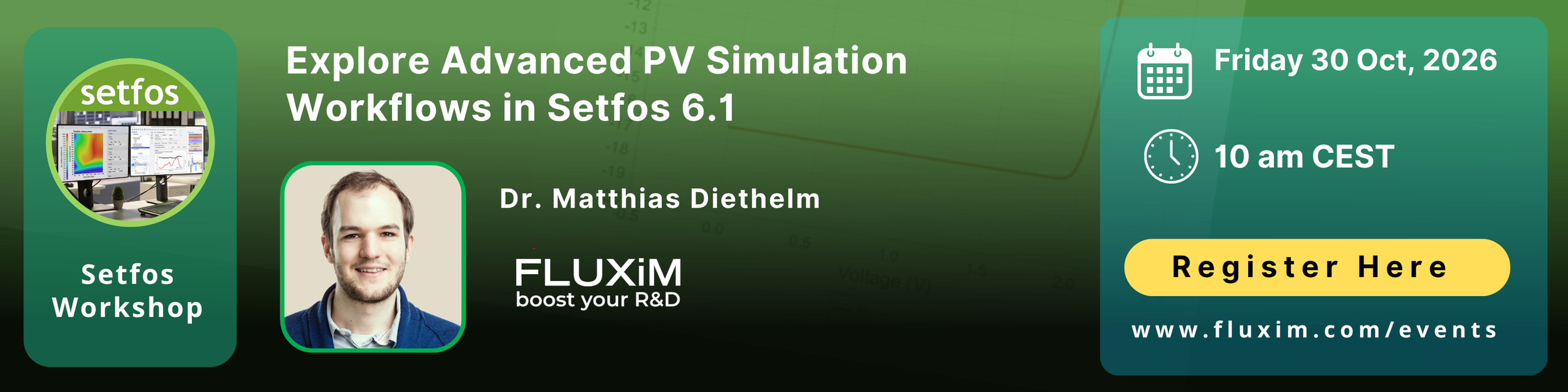
Fluxim’s experts will demonstrate selected workflows for tandem solar cells, EQE characterization, bifacial devices, multiple light sources, tunnelling, IMPLS and tandem loss analysis. The session combines a short tutorial with a practical live demonstration and an open Q&A.
The webinar is suitable for experienced Setfos users as well as researchers who are new to device simulation or considering working with Setfos.
Free live workshop · Setfos 6.1
Save your seat and shape the agenda
When you register, pick the topics you want to see. Your answers decide which Setfos 6.1 workflows our experts demonstrate live.
Register for the live session
Join on Microsoft Teams, directly in your browser. Registration takes less than a minute.
- Vote for bifacial, tandem EQE, IMPLS, TOPCon, tunneling or loss analysis
- Send in your own question, selected ones are answered live
- Open Q&A with Fluxim's application scientists
Register for the workshop → Teams event link
What you'll learn
Multiple light sources in one simulation. Define several sources, each with its own spectrum, incident angle and diffuse-light share, illuminating from the top or bottom. Apply it to bifacial cells, indoor PV and tandem EQE.
Sweeping and optimizing illumination. Vary light-source parameters and control individual sources in transient, IMPS and IMVS simulations.
IMPLS simulation. Use intensity-modulated photoluminescence spectroscopy as a contact-free complement to IMPS and IMVS for studying solar-cell dynamics.
Trap-assisted tunneling with the Hurkx model. See how it fits alongside the existing band-to-band and intra-band tunneling models.
Worked examples from the new tutorial set. Bifacial all-perovskite tandems, TOPCon cells, GaAs tunnel junctions and J–V loss analysis.
Who this workshop is for
Device physicists who want to identify the mechanism behind a measured result, not just describe it
Stack optimizers designing tandem, bifacial or indoor-PV architectures
Industrial R&D teams evaluating simulation workflows that scale from lab to product development
Current Setfos users upgrading to 6.1, and researchers new to Setfos
Agenda
What's new in Setfos 6.1 for photovoltaics
Live demo, multi-source illumination for bifacial and tandem devices
Live demo, IMPLS and small-signal analysis
Q&A with the presenter
About the presenter

Matthias is an R&D Scientist at Fluxim. His appointment at Fluxim follows a distinguished academic journey, most recently as a Postdoctoral Researcher at Empa and the University of Oxford, where he advanced key research in CIGS and perovskite photovoltaics. With a PhD from EPFL earned through research at Empa, Matthias has significantly contributed to our understanding of ion-influenced optoelectronics, OLED technologies and photovoltaics, demonstrated through numerous impactful publications.
Can't attend live?
Register anyway. All registrants receive the recording after the event.
Frequently asked questions
Is the workshop free?
Yes. Registration is free and takes less than a minute.
Do I need a Setfos licence to attend?
No. The workshop is open to everyone. If you want to follow along afterwards, you can request a free one-month Setfos trial.
Which software do I need to join?
Microsoft Teams in your browser or desktop app. No installation is required for the browser version.
How do I get Setfos 6.1?
Users with a current licence can update to 6.1. For licence questions, contact sales@fluxim.com.
Will there be time for questions?
Yes. The final part of the session is reserved for live Q&A.