

Publications
Here you will find research papers from our customers and our R&D team that use Fluxim’s R&D tools.
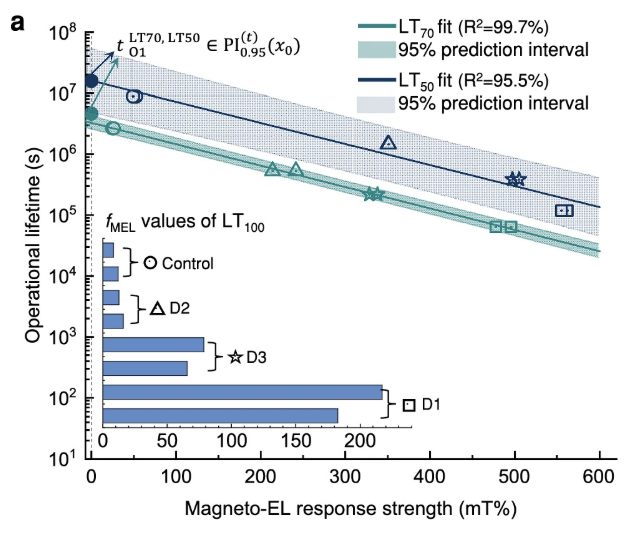
Research Paper — Predicting Blue OLED Lifetime with Magneto-Electroluminescence
Ji, J., Jung, Y. H., Jang, E.-J., Song, B., Oh, J., Lee, J.-H., Kwon, J. H., & Yoo, S. (2026). Magnetic electroluminescent response as a predictive indicator of operational lifetime in phosphorescent blue OLEDs. Nature Communications, 17, Article 10650.

Research Paper — Efficiency and stability trade-off in sky-blue OLEDs
Tankeleviciute, E., Jenatsch, S., Ruhstaller, B., Zysman-Colman, E., & Samuel, I. D. W. (2026). A trade-off between efficiency and stability in a class of sky-blue organic light-emitting diodes. FlexMat.

Research paper: Drift-diffusion modeling of blue OLED degradation
Pizano, A., Lampande, R., Cawthorn, R., & Giebink, N. C. (2025). Drift-diffusion modeling of blue OLED degradation. Synthetic Metals, 311, 117797.


Research Paper: Drift-diffusion modeling of blue OLED degradation
Drift-diffusion modeling of blue OLED degradation by Pizano, A., Lampande, R., Cawthorn, R., & Giebink, N. C. was published in Synthetic Metals (Vol. 299, 2024, Article 117797). This study uses Setfos to simulate luminance loss and voltage rise in blue OLEDs, comparing drift-diffusion modeling with a traditional rate-equation approach.

High efficiency blue organic light-emitting diodes with below-bandgap electroluminescence
Vasilopoulou, M., Mohd Yusoff, A.R.b., Daboczi, M. et al.
Nat Commun 12, 4868 (2021).

Correlation between optimized thicknesses of capping layer and thin metal electrode for efficient top-emitting blue organic light-emitting diodes
Cho, H., Joo, C. W., Kwon, B.-H., Kang, C., Choi, S., and Sin, J. W., ETRI Journal (2022), 1– 9.

Seven member ring based electron transporting materials for high-efficiency OLEDs
Kuo-Hsien Chou, Tun-Hao Chen, Xian-Qing Huang,a Chia-Sheng Huang, Chih-Hao Chang, Chien-Tien Chen and Jwo-Huei Jou
Mater. Adv., 2023,4, 1335-1344

Enhancing Blue Tadf Narrow-Band Emission Through Tandem Oleds with Optical Modeling Simulation
Xu, Ting and Jiang, Haixiao and Dong, Haojie and Zhao, Kele and Liang, Xiao and Sun, Yanqiu and Ding, Lei and meng, lingqiang and Meng, Hong,