
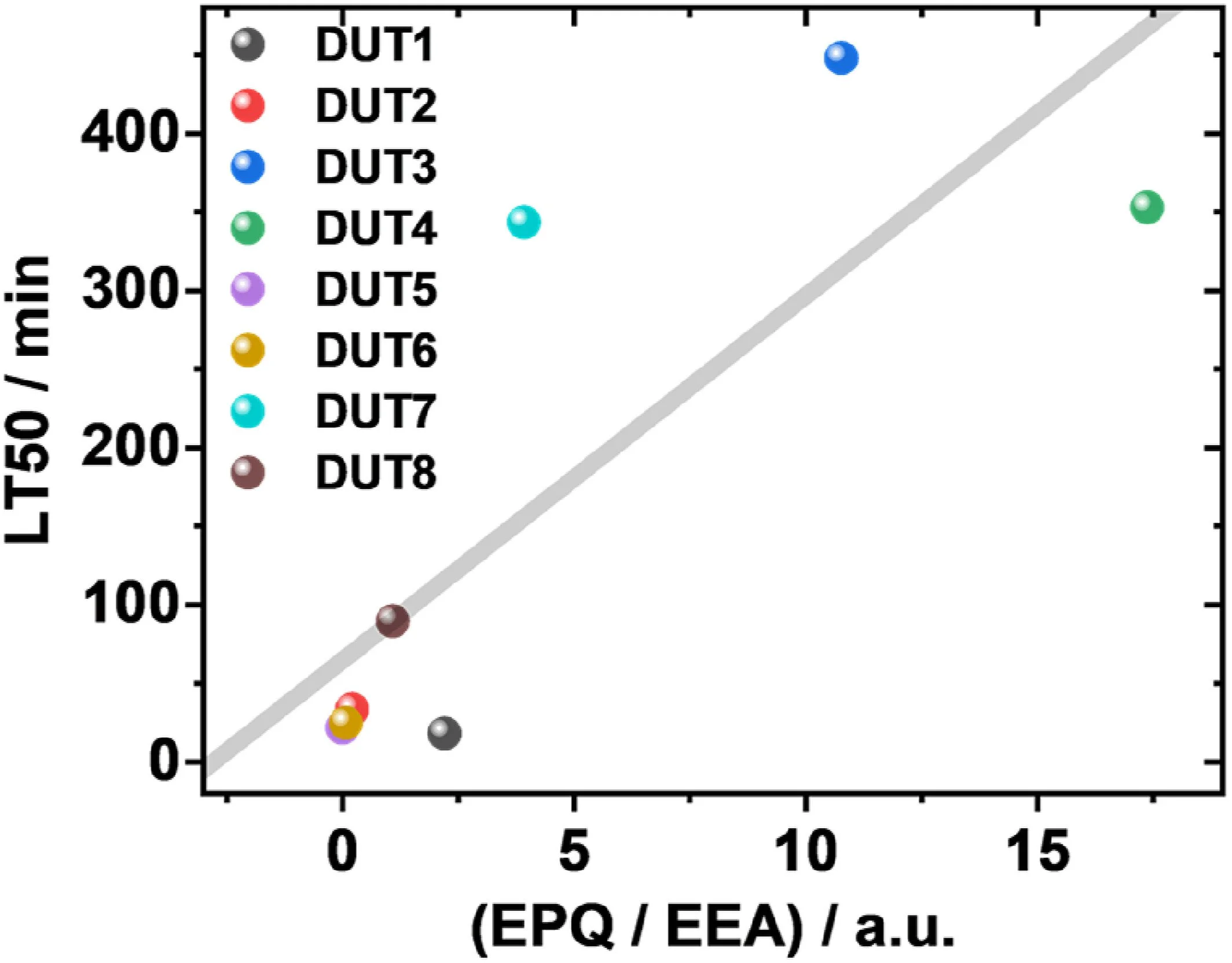

This study by our sponsored Ph.D. student Eglė Tankeleviciute from the University of St.Andrews investigates why sky-blue TADF OLEDs often show a trade-off between high efficiency and long operational lifetime. Across the studied device stacks, higher efficiency generally coincides with lower operational stability. By fitting drift-diffusion simulations to intermittent optoelectronic measurements collected during stress testing and coupling the electrical results to an excitonic model, the authors separate biexcitonic and polaronic contributions to efficiency roll-off. Efficient but less stable devices are mainly limited by exciton-exciton annihilation, while more stable but less efficient devices are dominated by exciton quenching by polarons. The extracted exciton rates show that a higher EPQ-to-EEA ratio correlates with improved stability, and the drift-diffusion fits indicate the largest degradation-related parameter changes occur in the emission layer, including increased trap density and, for several stacks, strongly reduced electron mobility. Overall, the results show that device structure governs the dominant non-radiative pathway, and that robust designs should minimize exciton accumulation at high brightness.
Publication details
Authors: Eglė Tankeleviciute; Sandra Jenatsch; Beat Ruhstaller; Eli Zysman-Colman; Ifor D. W. Samuel
Journal: FlexMat
Year: 2026
DOI: 10.1002/flm2.70036
Fluxim tools used
Paios - Used for capacitance-voltage (C-V) measurements to probe charge accumulation and transport (Figure 2D), and for intermittent current-voltage measurements during stress testing to track how device electrical characteristics evolve with degradation time (Figure 3).

Setfos - Used for drift-diffusion electrical simulations fitted to measured J-V curves (fresh and degraded states) to identify stress-induced changes in mobilities and trap densities (notably in the EML). The electrical model was then coupled to an exciton model (including singlet/triplet dynamics and TADF-related rates) and used to fit EQE roll-off by optimizing exciton-exciton annihilation terms (SSA/STA/TTA) and exciton-polaron quenching (EPQ) parameters, enabling the analysis linking the EPQ-to-EEA rate balance to device stability (Figure 6).
Why it matters
Distinguishes biexcitonic vs polaronic contributions to efficiency roll-off via coupled measurement and modeling.
Links the efficiency-lifetime trade-off to whether roll-off is dominated by EEA or polaron quenching.
Points to a clear design goal: minimize exciton accumulation at high brightness for efficient, stable OLED structures.
FAQs
Q1: What causes the efficiency and stability trade-off in these devices?
A: The paper finds efficient but less stable devices suffer mainly from exciton-exciton annihilation, while stable but less efficient devices have excitons predominantly quenched by polarons. FlexMat - 2026 - Tankelevičiūtė…
Q2: How did the authors separate biexcitonic and polaronic effects?
A: They coupled drift-diffusion electrical simulations (fitted to intermittent optoelectronic stress-test measurements) to an excitonic model to distinguish contributions to efficiency roll-off. FlexMat - 2026 - Tankelevičiūtė…
Q3: What is the practical design implication?
A: An efficient and stable OLED structure should aim to minimize exciton accumulation at high brightness.
Keywords OLED, organic light-emitting diode, sky-blue, TADF, thermally activated delayed fluorescence, device stability, device lifetime, degradation, efficiency roll-off, drift-diffusion simulation, excitonic model, biexcitonic events, polaronic events, exciton-exciton annihilation, exciton quenching, capacitance-voltage, Setfos, Paios.