
Stability insights at 85 °C with Litos Lite, Paios and Setfos
Interview with the team behind “Stabilizing Perovskite Solar Cells at 85 °C via Additive Engineering and MXene Interlayers,” EES Solar 2025
Overview
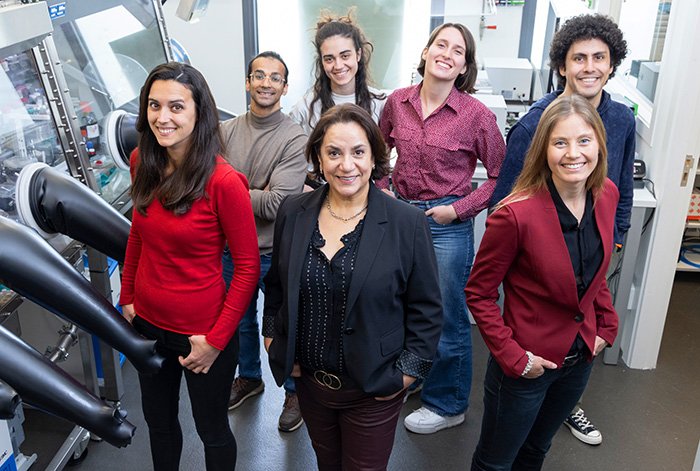
Perovskite solar cell stability at elevated temperatures remains one of the key challenges for industrial certification. A recent publication from the Nanostructured Materials for Photovoltaic Energy group at ICN2 combines additive engineering, MXene interlayers and advanced in operando measurements to study device behaviour under IEC 61215 and ISOS L3 conditions.
We spoke with lead author Dr Fanny Baumann about how Litos Lite™, Paios and Setfos helped uncover new stability mechanisms during high temperature operation.
Why 85 °C Stability Matters
The study focuses on understanding and improving the thermal stability of perovskite solar cells at 85 °C, a threshold relevant for commercial qualification. The team combined in operando electrical measurements with structural monitoring to track how degradation begins and evolves.
This is the first work to jointly observe structural dynamics with XRD and electrical behaviour in complete devices under continuous operation. Impedance spectroscopy before and after the operational testing provided further insight into changes in recombination resistance, shunt pathways and ionic transport.
Baumann, F., Padilla-Pantoja, J., Caicedo-Roque, J. M., Karimipour, M., Vahedigharehchopogh, N., Santiso, J., Ballesteros, B., Miranda Gamboa, R. A., Tian, Z., Raga, S. R., & Lira-Cantú, M. (2025). Stabilizing perovskite solar cells at 85 °C via additive engineering and MXene interlayers. EES Solar. Royal Society of Chemistry. https://doi.org/10.1039/D5EL00104H
Why H3PP and MXene Were Combined
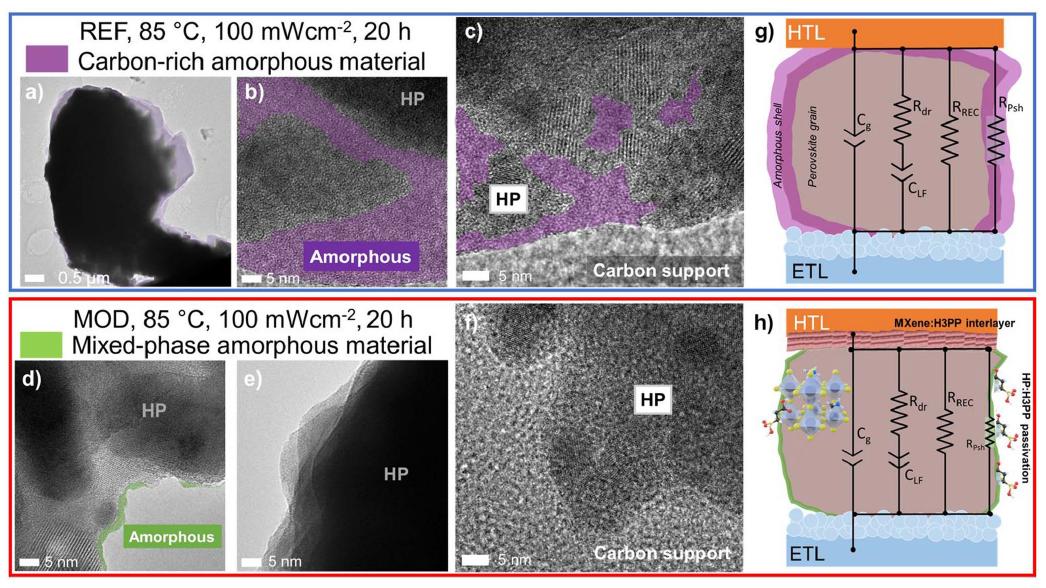
H3PP was introduced to passivate grain boundaries, while functionalized Ti₃C₂ MXene interlayers were used to reduce interfacial strain. Together they suppressed the formation of a carbon-rich amorphous shell during prolonged heating and illumination, and helped compensate strain from thermal expansion. The combined strategy delayed ionic movement, reduced recombination losses and stabilised the performance of the devices under 85 °C operation.
Fluxim R&D Tools Used in the Study

Litos Lite
Used for MPPT stability tests under ISOS L3 (∼100 mW cm⁻², 85 °C, N₂). It enabled long-term monitoring of efficiency, VMPP and JMPP for many devices at once, giving a solid statistical basis for identifying degradation trends.

Paios
By EIS in PAIOS the electro-optical joined causes of the changes in MPP point (performance degradation) observed were revealed. Quantitative support of increased ion conductivity, light and voltage dependent shunting, and voltage losses, made all the difference to understand how the formation of a new product as seen by TEM could be related to the losses in performance.

Setfos
Setfos aided in confirming that the changes we saw in impedance spectra could be related to ionic mobility, and it was excellent to be able to utilize a simple drift-diffusion model based on previous works from other authors and relatively quickly check if the changes we saw in the experimental data were supported by the model.
Linking Electrical and Structural Changes
The combination of Litos Lite, Paios and in situ XRD created a complete view of the evolution of crystal structure, ionic movement and device performance. A reversible voltage drop, together with increased ionic conductivity, aligned directly with the formation of a carbon-rich amorphous layer at perovskite grain surfaces. Using multiple in operando techniques made these links clearer and helped develop a more complete picture of how thermal stress affects device behaviour.
Key Results
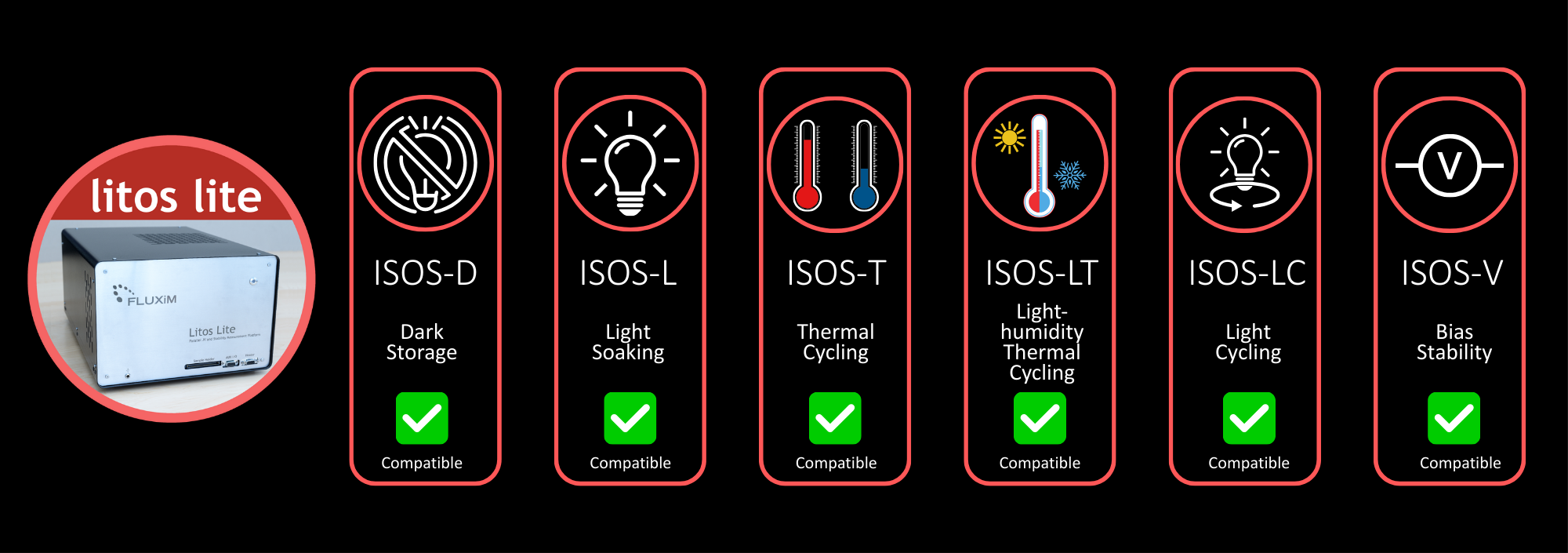
Litos Lite made it possible to run stable, standardised ISOS L3 tests at 85 °C on many devices in parallel. This was essential for linking the sharp voltage drop and recovery phenomenon to thermal lattice expansion and interfacial strain. Such effects could easily be overlooked in post-mortem or simple before/after tests.
Paios then provided quantitative evidence for increased ion mobility and voltage-dependent shunting, while Setfos supported the interpretation that mobility changes played a central role.
Experience Working With Fluxim Tools
Fanny notes: “I found the Fluxim hardware easy to use, and neat in a sense that it is compact with few separate components that possess many options for measurements to tailor them to the specific experiment. Sometimes the data-export could be a challenge, and I would have liked to be able to script the measurements and control them by code, but overall, the UI is easy to use and provides nice visualizations of the data.”
Experience working with the Fluxim team
“In general the Fluxim team has been very helpful and attentive, jumping on calls to help us solve software issues and eager to hear feedback about data formats and possible improvements. We have had some technical issues over the years and since we do not have any technicians on site for the Fluxim gear I have learned a considerable amount from the Fluxim team and from spending time with the equipment. I like that the team has been open to us producing a few of our own gadgets to go with the equipment. In preparation for this specific project, among others, we performed some changes to the device holder of Litos Lite. As a PhD student it is nice to see people passionate about finding the best technical solution, additionally thinking about solutions that are comfortable to use.”
How These Tools Accelerate Stability Research
“I think this article is a great showcase on how the methods can be used together for stability research. We have also used other optoelectronic characterization features in PAIOS (there are many) and variations of conditions in Litos Lite”
About the Researcher

Dr Fanny Baumann is a materials scientist with a strong focus on the stability of next-generation photovoltaic technologies. She recently completed her PhD at the Catalan Institute of Nanoscience and Nanotechnology (ICN2) in the Nanostructured Materials for Photovoltaic Energy group, on in-operando stability analysis of perovskite solar cells.
She holds an MSc in Nanoscience Engineering from Lund University and has broad experience with optoelectronic characterisation, device degradation mechanisms and advanced stability workflows.
Before turning to PV research, Fanny competed internationally in Olympic-class windsurfing and later coached youth athletes at the national level. She enjoys multidisciplinary challenges, aims for high-impact sustainability-driven work and brings precision, creativity and responsibility to her scientific projects.