
Research Paper — Transport-Layer Design Beyond Extraction Barriers
Can a solar cell remain efficient despite a large charge-extraction barrier? Yi et al. show that it can. Their simulations and perovskite solar-cell experiments demonstrate that barriers as high as 0.3 eV can be compensated when the voltage drop across the transport layer is sufficiently small.
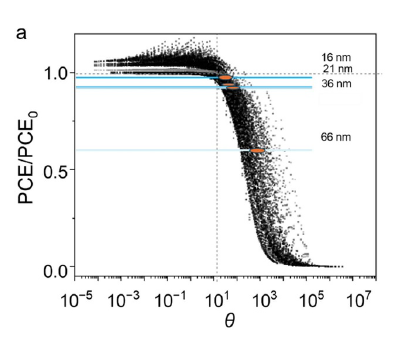
Using Fluxim’s Setfos, the researchers performed one-dimensional drift-diffusion simulations while varying transport-layer thickness, mobility, dielectric constant and extraction barrier. The resulting framework led to a new evaluation factor, θ, which combines these parameters into a single metric for transport-layer design. Across more than 10,000 simulations, PCE/PCE₀ approached unity when θ was ≤10.
Experimental perovskite devices supported the simulations. A 0.27 eV electron-extraction barrier reduced performance strongly when the new ETL was 66 nm thick, while reducing its thickness to 16 nm restored performance close to the barrier-free reference.
Publication details
Authors: Ruichen Yi, Zhijie Hu, Jia Zhang, Feng-Yu You, Tiankai Zhang, Bo Ma, Guangrui Zhu, Chunqin Zhu, Shaobo Liu, Xianxi Yu, Wen Feng, Yuan Pei, Anran Yu, Yiqiang Zhan, Weiwei Li, Jiajun Qin & Xiaoyuan Hou
Journal: Materials Futures
Year: 2026
Volume/article: 5, 025105
DOI: 10.1088/2752-5724/ae3ab8
Published: 12 March 2026
Fluxim tools used
Setfos — used for one-dimensional drift-diffusion simulations of the solar-cell structures and for systematic investigation of transport-layer extraction barriers, thickness, mobility and dielectric constant.
Why it matters
Shows that a large extraction barrier does not automatically exclude a transport-layer material from high-efficiency solar cells.
Establishes voltage drop across the transport layer as a more useful design consideration than extraction barrier alone.
Provides a compact metric, θ, for screening and optimizing transport layers before extensive experimental trial and error. Yi_2026_Mater._Futures_5_025105
AQs
Can a solar cell operate efficiently with a large extraction barrier?
Yes. The study shows that efficient devices can tolerate extraction barriers up to 0.3 eV when other transport-layer parameters are optimized to minimize the voltage drop across the layer.
What did Setfos contribute to the study?
Setfos 5.5 was used for the drift-diffusion simulations that revealed how extraction barrier, thickness, carrier mobility and dielectric constant collectively influence device performance.
What is θ?
θ is an evaluation factor combining absorber thickness, transport-layer thickness, photocurrent, dielectric constant, carrier mobility, extraction barrier and temperature. Lower θ values correspond to better compensation of extraction barriers; in the simulated dataset, PCE/PCE₀ approached 1 at θ ≤10.