
Fluxim 2025 Highlights and What’s Coming in 2026
2025 was a year of strong progress and collaboration at Fluxim. We launched Opixs, our new display simulation engine, released Setfos 6.0 with a powerful thermal module, and expanded our research impact through new projects; MetroPero and FADOS.
We highlight two outstanding Nature Communications papers demonstrating the effective use of Fluxim tools in cutting-edge OLED and perovskite solar cell research. Looking ahead to early 2026, we invite you to our January webinar, upcoming international conferences, and a first preview of Vitios, our next-generation characterization instrument.
Thank you for your trust and collaboration — we look forward to supporting your research in 2026.

A Message From Fluxim
Thank you for your collaboration this year. Your research and feedback has helped shape the improvements we make across simulation, characterization and stability testing. We’re excited to share what we achieved together in 2025 — and what’s coming next.
A clearer picture this Christmas with Opixs
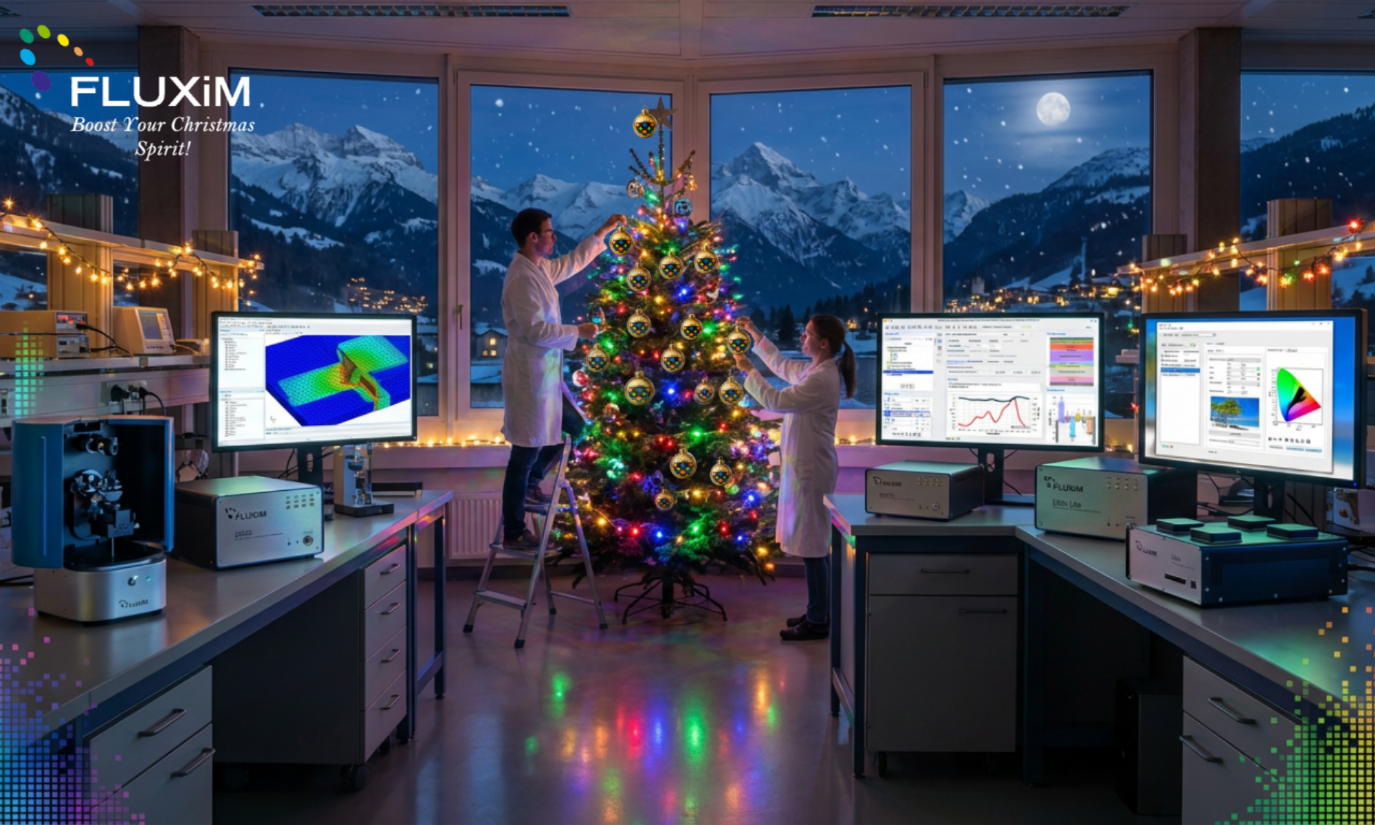
This year, our Christmas tree isn’t the only thing glowing. The colourful lights in our lab scene were created to showcase exactly what our new simulation software Opixs can do: analyse the optical performance of novel pixel configurations OLED displays, maximize their colour space, and reveal how different colours interact across a complex scene. With its wide spectrum of reds, greens, blues, and everything in between, this festive image becomes the perfect playground for Opixs—letting researchers explore optical efficiency in a setting far more joyful than a standard test pattern. As we wrap up the year, we’re excited to bring this new tool to your lab, helping you design brighter, more efficient displays… with just a little holiday sparkle. 🎄✨
So, here’s what you can learn with Opixs this Christmas
Starting from a real image, Opixs resolves display behaviour down to the subpixel level, allowing different pixel architectures to be evaluated under realistic colour and luminance content rather than idealised test patterns.
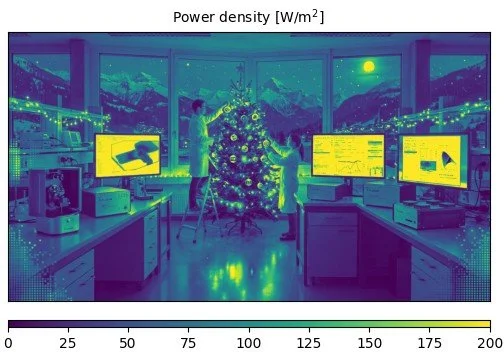
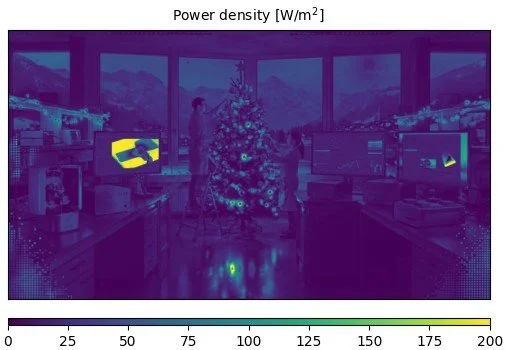
Power density – RGB vs RGBW]
While Opixs can visualise spatial power distributions, its real strength lies elsewhere. Display content determines where pixels are active—but Opixs shows which colours and which subpixel types carry the electrical load. By breaking down real images into subpixel-specific power, colour utilisation, and stress statistics, Opixs enables fair, image-based comparisons of different pixel architectures such as RGB and RGBW—well before fabrication.
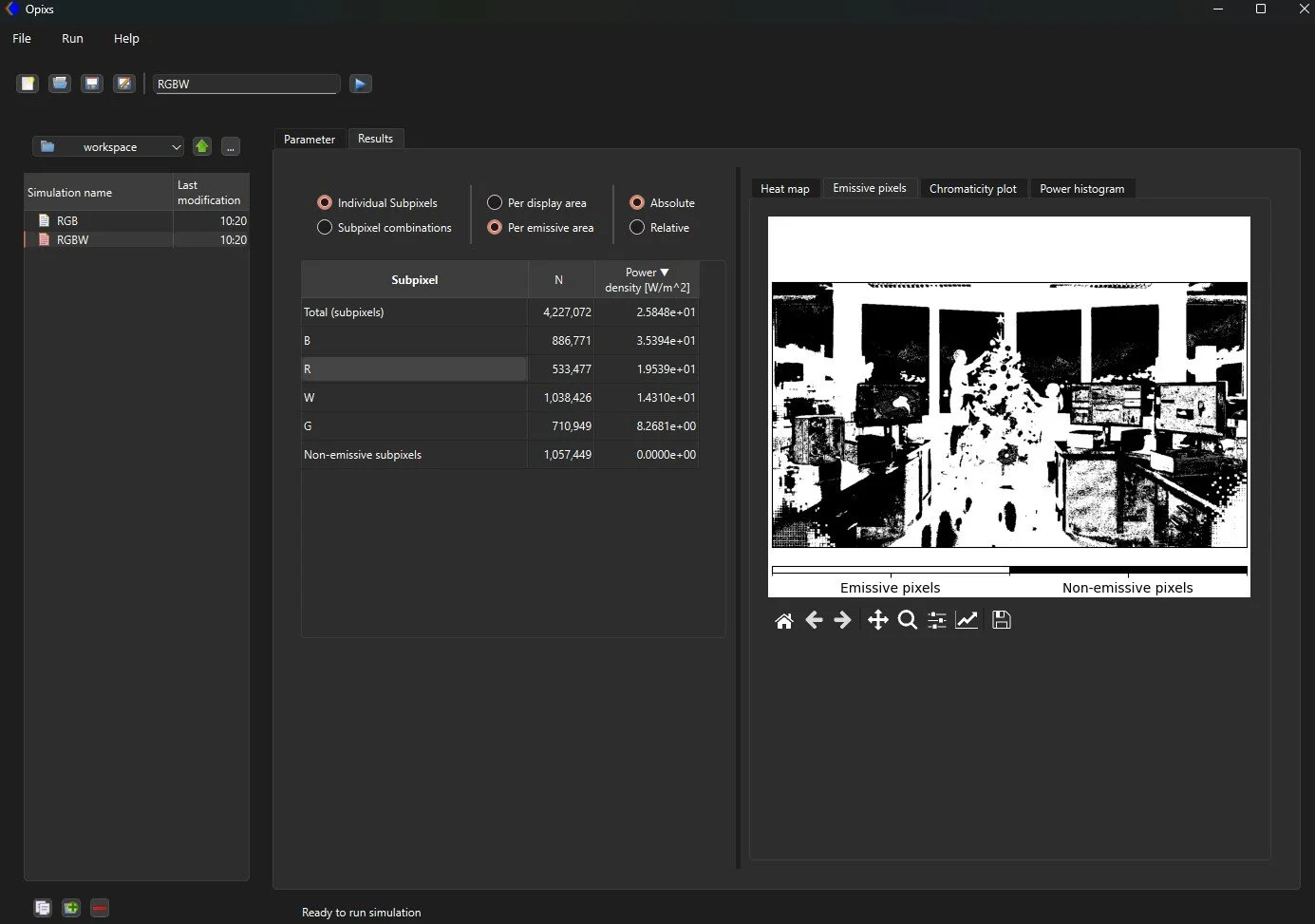
Chromaticity plot with image colours
Chromaticity plots illustrate the distribution of real image content within the selected colour space and device gamut. By indicating the representation of the respective colours by different combinations of subpixels, options to boost the efficiency by adding more subpixels are easily identified. Opixs links colour reproduction directly to subpixel driving conditions and enables consistent comparison of pixel concepts under identical visual targets.
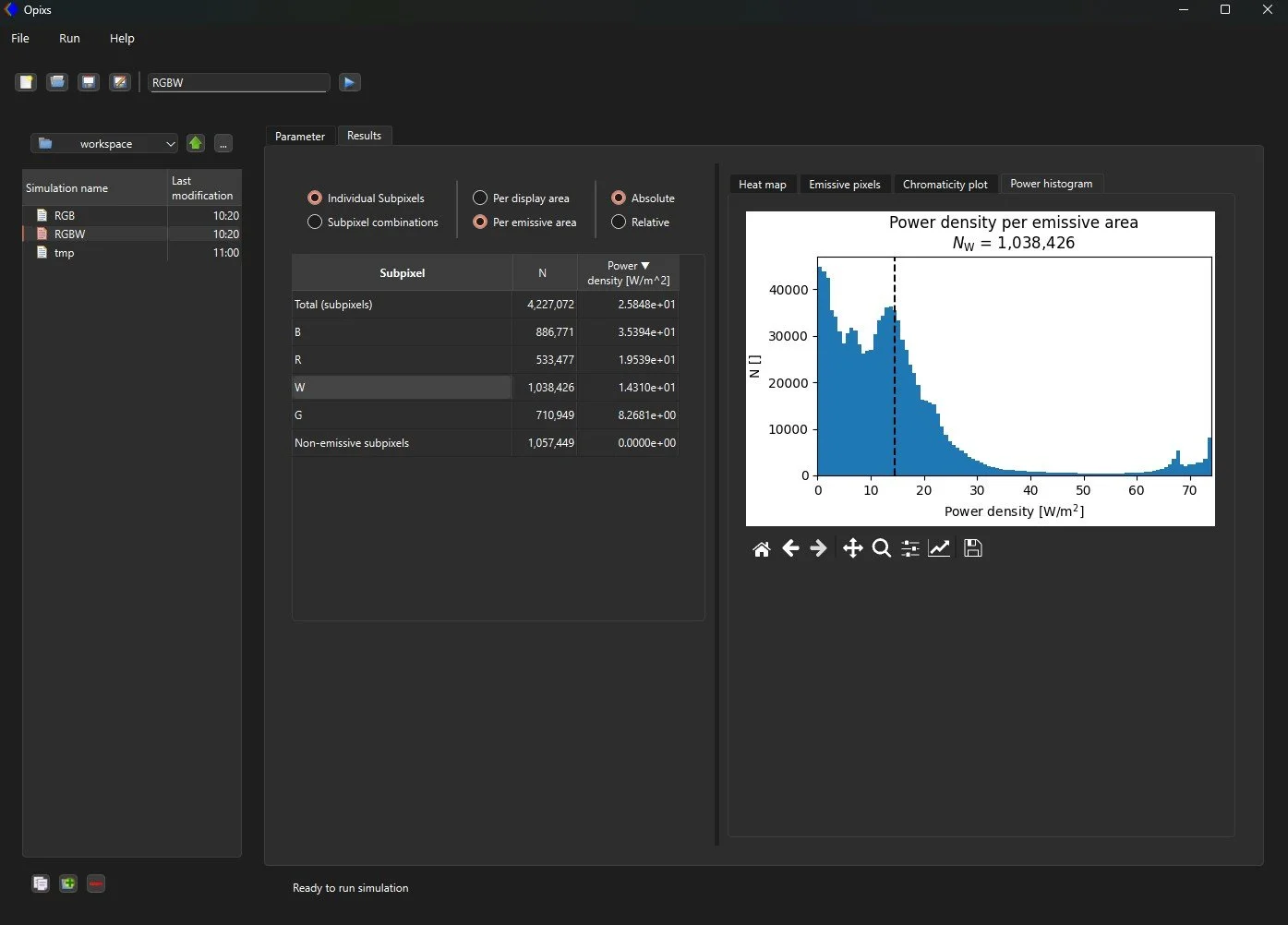
Power histogram – RGBW white subpixel
Power histograms quantify not only total consumption, but the statistical distribution of subpixel load. In the RGBW case, the white subpixel histogram clearly illustrates how luminance demand is redistributed, reducing peak power densities on coloured emitters and enabling a more balanced operating regime.
Taken together, these analyses allow pixel concepts to be compared on equal footing: same image, same luminance target, different subpixel layouts—yielding directly comparable power, colour utilisation, and stress distributions. Opixs supports informed pixel design decisions early in development, helping reduce iteration cycles long before fabrication.
Christmas invitation
If you’d like to explore these analyses yourself, request an Opixs trial license and put it to the test over the holidays. We’re closing for Christmas on the 22nd — so get in touch today and unwrap pixel-level insight before the year ends.
Setfos 6.0 and the new thermal module
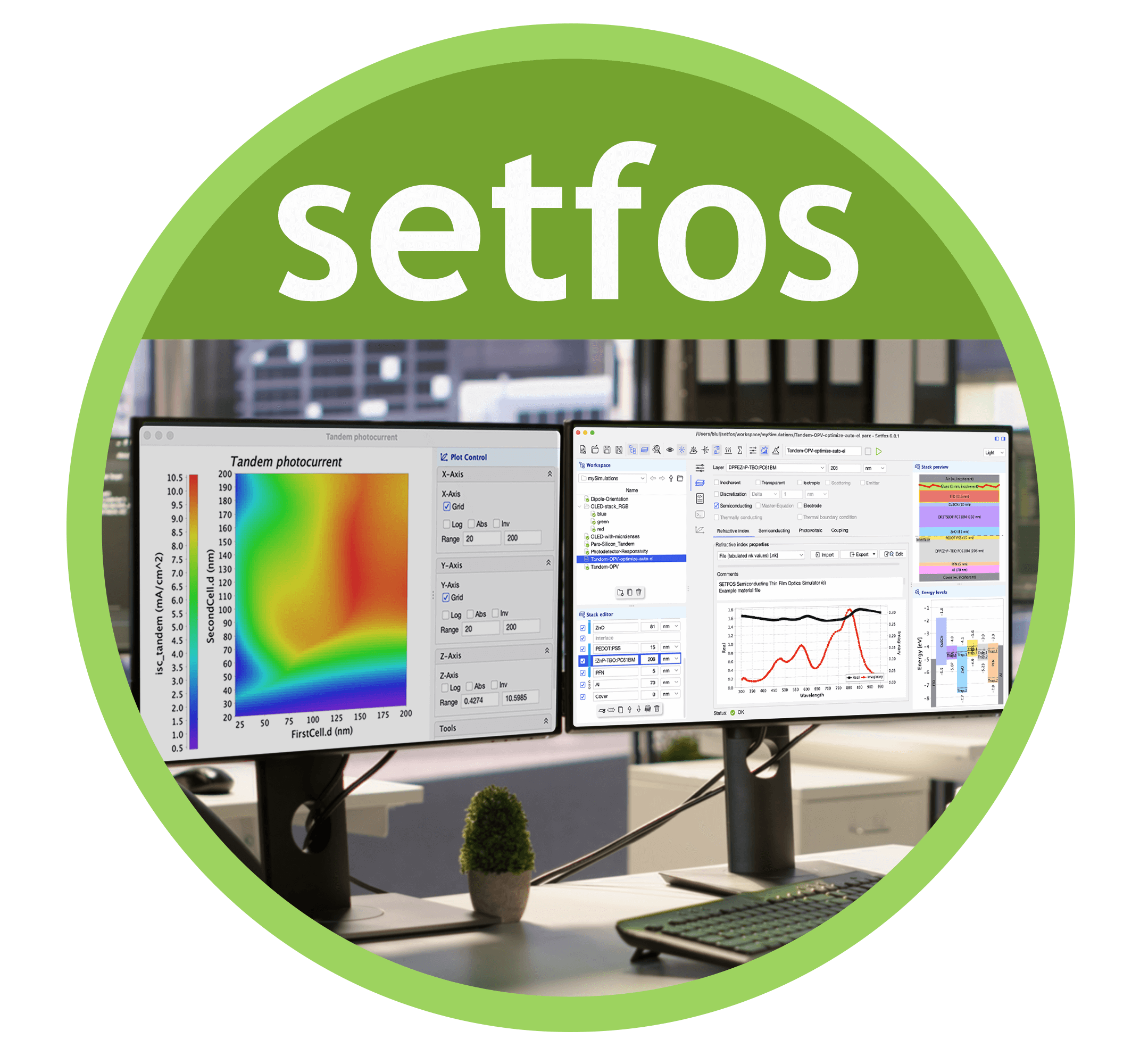
Setfos 6.0 was released in November and marked a major step forward in device simulation in 2025. With the introduction of the new thermal module, Setfos now allows researchers to model electrical, optical and thermal effects within a single, self-consistent framework. This makes it possible to study self-heating, temperature-dependent transport, and degradation-relevant effects in OLEDs and solar cells with much greater realism. Setfos 6.0 also brings improved workflows, extended material models, and enhanced post-processing, helping users move faster from physics to insight.
👉 Explore Setfos 6.0 and see how thermal effects change your device design:
https://www.fluxim.com/newsletters/2025/11/4/setfos-6-release
New research projects MetroPero and FADOS
Novel metrology equipment & protocols for perovskite-based photovoltaics reliability enhancement “MetroPero”
MetroPero is a 36-month Swiss–Korean R&D project (Nov 2025–Oct 2028) focused on accelerating reliability assessment for perovskite and perovskite/Si tandem solar cells. Funded by Innosuisse and KIAT, the project brings together Fluxim, CSEM, KIER, and TNE TECH to develop next-generation stress-testing equipment with in situ, multi-modal metrology (electrical, optical, PL, EL). By tracking degradation spatially and in real time under realistic stress conditions, MetroPero aims to identify dominant failure modes and establish accelerated aging protocols that support future industry standards for long-term PV stability.
Read more about MetroPero here
Fundamentals and Applications of Doped Organic Semiconductors“FADOS”

FADOS is a 48-month Marie Skłodowska-Curie Doctoral Network (starting Sept 2025) bringing together leading European universities, research institutes, and industry to advance doped organic semiconductors. The project goes beyond steady-state electronics, linking doping to thermal, mechanical, and even biological properties, enabling switchable and reconfigurable devices. Covering applications from OLEDs and photovoltaics to logic and modeling, FADOS combines fundamental research with strong industrial relevance. Doctoral candidates receive interdisciplinary training, including industry secondments, strengthening Europe’s competitiveness and enabling new, sustainable semiconductor technologies.
Fluxim team news
New Fluximers
As we look back on 2025, we were delighted to strengthen the Fluxim team with two new colleagues. Dr. Matthias Diethelm returned to Fluxim after postdoctoral work at Empa and the University of Oxford, bringing deep expertise in CIGS and perovskite solar cells, ion-based optoelectronics, OLEDs, and photovoltaics and to be our new webinar host!. We also welcomed Daniel Parsons as a PhD student. Following his work at the UK’s National Physical Laboratory on semiconductor characterisation for photovoltaics, Daniel began his research at Fluxim on degradation and optimisation of indoor PV devices within the MENTOR project, in collaboration with UPC.


Thank You to Daniele
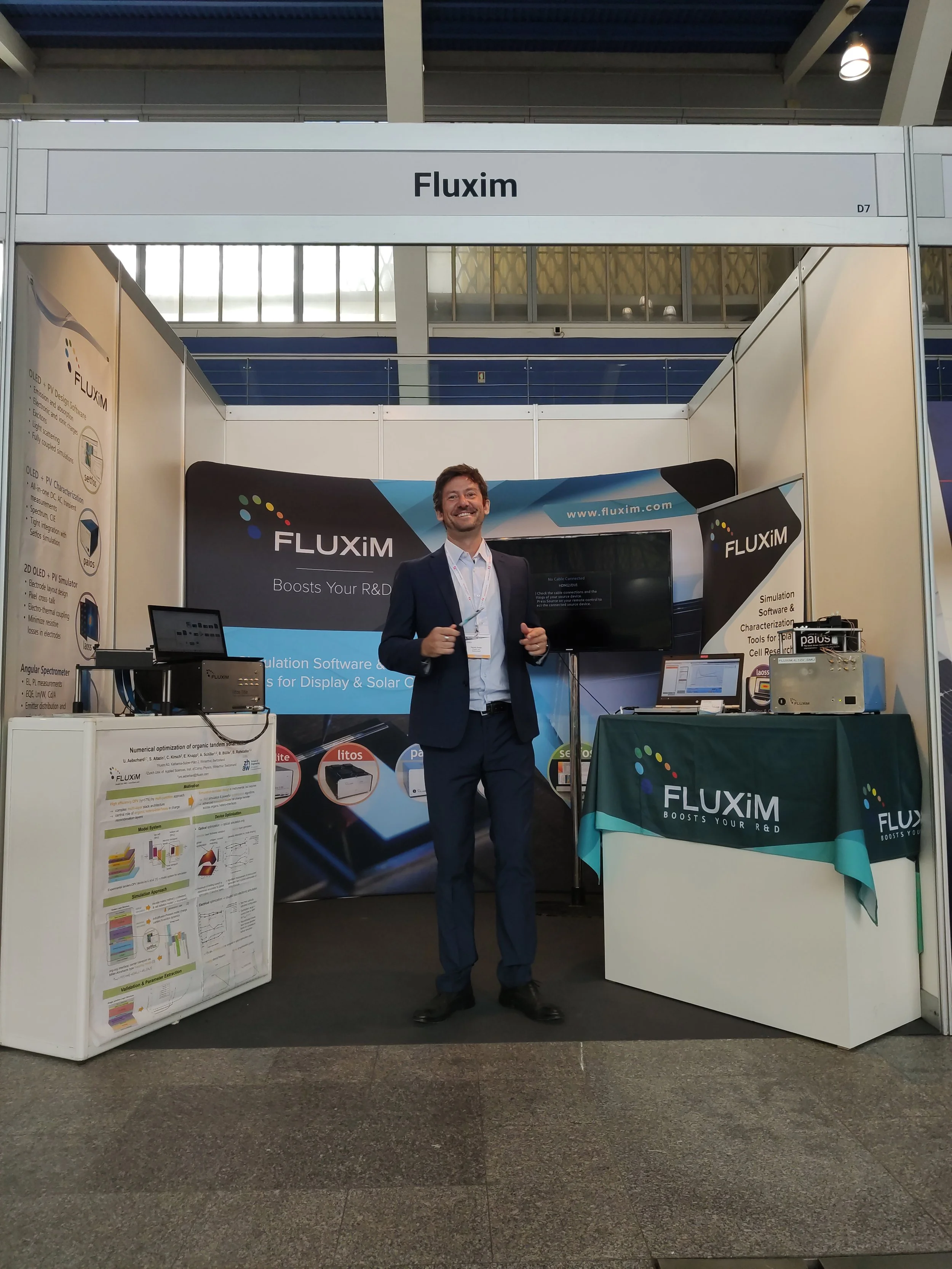

After seven years shaping Fluxim’s sales and marketing strategy, our colleague and friend Dr. Daniele Braga—well known to many of you—moved on to new opportunities. We thank him for his important contributions to Fluxim’s global recognition as a supplier of cutting-edge R&D tools. We wish him Viel Erfolg in his new role as Chief Business Officer at Oculux Technologies—where we’re sure he’ll still be thinking about physics.
Our favourite research papers of 2025
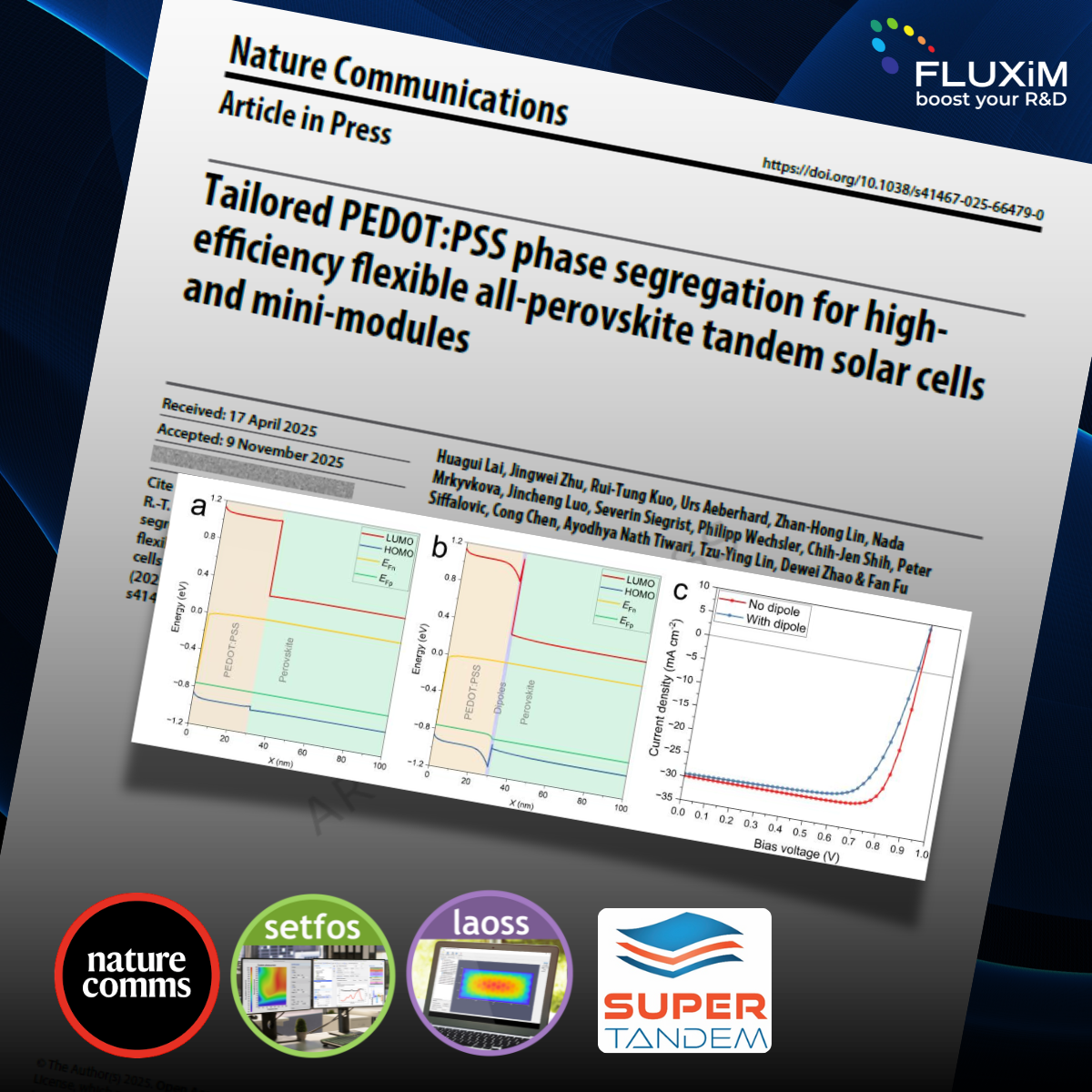
In this Nature Communications study, Huagui Lai, Fan Fu, Tzu-Ying Lin, Dewei Zhao, and colleagues from Empa, ETH Zürich, Sichuan University, National Tsing Hua University, the Slovak Academy of Sciences, and Fluxim AG investigate the role of ultra-thin PEDOT:PSS layers at the buried interface.
They show that PEDOT:PSS can form a vertically segregated structure that gives rise to interfacial electric dipoles, limiting hole extraction. By introducing the non-ionic surfactant Triton X-100, surface PSS accumulation is reduced, improving interfacial energetics and device reproducibility.
This enables flexible all-perovskite tandem solar cells with efficiencies up to 25.4% and proof-of-concept flexible mini-modules reaching 19.7%.
Simulation was used to support and rationalize the experimental findings. Drift–diffusion simulations using Setfos, performed by Urs Aeberhard, were applied to model dipole-induced losses at the PEDOT:PSS/perovskite interface, while hashtag#Laoss simulations were used to analyse loss mechanisms, guide laser scribing and layout optimisation, and explore scalable module designs with projected efficiencies exceeding 24%.
This work was performed in the framework of the Horizon Europe project SuperTandem, and we expect it to be of strong interest to the project partners and coordination team.
Congratulations to Huagui Lai and all co-authors on this excellent piece of work.
Read the openaccess paper here: Lai, H., Zhu, J., Kuo, RT. et al. Tailored PEDOT:PSS phase segregation for high-efficiency flexible all-perovskite tandem solar cells and mini-modules. Nat Commun (2025).https://doi.org/10.1038/s41467-025-66479-0

In this second Nature Communications study, Debasish Barman, Youichi Tsuchiya and Chihaya Adachi from Kyushu University’s Center for Organic Photonics and Electronics Research (OPERA) and I²CNER devised a novel design strategy for multi‑resonance charge‑transfer (MRCT) thermally activated delayed‑fluorescence (TADF) emitters. By extending the C–C bond between the carbazole donor and the boron‑based acceptor, they created DBACzPh and DBADCzPh emitters that adopt a nearly 100 % horizontal molecular orientation in a high‑polarity PPF host. This alignment, together with balanced carrier transport and efficient host‑to‑dopant energy transfer, boosts light out‑coupling; the DBADCzPh device achieved a record sky‑blue external quantum efficiency of about 42.5 %.
Simulation played a key role in supporting the experimental findings. Optical modelling and angular‑dependent PL simulations performed with Fluxim’s Setfos confirmed the horizontal orientation of the emitters and linked it to enhanced out‑coupling efficiency. The strong TADF emission and high photoluminescence quantum yield (≈91 %) stem from accelerated reverse intersystem crossing via ^3LE states. Congratulations to Debasish Barman and the OPERA team on this excellent work.
You can read the open‑access paper here:
Barman, D., Tsuchiya, Y. & Adachi, C. “Horizontally oriented MRCT‑type TADF emitter achieving EQE over 40 % for sky‑blue OLED.” Nature Communications 16, 5023 (2025).
Coming Early 2026
Next research webinar with Dr. Fanny Baumann

Webinar – January 20, at 10:00am CET
Invited speaker Dr. Fanny Baumann (ICN2) will present her latest work on multimodal, in-situ tracking of strain, optoelectronics, and performance in perovskite solar cells operating at 85 °C.
This is followed by a live demonstration of Setfos 6.0 by Fluxim’s Dr. Matthias Diethelm, highlighting the new thermal module and degradation models.
A must-attend webinar for researchers focused on stability and thermal effects in OLEDs and solar cells and great opportunity for Setfos users to see the new features beiing used by an expert.
Fluxim at ICDT China

ICDT 2026 – International Conference on Display Technology takes place 31 March–3 April 2026 in Chongqing, China. As SID China’s flagship display conference, ICDT covers OLED, micro-OLED, QD-OLED, microLED, LCD, flexible displays, backplanes, and driving electronics.
Fluxim will attend to connect with OLED and microdisplay R&D teams, represented on site by Fluxim’s Dr. Lu Zhang together with our distributor GSI/HTTR. Meet us to discuss how Setfos, Laoss, Paios, Phelos, Opixs and Litos support efficient, reliable display development—from stack design and simulation to characterization and stability testing.

You can contact Lu directly on WeChat to arrange a meeting to discuss our software and measurement instruments.
A new measurement instrument coming in 2026

Vitios, our next measurement instrument, is launching early next year. Our 5th instrument brings multispectral imaging and electrical characterization together in one compact package. EL and PL imaging, lock-in thermography, impedance spectroscopy, JV —it’s all there, spatially resolved and designed to show why a device behaves the way it does. If you’re trying to understand degradation, defects, or performance limits Vitios is built exactly for that moment in your R&D workflow.
We’ll share more on Vitios as the launch approaches.
A festive Fluxim-themed musical finale
Thank you for your continued trust in our R&D tools in 2025.
In the spirit of the season, we would like to share a small, light-hearted Christmas song written by Beat, offering a glimpse into what some Fluximers get up to when we are not building cutting-edge R&D tools. Parts of it are in Swiss German — see if you can translate them.
“Mir fiired hüt es Wiehnachtsesse!
das wirsch Du nümmeh vergässe!
Mir sind stolz, bi Fluxim z’sii!
Enabling tools for R&D!
Setfos, Paios und no vil meh!
Simulation und Messinstrument
Setfos, Paios und no vil meh!
Mit vil Chopf, Herz und Hand!
Litos, Litos-Lite und Phelos dazue!
verkaufed mir odr bruucheds selber!
Offerte schriibe und Webinars halte
das isch viel Arbeit und gaht immer schneller!
Let’s have a good time tonight
eat and drink the entire night
Tonight Fluxim covers it all,
This is great one for all!
Fluxim enabling tools for you!
If there’s a bug we fix it soon!
Don’t you believe that this is true?
Please, enjoy it’s full moon!
Mir fiired hüt es Wiehnachtsesse!
das wirsch Du nümmeh vergässe!
Mir sind stolz, bi Fluxim z’sii!
Enabling tools for R&D!”

Beat Ruhstaller and the ZHAW band perform on a cold Christmas evening on a rooftop somewhere in Winterthur…..
Mir wünsche eu schöni Wiehnachte, guete Rutsch is neue Jahr und nur s’Beschte für 2026!
Your Fluxim Team