
Research Blogs

Investigating Current Matching and Hysteresis in Perovskite-Silicon Tandem Solar Cells with Drift-Diffusion Simulations
Perovskite-silicon tandem solar cells are revolutionizing photovoltaics, but optimizing current matching between layers is critical for achieving peak efficiency. A mismatch can lead to power losses, limiting overall performance. In this blog, we explore how optical and electrical simulations help fine-tune device design, ensuring both sub-cells generate maximum power.
Discover how precise modeling can boost tandem cell efficiency and accelerate the path to commercialization.
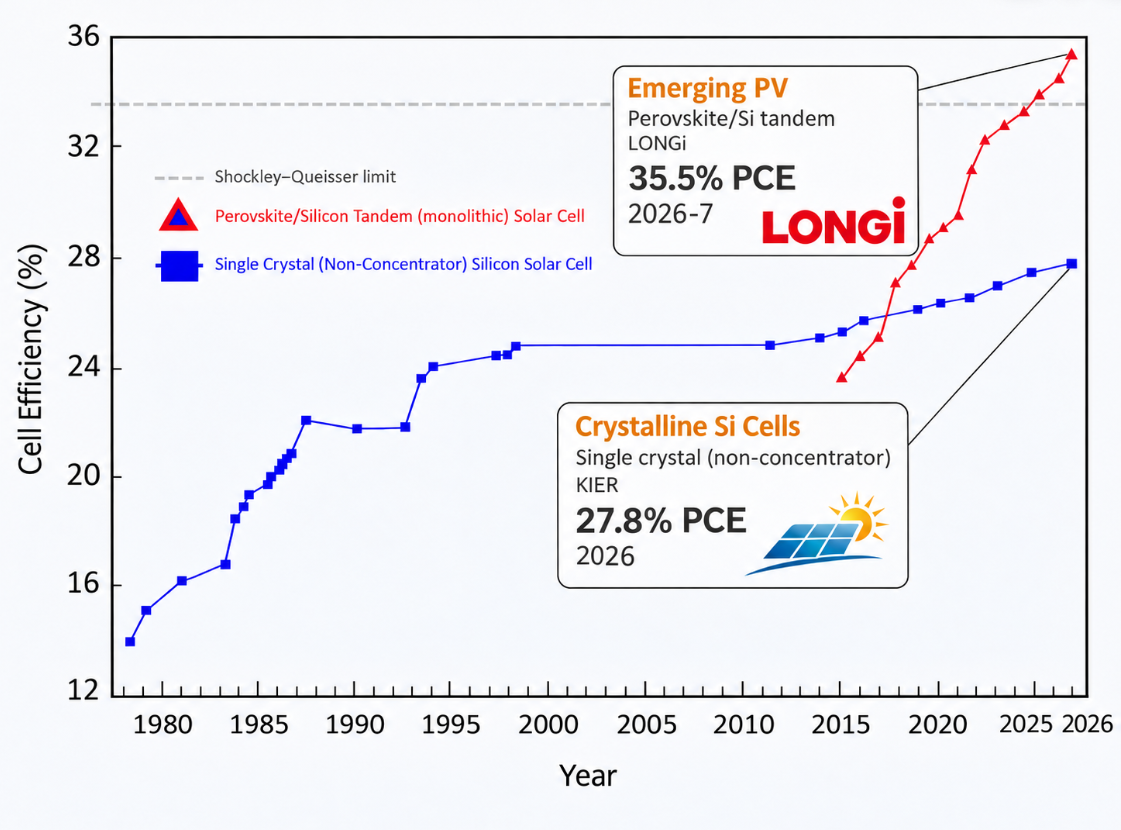
Highest Efficiency Solar Cells: Perovskite Solar Cells (2026 Update)
Discover LONGi's latest 35.5% perovskite–silicon tandem solar cell efficiency record, announced in July 2026. Explore how solar cell simulations help optimise performance and advance multi-junction photovoltaic technologies.

Increase the efficiency of a Perovskite-Silicon Tandem Solar Cell with a Full Electro-Optical Simulation
The emerging solar cell technology of perovskite solar cells already reach an efficiency of 25.5%. The advantage of perovskite solar cells is that they absorb light better in the visible part of the spectrum whereas silicon-based solar cells can absorb near-infrared photons as well. This means that by combining these two technologies in tandem multi-junction solar cells, it will be possible to absorb light over a wide range of the spectrum very efficiently. Theoretically, efficiencies up to almost 40% are expected to be possible.
In this blog post, we will show how SETFOS can be used to analyze a tandem solar cell optically as well as electrically. This simulation approach reveals bottlenecks in the optimization and shows pathways for improvement. This study has been presented at the EUPVSEC 2020 by Urs Aeberhard.

Numerical Optimization of Organic and Hybrid Multijunction and Tandem Solar Cells
We present a numerical optimization of organic and hybrid multijunction solar cell devices , using an integrated optoelectronic device simulation approach that captures the essential properties of the complex multilayer structures, such as, light scattering at both macroscopic and rough thin film textures, resonator effects in coherent stacks, and the impact of organic interface properties for the design of efficient recombination layers . The optimization capabilities of the numerical device simulation framework are illustrated in the examples of textured perovskite silicon and all organic tandem solar cells.