

Litos Lite
ISOS-Compliant Stability Tester with Parallel JV & MPP Tracking
Litos Lite is a platform to perform parallel JV and stability measurements on organic, perovskite solar cells, perovskite/silicon tandem solar cells, and minimodules.
Litos Lite Workflow
The Litos Lite workflow guides researchers from sample mounting and software setup through measurement recipe configuration and results analysis for parallel JV and stability measurements.
-
Custom-made sample holder
Place the sample in the custom-made holder. The holder shown is for tandem solar cells. Other versions are available, including a mini-module extension.
-
Sample interface
Define samples, layouts and channel assignments before starting a measurement workflow.
-
Measurement interface
Configure measurement recipes for JV scans, MPP tracking and stability protocols.
-
Results interface
Review JV curves, stability data and measurement results in the software interface.
Litos Lite can perform JV measurements on up to 56 lab-scale devices (16 for tandems) and up to 4 minimodules in 4-wire sensing. Choose the stressing condition for each individual device. The temperature of the samples can be cycled from 25 °C up to 85°C under 1-sun illumination intensity.
Litos Lite is fully compatible with standard ISOS protocols for stability testing, making it ideal for both academic and industrial photovoltaic R&D.
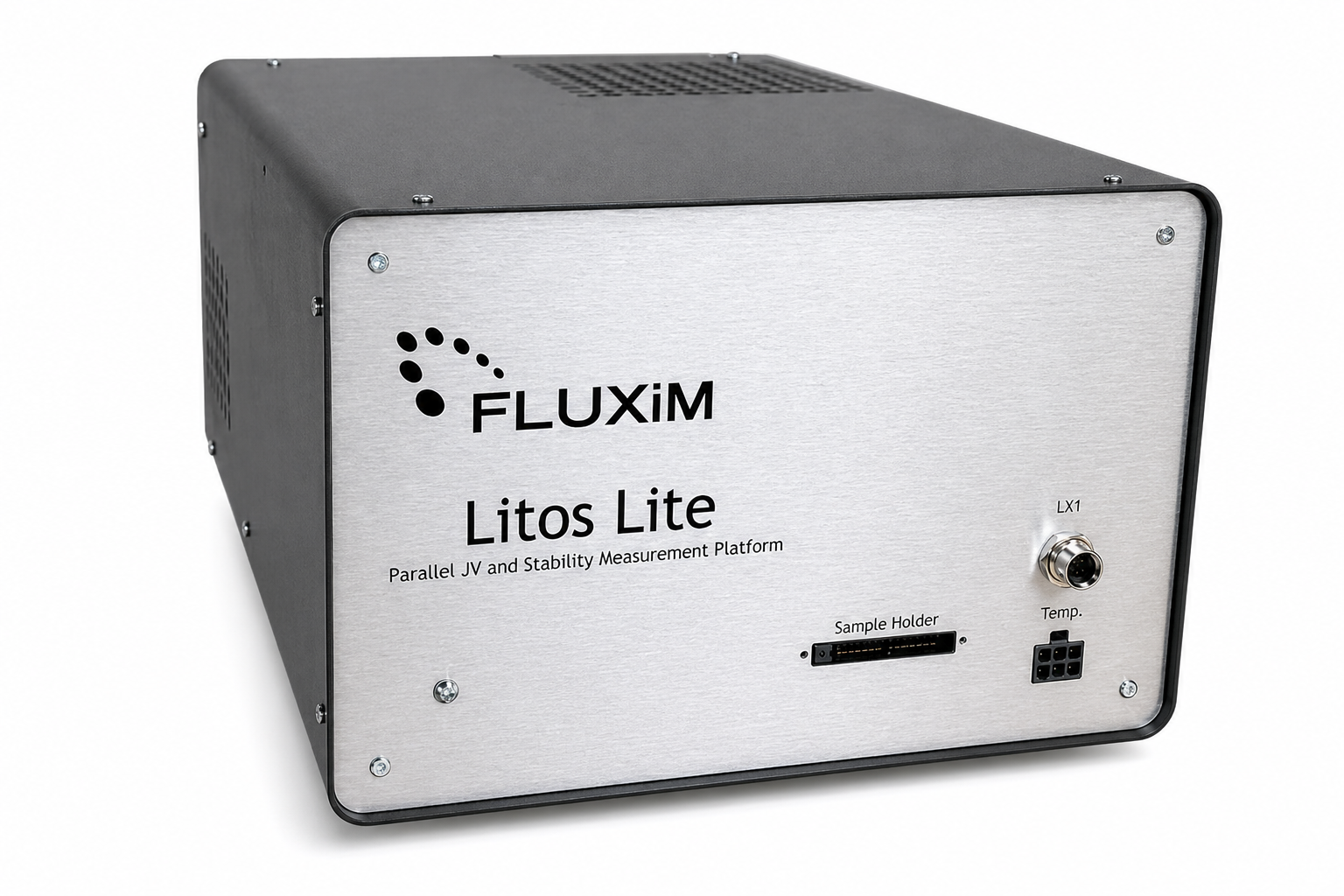
Litos Lite - parallel JV and stability measurement platform for perovskite solar cells

Litos Lite with Optional Mini Module Extension

Litos Lite small custom sample holder

Custom sample holder for Tandem Solar Cells

Get a Quote for Litos Lite
Technical Questions?
Talk to our Litos Lite Product Manager,
Dr. Antonio Cabas Vidani or
Email: info@fluxim.com
Telephone: +41 44 500 47 70

Choose the Right Tool for
Solar Cell Stability Analysis
| Stability Requirements |
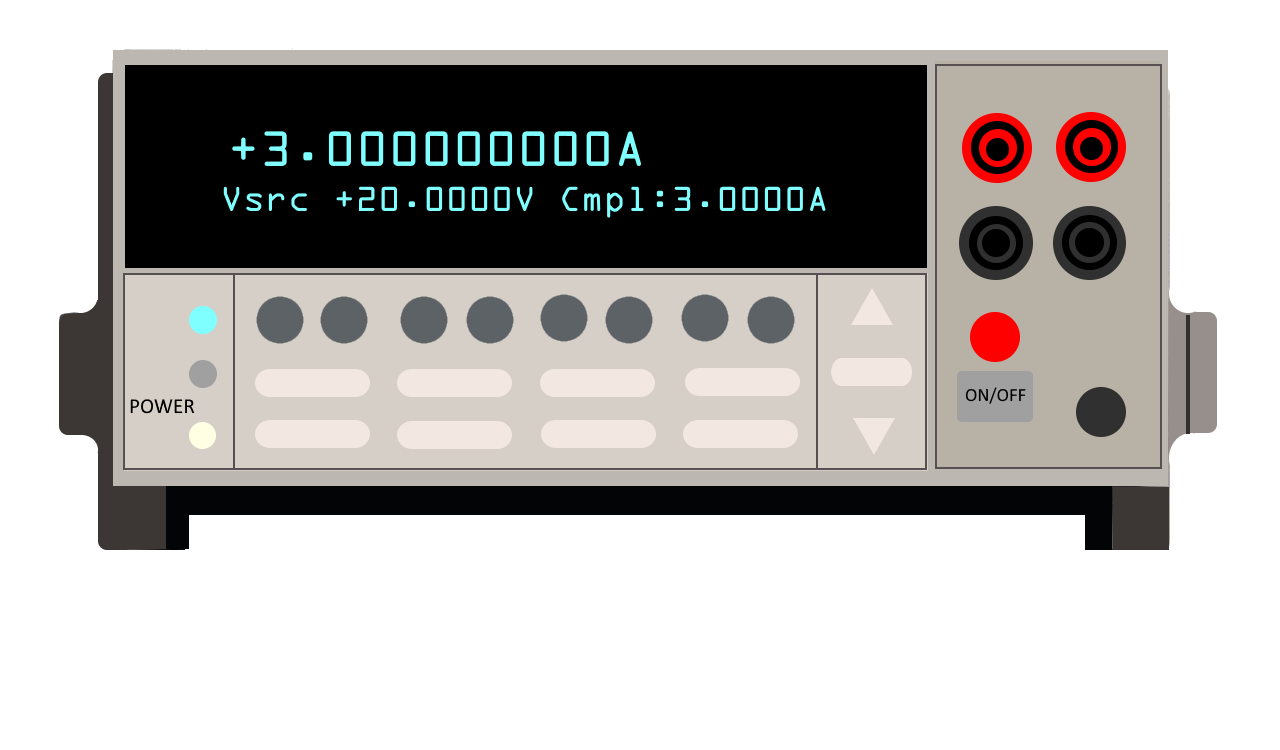
SMU
|
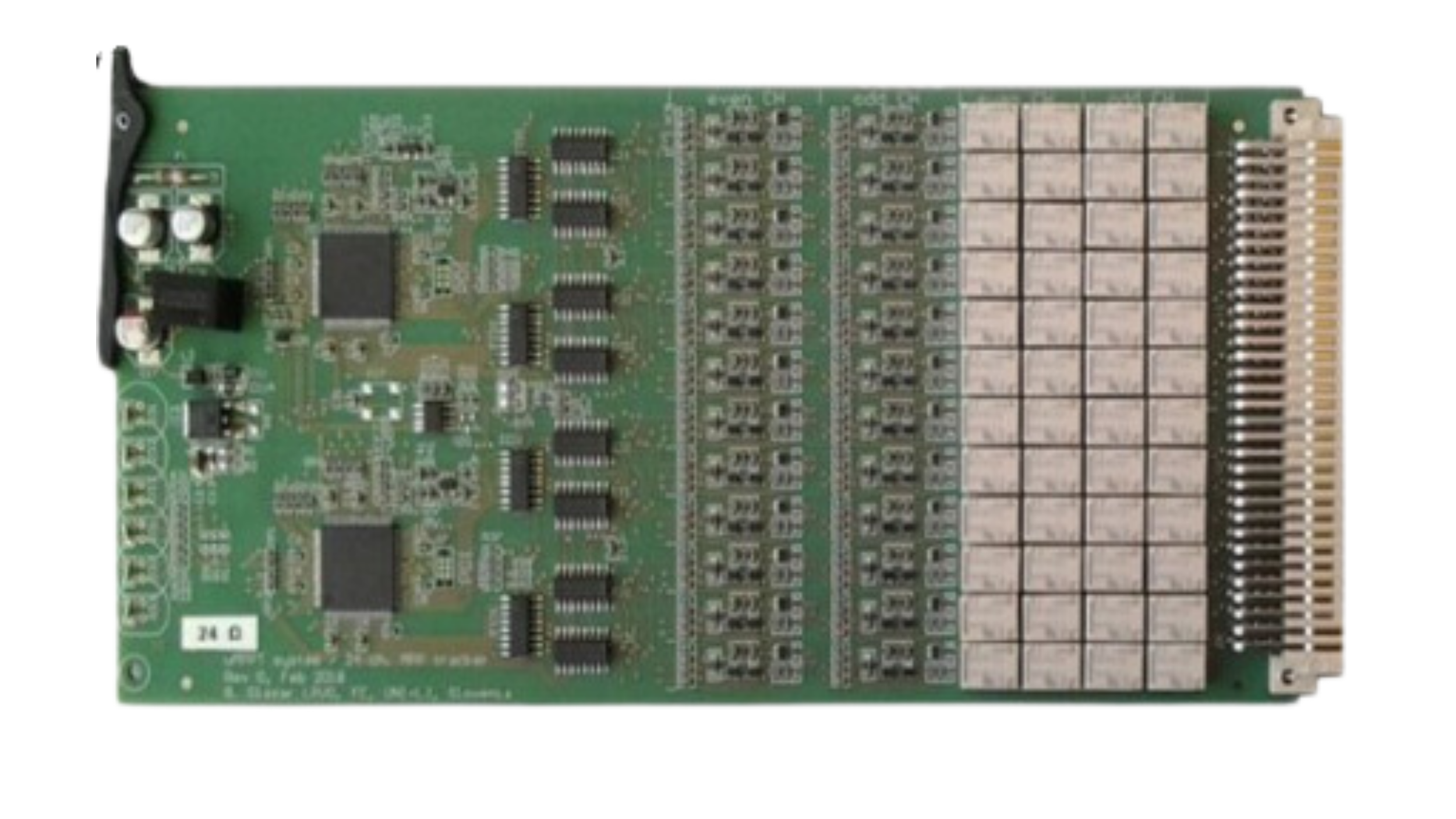
MPP Tracker
|

Litos Lite
|
|---|---|---|---|
| Parallel Stress (MPP or constant V) | ✕ | ✓ | ✓ |
| Parallel JV | ✕ | ✕ | ✓ |
| Current-Voltage (JV) in 4 Quadrants | ✓ | ✕ | ✓ |
| Software Controlled Sun Simulator | ✕ | Limited | ✓ |
| Cycling (Light, JV, MPP...) | ✕ | ✕ | ✓ |
| Environment Control (T, Humidity,...) | ✕ | Limited | ✓ |
| ISOS Protocols Compatibility | ✕ | ✕ | ✓ |
| Stress labscale solar cells and mini-modules | ✓ | Limited | ✓ |
Litos Lite supports parallel stress, parallel JV, four-quadrant JV, software-controlled sun simulator operation, cycling, environmental control, ISOS protocol compatibility, and stressing of lab-scale solar cells and mini-modules.
Advantages of using Litos Lite
Up to 56 devices in parallel
Up to 56 independent channels for parallel measurements and stressing. Max current 50 mA. Voltage range ±9.5 V.
Measure up to 16 tandem solar cells
Measure up to 16 perovskite/silicon tandem solar cells in parallel.
Customized sample holder
Sample holders can be customized to your sample layout or layouts.
Temperature control from 20 to 90 °C
Peltier-based temperature control. During cycling, the range is 25 to 85 °C.
Up to 4 large-area samples in parallel
High-current, high-voltage module. Max current 400 mA. Voltage range ±19 V.
Software-controlled illumination
Wavelabs solar simulators can be controlled by Litos Lite. Other simulators can be controlled via Python APIs.
Professional measurement automation software
Automated measurements, live control, cycling between JV and stressing, and sweeps of light intensity, temperature, and JV scan rate.
Litos Lite advantages include up to 56 independent channels, tandem solar cell testing, customized sample holders, temperature control, high-current and high-voltage modules, software-controlled illumination, and measurement automation software.
Which Litos Lite setup fits your lab?
High-throughput researcher
The yield hunter
Low process repeatability — statistics are everything
"One device at a time is not an option. We need numbers. We fabricate tens of lab-scale devices in a short cycle."
The challenge
With low yield and poor device-to-device repeatability, testing a handful of samples makes it impossible to draw statistically meaningful conclusions — and every wasted run costs days.
How Litos Lite helps
A sample holder tailored to your exact device layout lets you stress and measure the entire batch in parallel, overnight, under controlled conditions — turning a week of testing into a single experiment.
Key specs
- Channels: Up to 56 independent channels
- Sample holder: Custom layout; spring contacts; sealed
- Stress modes: MPP tracking, constant-V or constant-I per device
- Temperature: 25–85 °C with cycling; integrated T/RH sensors
- Atmosphere: N2-flushable pump down to a low vacuum
Flexible integrator
The scaling explorer
Evolving geometry, custom test infrastructure
"Our devices and setup keep changing — we need a system that keeps up."
The challenge
Device geometry shifts constantly — from small unencapsulated cells to large minimodules — and the lab already runs its own solar simulator and environmental chamber.
How Litos Lite helps
Banana connectors and an extended voltage and current range accommodate any device size or encapsulation state, while a Python API integrates with your existing simulator and chamber — no infrastructure change needed.
Key specs
- Channels: Up to 16 devices in parallel via banana connectors
- Minimodules: Up to 4 channels at 400 mA / ±19 V each
- Precision: 4-wire (Kelvin) sensing available
- Integration: Python API to integrate 3rd party electronics
Software Suite for Parallel Measurement (SPM)
The Suite for Parallel Measurement (SPM) is the dedicated software environment for Litos Lite. Developed and maintained by Fluxim, it supports the full workflow for parallel JV and stability measurements, from sample definition and automated measurement setup to live monitoring, analysis, and export.
Set sample properties (name, polarity, area…) → create measurement automation → follow live measurement → analyze and export results.
Litos Lite Workflow
Automate your measurements
Loop your measurement. Ideal for statistical analysis. Devices never behave the same twice in a row.
Sweep any measurement parameter. Repeat the measurement with increasing temperature. Automate JV repetition with varying voltage scan rate.
Specify the stressing conditions for each device. Perform it in parallel on all devices.
Integrate the control of third-party electronics with Python. Embed the control of a shutter, a home-made sun simulator or a hotplate within SPM. Include it as part of the measurement recipe.
Use pre-made ISOS-compatible recipes.
Control the MPP tracking algorithm
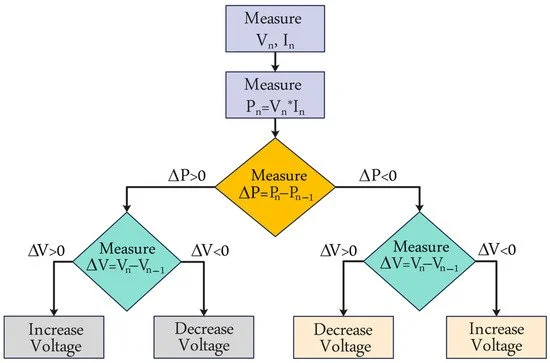
The MPP tracking of Litos Lite is a modified version of the perturb & observe (P&O) algorithm.
Change the Algorithm
We know that the algorithm is not a one-size-fits-all solution. Your device might not respond properly to the default settings. You can therefore adapt the algorithm settings, vary the magnitude of the voltage step during MPP tracking, and see how your device responds.
Watch how easy it is to stress your solar cells
This SPM software demo shows how Litos Lite supports parallel JV and stability measurements through automated recipes, live monitoring, MPP tracking, temperature control, sweep functions, and data export. Researchers can configure devices, run reproducible workflows, and analyze multiple samples under identical test conditions from one integrated software environment.
Sample Holders
Litos Lite sample holders are tailored to your device layout and selected channel configuration. We offer:
Custom holders for precise alignment (single junction and tandem devices)
Swappable holders for different layouts
Customizable to any sample layout
Switching between configurations is effortless — just clip in a new holder and the software will recognize it.
Simple and Secure Loading
Each holder includes an alignment guide to position your samples. Add masks if needed, then secure everything by screwing down the cover. Spring-loaded legs ensure reliable electrical contact.
Controlled Atmosphere
All sample holders include gas inlets and outlets and can be sealed with a quartz window to maintain a nitrogen-rich environment. Connect it to a pump if you want a light vacuum. Load the sample holder inside a glovebox and perform the measurement outside.
Built-in Sensors
Environmental sensors inside each holder track temperature and humidity in real-time, providing accurate data throughout your measurement routine.
Litos Lite Testimonials

“5 star recommendation for LITOS LITE and FLUXIM support. A great choice for my lab, for setting up a nicely working system for monitoring stability under different conditions of our perovskite solar cells! Great communication with FLUXIM for installation, training and support! Highly recommended!”
Prof. Giulia Grancini
Director of ERC HYNANO project and pvsquared2 team and University of Pavia, Italy
Lab set-up: Litos Lite with 24 channels, temperature controlled sample holder and Wavelabs Sinus-70 solar simulator.

“Highly recommended. We have one in our labs and we are saving hours of work by measuring many samples at one time. No time to build our setup up so this was a great purchase!”
Prof. Dr. Juan-Pablo Correa-Baena
Georgia Institute of Technology
Lab set-up:Litos Lite with Sinus-70 integration, Litos for PV, Paios, atmosphere control and in situ optical monitoring
Watch how LITOS LITE streamlines stability testing workflows in advanced solar cell R&D. This demo covers setup, JV sweep automation, MPP tracking, and how Litos Lite supports major ISOS protocols like ISOS-D, ISOS-L, and ISOS-V.
Litos Lite Compatibility with the ISOS protocols
ISOS protocols are internationally recognized procedures for evaluating the long-term stability of solar cells under defined testing conditions. Whether you are running dark storage (ISOS-D), light soaking (ISOS-L), or voltage bias stress (ISOS-V) tests, selecting the right measurement platform is essential. The table below shows which ISOS protocols can be carried out with Fluxim's Litos Lite, a high-throughput platform for parallel JV and stability testing of organic, perovskite, and tandem solar cells. The Litos Lite software, SPM, includes pre-loaded ISOS test routines and enables users to generate publication-ready ISOS-labelled plots.
Do you want a deeper explanation of each protocol and how they relate to solar cell stability? Read our full guide: ISOS Protocols for Perovskite Stability Testing.
If your lab requires high-throughput, ISOS-compliant testing, get in touch with us today to see how Litos Lite can support your solar cell research.
Litos Lite Technical Specifications
Below you’ll find the technical specifications for Litos Lite, Fluxim’s high-throughput platform for solar cell JV and stability testing, including support for ISOS protocols, tandem cells, and minimodule compatibility.
| Litos Lite Specifications | |
|---|---|
| Best For | High-throughput, high-precision JV & stressing of solar cells |
| Functionality | Parallel JV, stressing at MPP, constant-V, constant-J |
| Operation | Specify measurement conditions on each pixel |
| No. of Channels | 16, 24, 32, 40, 48, 56 |
| Sample Holder Design | Single chamber; custom-made; glovebox-compatible |
| Sample Geometry | Custom to device layout |
| Sample Holder Specifications | For each channel: ±10 V and 50 mA |
| Current Resolution | Best/typical: 1 µA / 5 µA |
| Illumination | External LED-based sun simulator or LED array. Software integration via Python API. Wavelabs Sinus 70/230 are already software integrated. |
| Temperature Range | 25 °C – 85 °C with cycling; 20 °C – 90 °C without cycling |
| Tandem Compatibility | Up to 16 perovskite/silicon tandems with top-bottom contact; ±10 V; 50 mA |
| 4-Wire Sensing | Available for front-plate channels to improve voltage accuracy by separating current supply and voltage measurement. Supports standard, high-current, and high-current/high-voltage configurations. Sample-holder channels use 2-wire sensing to retain up to 56 channels. |
| Mini-Module Extension | Up to 4 channels with 400 mA and ±19 V each. Flexible contacting via BNC or banana connectors. |
4-Wire Sensing Option
Series resistance distorts the determination of Fill Factor and Pmax of your devices. Cables, connectors, and resistance of the electrodes all contribute to it. With a silicon reference cell a 2-wire sensing measurement without calibration has a fill factor about 14% lower, while the power is about 20% lower. Litos Lite has a 2-step calibration procedure. It guarantees, assuming good contacting, results perfectly comparable with a 4-wire sensing system.
If your device has a common electrode (one electrode shared with multiple devices) or a high resistance contact pad, the 4-wire sensing is still recommended.
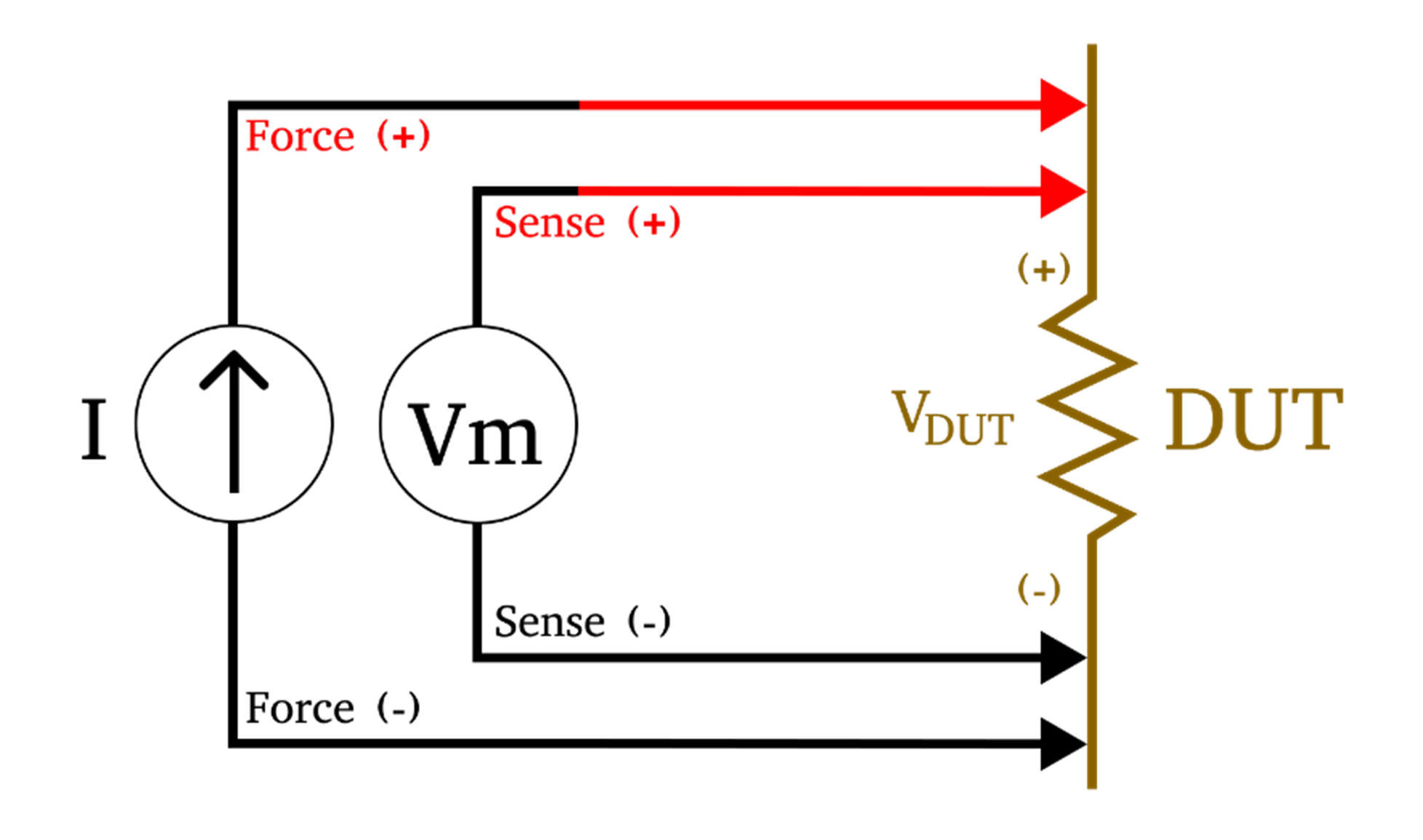

The electrical connections to the sample are designed according to the customer requirements.

Banana clip connectors for Litos Lite mini module extension
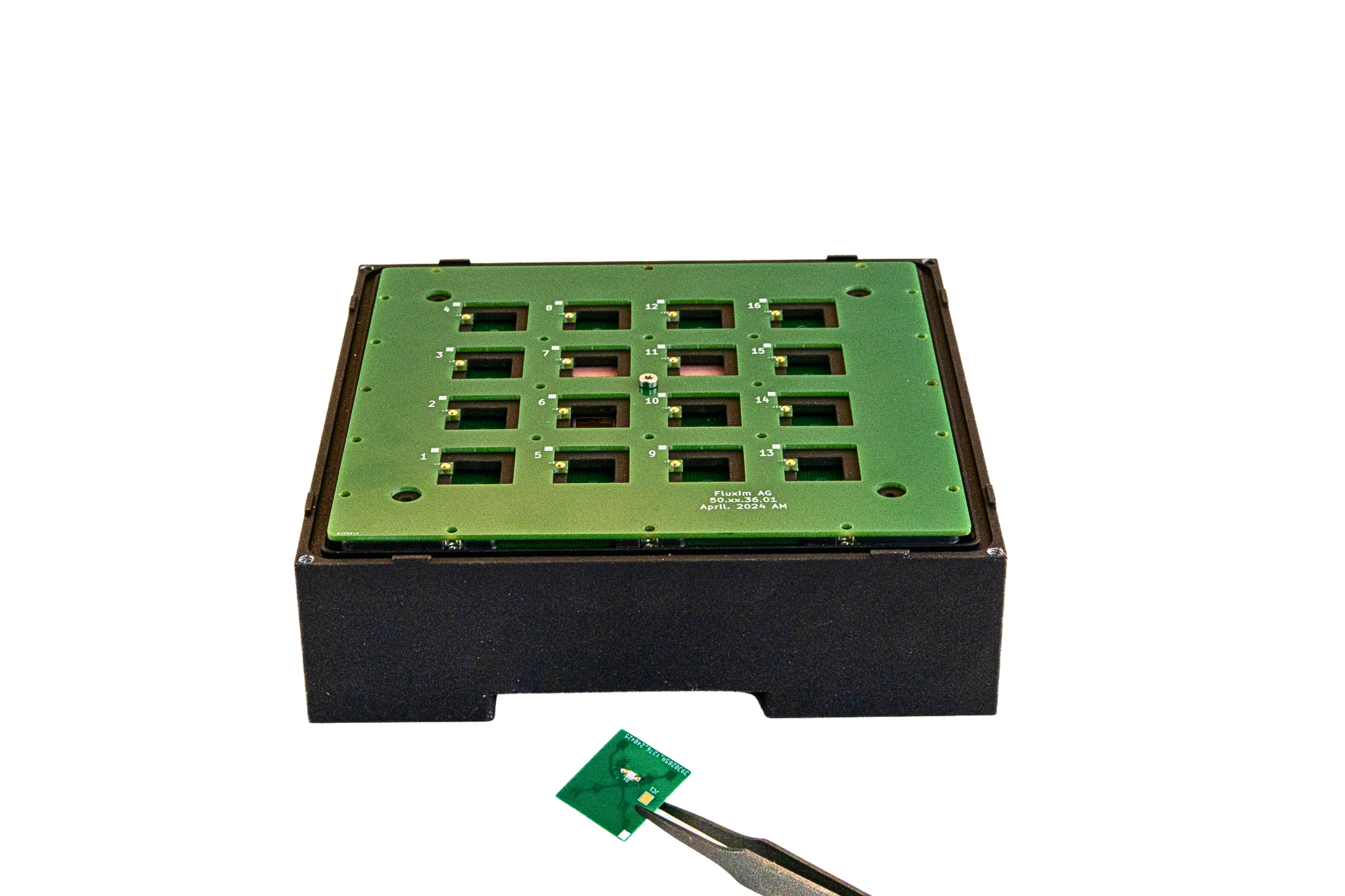
Tandem Solar Cell Sample Holder, customizable to your sample size.
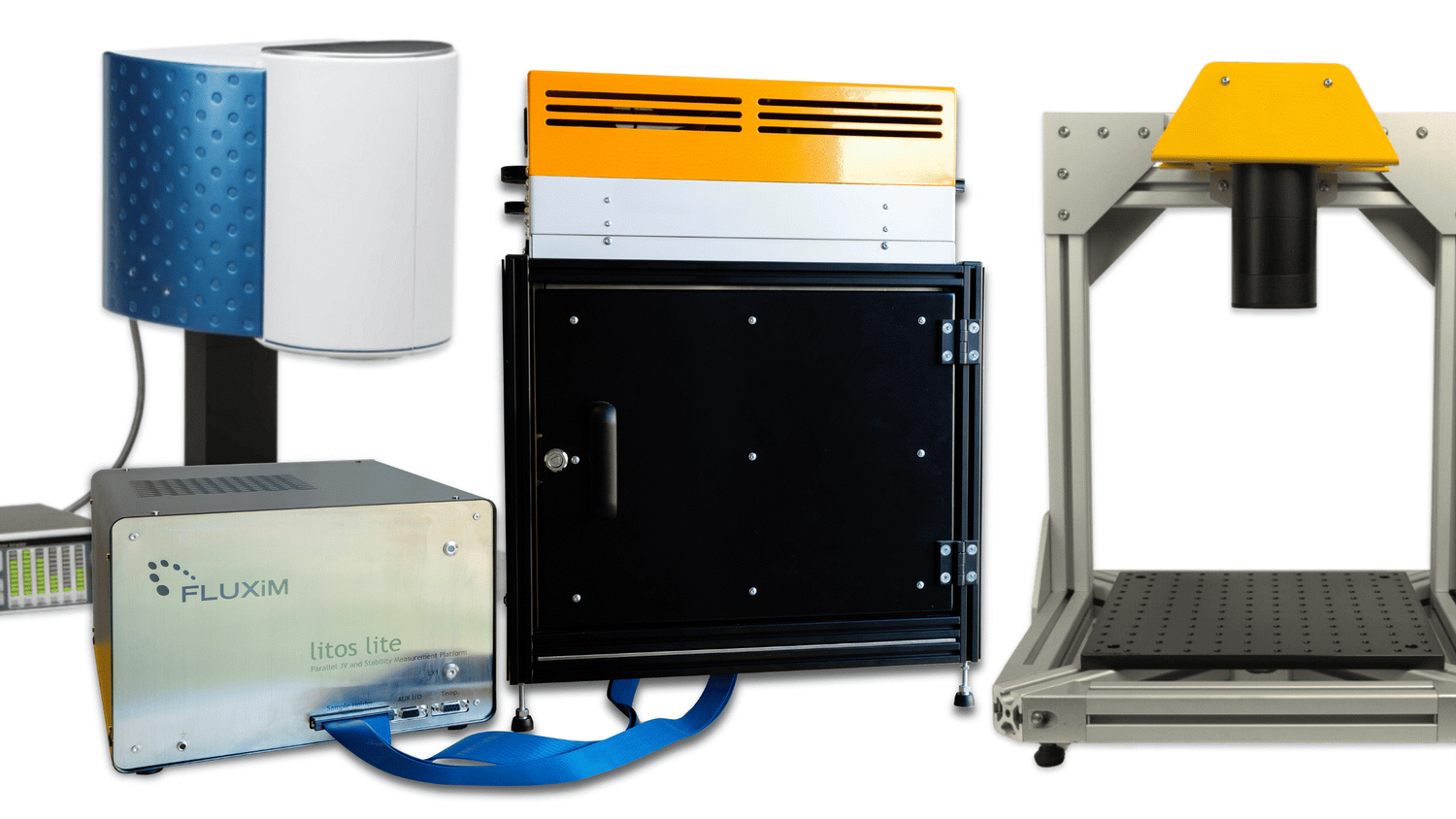
Litos Lite is compatible with most light sources if they can be controlled with a python script.

Litso Lite custom sample holder for tandem solar cell, heating stage shown.
Illumination - Solar Simulator or LED Array
Litos Lite is designed to work with different illumination sources. Fluxim can provide a ready-to-go solution with one of our chosen light sources. We can also integrate other solar simulators into the system (as a custom-made solution).
For efficiency measurements, accuracy depends on the light source. Litos Lite supports a range of class-leading LED and lamp-based solar simulators that can be controlled directly from our software. Users can adjust irradiance and—where supported—tune spectral channels, automate intensity/spectrum sweeps, and synchronize illumination with MPP tracking and other measurements.
LED solar simulators can maintain a constant emission spectrum at a constant level over time by self-adjusting the output with an integrated photodiode and spectrometer. This is a major advantage over standard Xenon lamp simulators when you need to perform a stability analysis: the output of the solar simulator does not degrade during the experiment.
Moreover, the different LEDs can be controlled independently to define light outputs that are specific to selected experiments. The spectrum can be adapted to different standards (AM 1.5G or AM 0) automatically, without using an external filter.
Litos Lite combined with an LED solar simulator is an ideal light soaking setup that can provide reliable stability measurements on your perovskite and organic solar cells.
Frequently Asked Questions (FAQs)
-
Litos Lite is designed for high-throughput JV and stability testing of perovskite, organic, and tandem solar cells. It supports ISOS protocols and enables researchers to stress and measure multiple devices in parallel.
-
Litos Lite supports up to 56 devices for standard solar cells, 16 for tandem cells, 8 for high-current samples, or 4 mini-modules.
-
Yes. Litos Lite supports ISOS-D, ISOS-V, ISOS-T, ISOS-L, ISOS-O, ISOS-LC, and ISOS-LT protocols. The table on this page outlines exact compatibility.
-
Yes. The sample holder is glovebox-compatible, allowing researchers to load samples in an inert atmosphere before measurements.
-
Yes. Each channel can independently track the Maximum Power Point (MPP) or be held at a constant voltage or current.
-
Yes. Litos Lite includes a dedicated tandem sample holder and supports parallel measurement of up to 16 tandem cells.
-
Litos Lite is compatible with external illumination sources, including Wavelabs Sinus 70/230 Solar Simulators or custom LED arrays.
-
Yes. Litos Lite is operated via Fluxim’s Suite for Parallel Measurement (SPM) software, which is supplied as a separate licensed product alongside the hardware. SPM is used for configuring stress/measurement routines, data acquisition, and visualization.
-
You can contact us here to request a quote or arrange a virtual demo tailored to your research needs.
-
Use an ISOS-compliant platform such as Litos Lite. Keep devices at Maximum Power Point, control temperature (25 °C – 85 °C), and flush the sample holder with dry nitrogen to prevent encapsulation-related degradation.
Litos Lite Video Tutorials and Demonstrations
Explore video tutorials, webinars, and shorts showcasing how to perform JV, MPP, ISOS stability tests, and more using Litos Lite.