

Publications
Here you will find research papers from our customers and our R&D team that use Fluxim’s R&D tools.
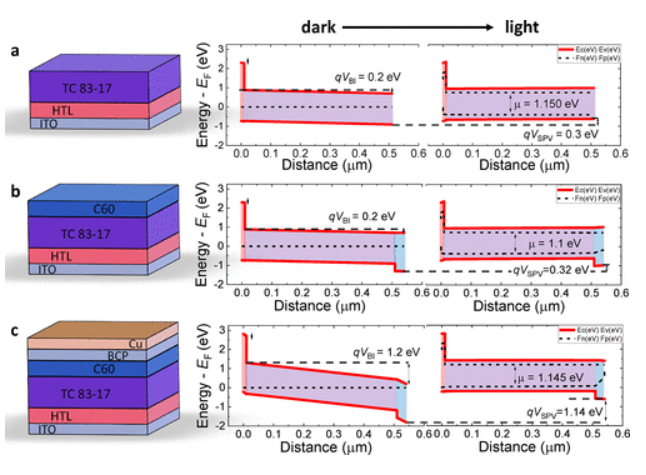
Toward Understanding the Built-in Field in Perovskite Solar Cellsthrough Layer-by-Layer Surface Photovoltage Measurements
Gutierrez-Partida, E., Rusu, M., Zu, F., Raoufi, M., Diekmann, J., Tokmoldin, N., Warby, J., Menzel, D., Lang, F., Shah, S., Shoaee, S., Korte, L., Unold, T., Koch, N., Kirchartz, T., & Neher, D., Stolterfoht, M. (2025). Toward understanding the built-in field in perovskite solar cells through layer-by-layer surface photovoltage measurements. ACS Applied Materials & Interfaces, 17(7), Article 7.
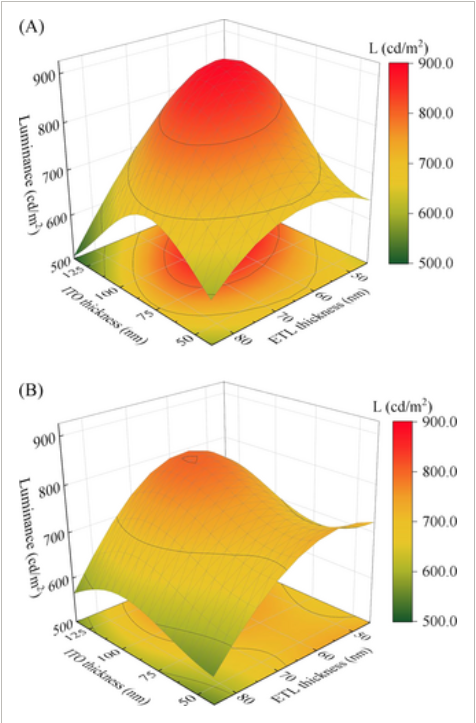
Optimizing OLED performance on polyimide substrates: Evaluation of ITO and organic layer thicknesses with different encapsulation materials
H. Cho, G. H. Kim, W.-j. Lee, and Y.-H. Kim, Optimizing OLED performance on polyimide substrates: Evaluation of ITO and organic layer thicknesses with different encapsulation materials, ETRI Journal (2025), 1–10

Defect chemistry of mixed ionic-electronic conductors under light: halide perovskites as master example
Moia, D., & Maier, J. (2025). Defect chemistry of mixed ionic-electronic conductors under light: Halide perovskites as master example [Preprint]. arXiv.
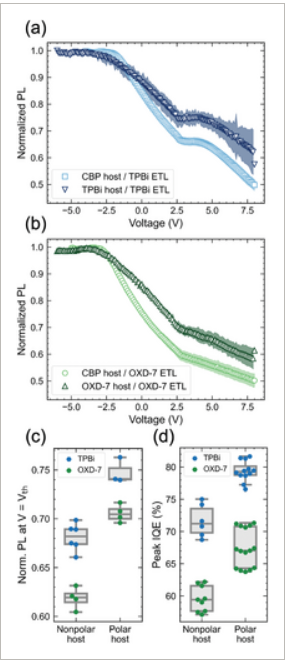
Controlling Polarization-Induced Polaron Accumulation in OLEDs via Device Design
E. Pakhomenko, S. Martin, S. He, A. Kapur, R. J. Holmes, Controlling Polarization-Induced Polaron Accumulation in OLEDs via Device Design. Adv. Funct. Mater. 2025, 35, 2412329.

Numerical Analysis of Trap-Induced Negative Capacitance in Organic LightEmitting Diodes
L. S. C. Pingree, B. J. Scott, M. T. Russell, T. J. Marks, M. C. Hersam; Negative capacitance in organic light-emitting diodes. Appl. Phys. Lett. 14 February 2005; 86 (7): 073509.
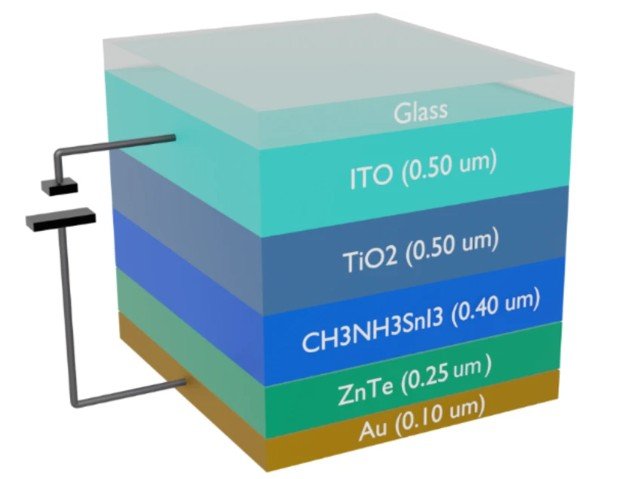
Efficiency optimization of lead-free CH3NH3SnI3-based perovskite solar cells through material and structural modifications
Alsulami, Q.A., Redoy, R.A. & Wageh, S. Efficiency optimization of lead-free CH3NH3SnI3-based perovskite solar cells through material and structural modifications. Sci Rep 15, 13170 (2025).
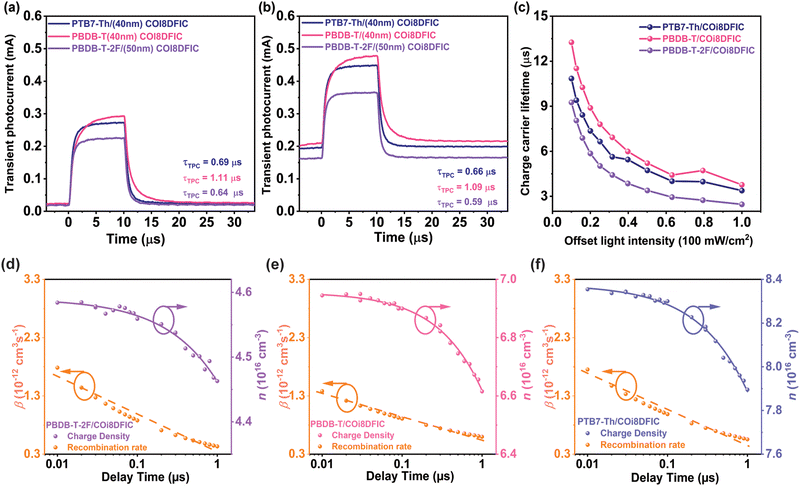
Enhanced device performance through optimization of acceptor layer thickness relative to exciton diffusion length and ionization energy offset in bilayer organic solar cells
Huang, Y.; Azeez, A.; Zhao, J.; Zhao, Z.; Dasannagari, M.; Laquai, F.; Kan, Z.; Karuthedath, S. Enhanced device performance through optimization of acceptor layer thickness relative to exciton diffusion length and ionization energy offset in bilayer organic solar cells. J. Mater. Chem. C 2025, 13, 5911–5919.
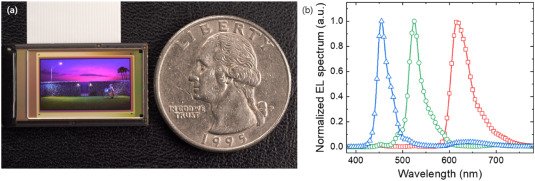
Strategic use of dopants and device structure optimization for enhanced color gamut and efficiency in organic light-emitting diodes microdisplay applications
Hyunsu Cho, Dae Hyun Ahn, Sukyung Choi, Gi Heon Kim, Chul Woong Joo, Chan-mo Kang, Jin-Wook Shin, Kukjoo Kim, Byoung-Hwa Kwon, Chunwon Byun, Nam Sung Cho, Young Jae An, Jin Sun Kim, Hyoc Min Youn,
Strategic use of dopants and device structure optimization for enhanced color gamut and efficiency in organic light-emitting diodes microdisplay applications, Optical Materials, Volume 159, 2025, 116571, ISSN 0925-3467,
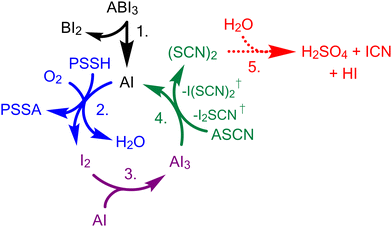
23.2% efficient low band gap perovskite solar cells with cyanogen management
Perera, W. H. K.; Zhou, Y.; Webb, T.; Trindade, G. F.; Xu, Y.; Zhu, J.; Masteghin, M. G.; Harvey, S. P.; Macdonald, T. J.; Jenatsch, S.; Dai, L.; Sathasivam, S.; Hinder, S. J.; Stranks, S. D.; Jayawardena, K. D. G. I.; Zhao, D.; Zhao, Y.; Zhang, W.; Haque, S. A.; Silva, S. R. P.
Energy Environ. Sci. 2025, 18, 439–453
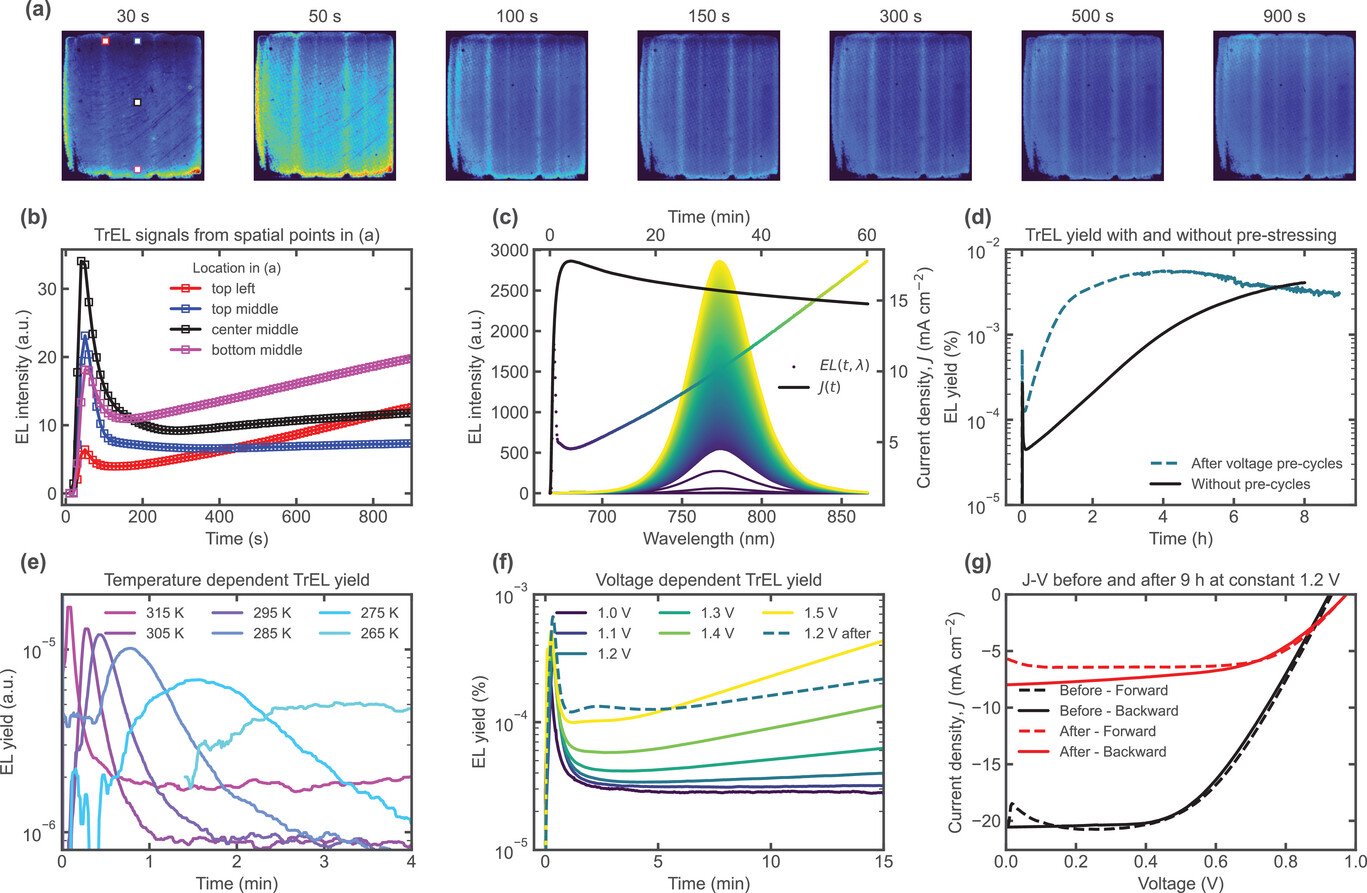
Ion Migration in Mesoscopic Perovskite Solar Cells: Effects on Electroluminescence, Open Circuit Voltage, and Photovoltaic Quantum Efficiency
M. A. Torre Cachafeiro, E. L. Comi, S. Parayil Shaji, S. Narbey, S. Jenatsch, E. Knapp, W. Tress, Adv. Energy Mater. 2025, 15, 2403850.

Improved radicchio seedling growth under CsPbI3 perovskite rooftop in a laboratory-scale greenhouse for Agrivoltaics application
Spampinato, C., Valastro, S., Calogero, G. et al. Nat Commu, 16:2190 (2025).

Thin-film transistor-driven vertically stacked full-color organic light-emitting diodes for high-resolution active-matrix displays
Choi, S., Kang, Cm., Byun, CW. et al. Nature Comm, 2732 (2020)

Evidence for localized trap formation during TADF OLED degradation
Edoardo Stanzani, Stefano Sem, Simon Züfle, Beat Ruhstaller, Sandra Jenatsch,
Organic Electronics, Volume 139, 2025, 107204, ISSN 1566-1199

Effects of Photon Recycling and Luminescent Coupling in All-Perovskite Tandem Solar Cells Assessed by Full Opto-electronic Simulation
Aeberhard, U., Zeder, S.J. and Ruhstaller, B. (2024), Sol. RRL, 8: 2400264.

Overcoming optical losses in thin metal-based recombination layers for efficient n-i-p perovskite-organic tandem solar cells
Tian, J., Liu, C., Forberich, K. et al. Nat Commun, 154 (2025).
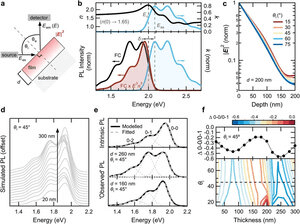
Extrinsic Influences on Photoluminescence Spectral Lineshape in Thin Films
Dyson, M. J., van der, T. P. A., Meskers, S. C. J.
Adv. Optical Mater. 2021, 2001997.
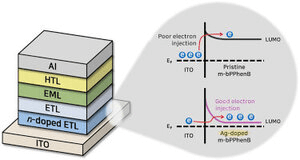
Efficient cathode contacts through Ag-doping in multifunctional strong nucleophilic electron transport layer for high performance inverted OLEDs
Hye In Yang, Jang Hyuk Kwon, et al.
Organic Electronics, Volume 89, 2021, 106031, ISSN 1566-1199
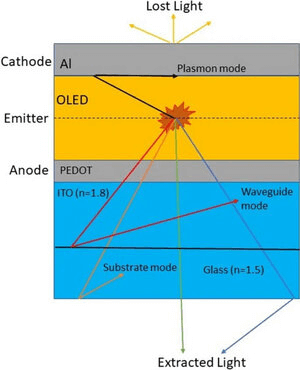
Light extraction efficiency analysis of fluorescent OLEDs device
Sharma, A., Das, T.D.
Opt Quant Electron 53, 83 (2021)
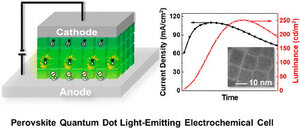
Highly Soluble CsPbBr 3 Perovskite Quantum Dots for Solution-Processed Light-Emission Devices
Y. Liu, J. Wang, et al.
ACS Applied Nano Materials Article ASAP
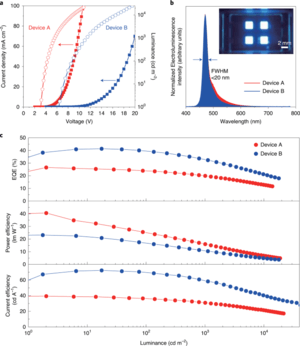
Stable pure-blue hyperfluorescence organic light-emitting diodes with high-efficiency and narrow emission
Chan, CY., Tanaka, M., Lee, YT. et al.
Nat. Photonics (2021).