Paios
Electrical & Optical Characterization of LEDs and Solar Cells
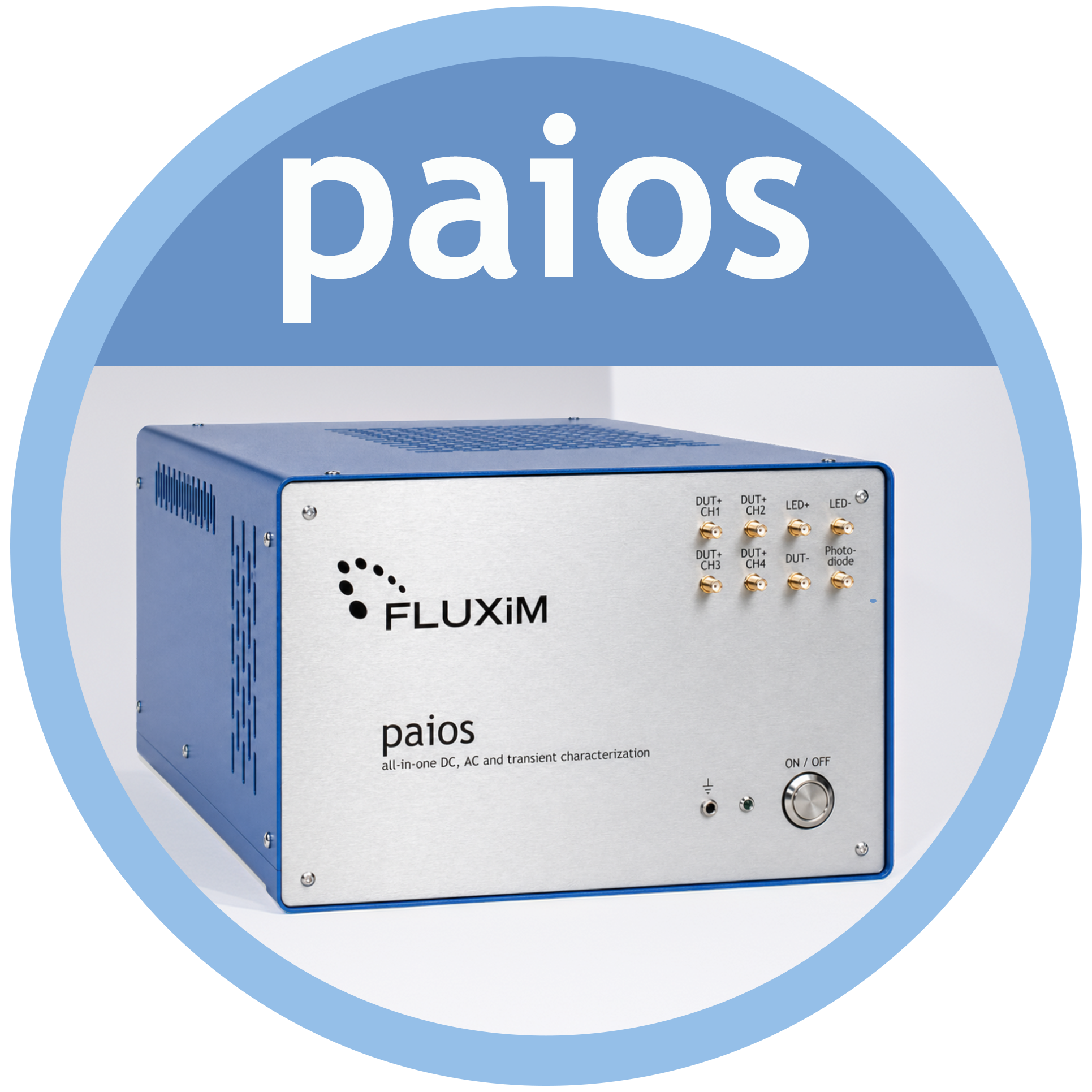
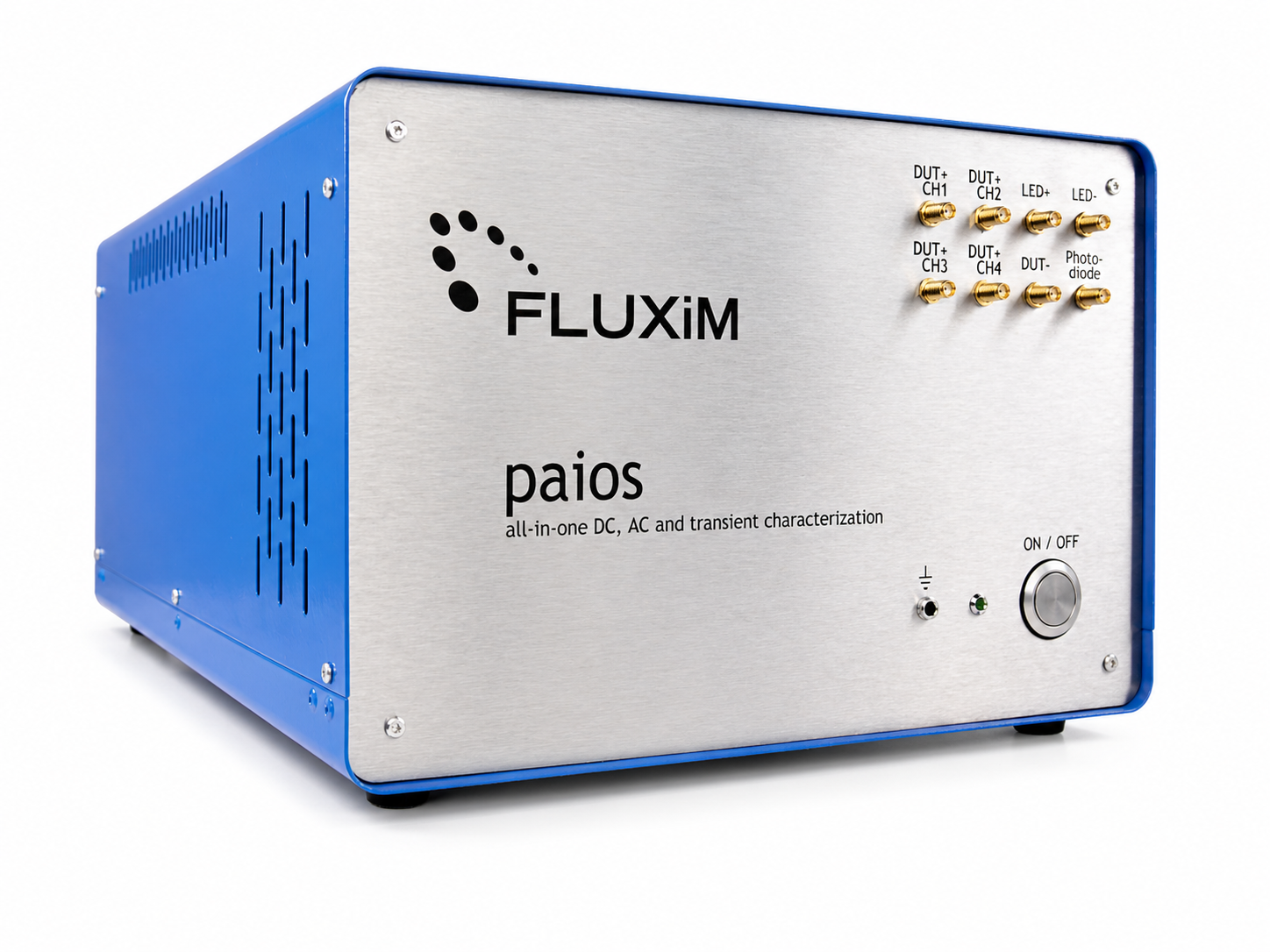
The All-in-One Solution for Comprehensive Device Analysis
Paios performs a large variety of electrical and optical characterizations on organic, perovskite, and quantum-dot LEDs and solar cells with one click. Get consistent and precise measurement data, directly compare your results in the Characterization Suite (CS) measurement software and speed up your R&D.
Paios experiments
Current-Voltage-Luminance
Transient Photocurrent (TPC)
Transient Photovoltage (TPV)
Transient Electroluminescence
Charge Extraction, BACE
Dark Injection Transients
Dark/Photo/MIS/Injection-CELIV
DLTS (Deep-Level Transient Spectroscopy)
Impedance Spectroscopy
Capacitance-Voltage
IMPS, IMVS
MELS, MPLS
Emission Spectrum
User-Defined Signals
Current Pulse, Voltage Pulse
Connect your device, launch the routine and every measurement is performed automatically.
Reliable and low-noise signals. High reproducibility.
Compare all your devices in the Characterization Suite (CS) software. Fit and analyze the data with the integrated routines and export your results for publication.
Build a reproducible and reliable device database and store it in the Paios managing software.
Think about physics. Paios can handle the rest.
Paios Review
”Paios and Setfos have been an asset to our research capability in CSIRO Energy and a key tool in our research and assessment of next generation thin-film photovoltaics, in particular, organic and perovskite solar cells. One of the key points of differentiation – and a clear attraction – has been the flexibility of the system and the ease in which user-defined experiments can be created. Our Team has appreciated the interaction with Fluxim and realised this has been much more than a transactional experience – we’ve formed a real partnership between developers and researchers.”
Dr Gregory J. Wilson, Research Group Leader, CSIRO Energy, Newcastle, Australia


DC, AC and Transient Characterization of OLEDs and Solar Cells
CELIV (Photo-CELIV, Dark-CELIV,MIS-CELIV, Injection-CELIV, OTRACE) is a powerful technique to investigate charge carrier mobility, recombination, photo-generated charge and doping densities.
Impedance Spectroscopy is used to study charge carrier dynamics and charge trapping over a large range of time scales. It is widely used on both PVs and LEDs.
Capacitance-Voltage reveals information about charge injection and accumulation as well as polar layers. Doping density is extracted with Mott-Schottky analysis.
(Intensity) Modulated Photoluminescence Spectroscopy (IMPLS) probes exciton processes in OLEDs or ionic properties of perovskite solar cells at different frequencies or working points.
Transient Photovoltage (TPV) is frequently used to determine charge carrier recombination lifetimes in solar cells.
Bias-assisted charge extraction (BACE) is a measurement to characterize mobile ions in perovskite solar cells and batteries. A voltage step leads to a small ionic current from which the ion density and mobility can be analyzed.
Transient Electroluminescence (TEL) allows extracting mobilities and the phosphorescence lifetime in an OLED.
Transient Photocurrent (TPC) provides information on the charge carrier dynamics, trapping and extraction.
Dark/Double Injection Transients (DIT) are used to study carrier injection and transport. In thick unipolar devices it is possible to analyze the carrier mobility.
IV & IVL are the standard characterization techniques for solar cells and OLEDs. The current-voltage curve can be fitted with the diode model.
Current Pulses can be performed with the SMU module on a ms time scale.
Charge Extraction estimates the photo-generated charge carrier density of a solar cell at open-circuit condition.
Intensity Modulated Photocurrent Spectroscopy (IMPS) probes charge transport and collection by a sinusoidal light intensity variation at short-circuit.
Intensity Modulated Photovoltage Spectroscopy (IMVS) probes charge recombination by a sinusoidal light intensity variation at open-circuit.
Modulated Electroluminescence Spectroscopy (MELS) probes charge transport in OLEDs at different frequencies and working points.
Emission Spectrum can be measured at specified voltage/current conditions in DC, pulsed and pulse-width modulation modes.
User Defined Signals employing an arbitrary transient voltage and illumination signal can be generated with the custom signal editor. An example is the hysteresis-IV consisting of a voltage ramp up and down.
Deep-level transient spectroscopy (DLTS) records the filling and release of traps as a repsonse to a voltage step. In Paios the current-DLTS and capacitance-DLTS methods are implemented. Temperature-dependent measurements can be used to determine the trap energy.
An overview of all characterization techniques for solar cells can be found in our tutorial “Characterization of Perovskite and Organic Solar Cells”.
If you are interested in OLEDs, please check our tutorial paper “Combining steady-state with frequency and time domain data to quantitatively analyze charge transport in organic light-emitting diodes”
















OLED and PV Characterization
Paios is optimized for the characterization of both solar cells and (O)LEDs and available as an LED version and PV version.
The versatile Combined Version is suitable for research and development on both LEDs and photovoltaic devices.
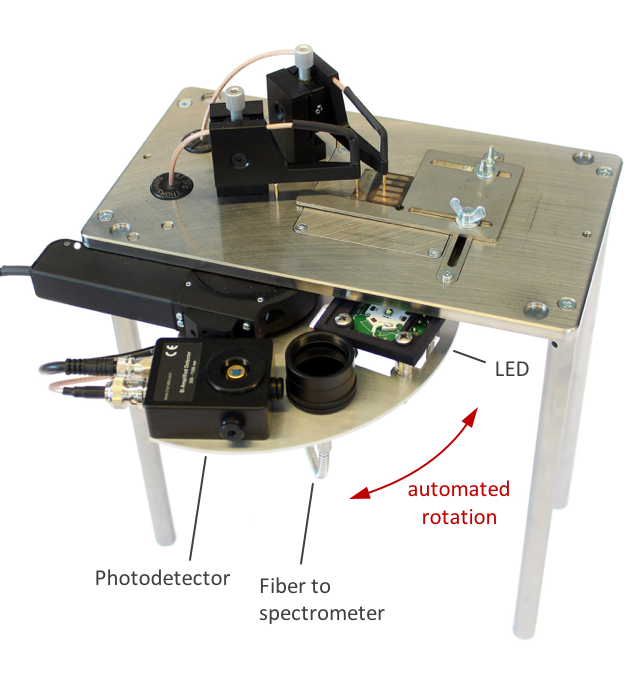
Solar Cells: The main hardware is equipped with a high-power white LED illumination system. A multi-LED board can be optionally employed for measurements at selected wavelengths. The LED intensities can be varied over 6 orders of magnitude. For even faster transient measurements, a nanosecond pulser module is also available.
Light Emitting Devices: An amplified photodetector with automatic gain adaption is included in the version for LED research. A fiber-coupled spectrometer for spectral emission characterization of (O)LEDs is also available. Furthermore, a photomultiplier-tube module can be added to increase the dynamic range for emission measurements.
| DC, AC and Transient Analysis | |
|---|---|
| Sampling-rate | 60 MSa/s |
| Time resolution | 17 ns |
| Voltage range | ± 12 V |
| Extended voltage range SMU module (up to 1 kHz) | ± 60 V |
| Frequency range (AC measurements) | 10 mHz to 10 MHz |
| Minimal resolvable current | < 100 pA |
| Maximum Current | 100 mA |
| Measurement resolution | 12 Bit |
| LED rise/fall time (PV version) | 100 ns |
| Illumination area (PV version) | 2.0 cm2 |
| Computer Connection | PXIe/PCIe and USB |
| Weight | 16 kg |
| Dimensions | 41 x 30 x 20 cm3 |
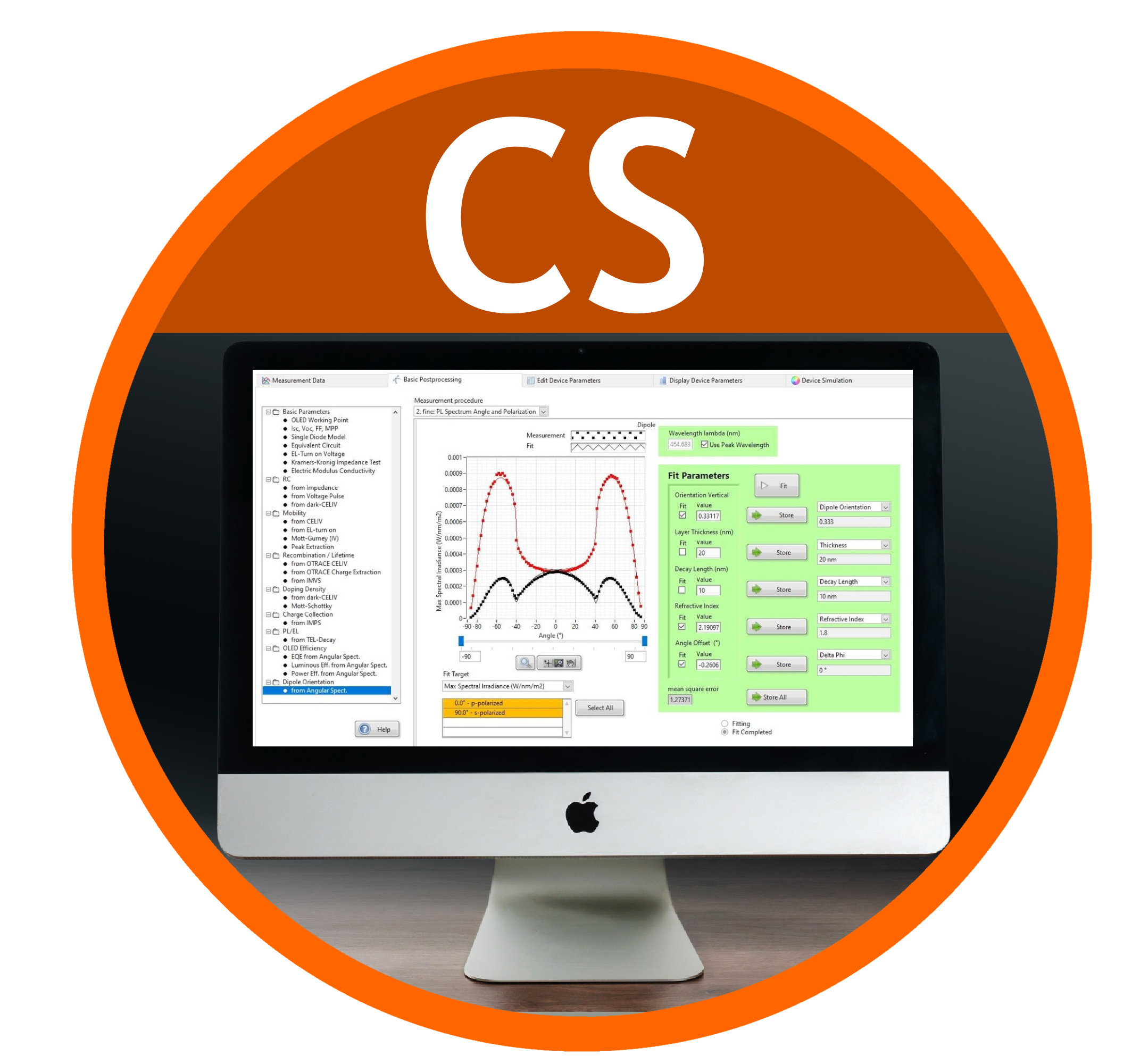
Characterization Suite (CS) Software for Paios
Paios is operated via the Characterization Suite (CS), Fluxim’s integrated control and analysis software for optoelectronic device characterization. CS supports the full range of measurement techniques—from standard current–voltage scans to advanced transient and impedance spectroscopy—within a unified, intuitive interface. Researchers can configure predefined or custom protocols, acquire high-quality, consistent data, and perform advanced parameter extraction.
See the full range of experiments, analysis tools, and modules on the Paios Features page.
Research Fields
Paios can be employed to characterize different types of devices based on organic semiconductors, perovskites and quantum-dots:
Perovskite solar cells
Organic, quantum dot, and hybrid solar cells
CIGS, CdTe, CZTS solar cells
Dye-sensitized solar cells
Tandem solar cells
Photodetectors
Solid-state thin-film batteries
Organic light-emitting diodes (OLEDs)
Perovskite LEDs and QD LEDs
Light-emitting electrochemical cells (LECs)
Unipolar devices
Metal-Insulator-Semiconductor (MIS) devices
Paios Videos
More about Paios